Get Full Government Meeting Transcripts, Videos, & Alerts Forever!
Get email alerts on the Transportation Funding topic
No spam. Unsubscribe anytime.
Sen. Moser urges doubling Build Nebraska Act sales-tax share to address rising road costs
Summary
Lawmakers and construction and engineering groups told the Revenue Committee that Nebraska’s Build Nebraska Act funding is not keeping pace with construction cost escalation and urged increasing the dedicated sales-tax share from a quarter‑cent to a half‑cent.
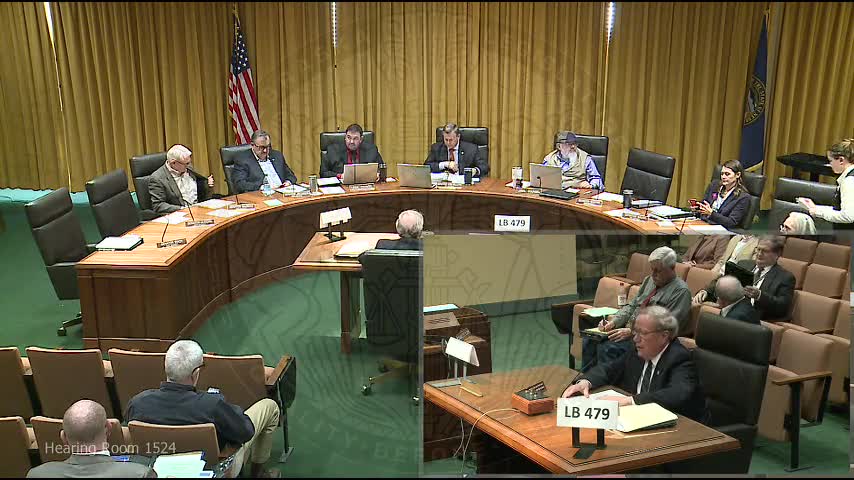
Senator Mike Moser, introducing LB 479 to the Revenue Committee, asked lawmakers to increase the share of sales‑tax revenue dedicated to the Build Nebraska Act (BNA) from one quarter of one percent to one half of one percent, saying construction costs have risen sharply and BNA revenue is no longer keeping pace.
The bill would double the current sales‑tax allocation for the BNA, a fund created in 2011 that dedicates 0.25% of the state sales tax to expressway expansion, federally designated high‑priority corridors and reconstruction of existing state transportation infrastructure. “Therefore, we need to increase the percentage of sales tax revenue dedicated to fund the Build Nebraska Act from 1 quarter of 1% to 1 half of 1%,” Moser said in his opening remarks.
Supporters from the construction and engineering sectors told the committee that rising materials, labor and equipment costs and other project risks have increased the state’s highway funding gap. Tyler Chercoigne of the Associated General Contractors–Nebraska chapter said the Nebraska Department of Transportation (NDOT) reported an annual shortfall in the range of $150 million and that construction costs for several major projects have roughly doubled in a few years. Jeannie McClure of the American Council of Engineering Companies of Nebraska and Lynn Rex of the League of Nebraska Municipalities echoed that rising costs delay projects and raise long‑term expenses.
Why it matters: The BNA currently directs about 85% of its receipts to NDOT projects and 15% to city and county roads and streets. Supporters said the dedicated sales‑tax approach broadens the revenue base beyond fuel taxes — important as vehicle efficiency and electric vehicle adoption reduce fuel‑tax yield — and that failing to increase dedicated funds will delay key expressway and corridor work that proponents say affects safety and economic development.
Details and context - Built in 2011 and effective 2013, the Build Nebraska Act dedicates a quarter‑cent of sales tax revenue for expressway and major corridor projects. Moser noted prior legislation extended the BNA sunset to 2042 and said the program now produces roughly $100 million a year in receipts. - Witnesses and the introducer cited NDOT’s needs reporting and a Transportation Innovation Act / BNA report showing major project cost growth since 2019–2021 and an NDOT presentation indicating an ongoing annual funding shortfall. - The bill’s supporters described the split of BNA receipts (85% NDOT / 15% city and county allocation) and said doubling the set‑aside would increase local allocations proportionally. Moser explained that under the existing split a 15% allocation equates to roughly $15 million of a $100 million annual BNA take, and doubling the set aside would raise those amounts proportionally.
Committee discussion and next steps Committee members asked presenters for traffic counts, allocation formulas and whether a gas‑tax increase should be considered. Supporters said traffic counts and detailed project priority and performance scoring are NDOT’s responsibility and noted earlier bills and proposals that would study or propose alternative revenue sources. Senator Moser said he would be willing to bring LB 479 to the floor for broader debate and that advancing the bill would allow fuller discussion of revenue and budget tradeoffs.
No formal committee vote or final action was recorded during the hearing. The record shows multiple proponents and no registered opponents at the hearing.
Ending Proponents urged the committee to advance LB 479 for floor debate so members across the Legislature could weigh the tradeoffs between reallocating general‑fund receipts, raising new revenue (for example via fuel taxes) or dedicating more sales‑tax to roads. The committee closed the LB 479 hearing after the introducer’s closing remarks.