Get Full Government Meeting Transcripts, Videos, & Alerts Forever!
Get email alerts on the Property Taxes Homestead Exemption topic
No spam. Unsubscribe anytime.
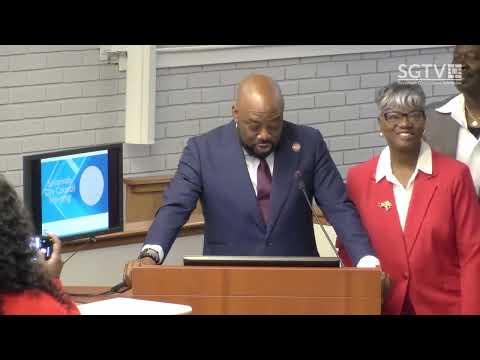
Savannah Council holds first public hearing on state homestead exemption; staff recommends opting out
Summary
City staff briefed the council and residents on Georgia House Bill 581 and the local "Stevens Day" homestead exemption, recommended opting out for now, and closed the first of three public hearings after two minutes-per-speaker public comment.
Mayor Van Johnson and city staff held the first of three public hearings on Georgia House Bill 581, the statewide homestead exemption approved by voters in November, and staff recommended that Savannah opt out while the city evaluates potential administrative complications and unresolved differences with the county’s long‑standing Stevens Day exemption. Council closed the hearing after public comment.
City Manager staff described how Stevens Day, enacted locally in 1999, freezes a homeowner’s base tax year for some local taxes and noted that, in many cases, Stevens Day will continue to provide equal or greater protection to homeowners than House Bill 581. The manager said the city can meet state notice requirements, reiterated that homeowners would receive the exemption that yields the greatest benefit, and advised council that opting out is the "safest and smartest" route given Stevens Day's 25‑year history and litigation/clarifications made over time.
The briefing explained core terms: "base tax year" (the year a homeowner first qualified for a homestead exemption), "floating inflation‑proof exemption" (an exemption whose dollar amount can increase with inflation), and "fair market value." Staff noted HB 581 became law in February 2024 and that taxing jurisdictions statewide must decide whether to opt in or opt out by March 1, 2025. The manager also provided an illustrative example: for a hypothetical new home valued at $350,000 with a 2025 base year, Stevens Day produced roughly $60 more annual protection than HB 581 under the sample scenario shown to council.
Council members asked clarifying questions. Alderman Alicia Miller Blakely asked whether opting in would raise a homeowner’s taxes; staff responded that homeowners who already hold Stevens Day would not pay more and would receive whichever exemption gives them the greater benefit. The manager confirmed that a homeowner’s base tax year changes only after a sale, transfer or a substantial improvement to the property and said he would provide more detail about what the tax assessor defines as a "substantial improvement" at the next hearing.
Public comment was limited to two minutes per speaker. Jason Combs, president of the Thomas Square Neighborhood Association, asked for more side‑by‑side examples (including older homes) and for clarity about appeals procedures under HB 581. Bob Rosenwald, a downtown resident, noted the referendum passed with 68% support countywide and urged careful legal review. Billy Neve and other residents asked whether Stevens Day and HB 581 apply evenly to all millage rates; staff reiterated that under Stevens Day the county ad valorem portion has historically been frozen at base year for Chatham County while HB 581 ties all taxing authorities to the inflation rate.
After public comment, the council voted to close the hearing. No decision on opting in or out was taken at this meeting; the manager promised to collect council and public questions and publish answers within 24 hours and to return the matter to later hearings for further consideration.
What happens next: The council will hold at least two more public hearings on HB 581, publish answers to questions raised at this session, and may schedule additional briefings with the city attorney and county staff before deciding whether to opt in or opt out by the state deadline of 2025‑03‑01.