Get Full Government Meeting Transcripts, Videos, & Alerts Forever!
Get email alerts on the Healthcare 340b topic
No spam. Unsubscribe anytime.
Senate oversight committee advances bills aimed at 340B transparency and contract-pharmacy restrictions
Summary
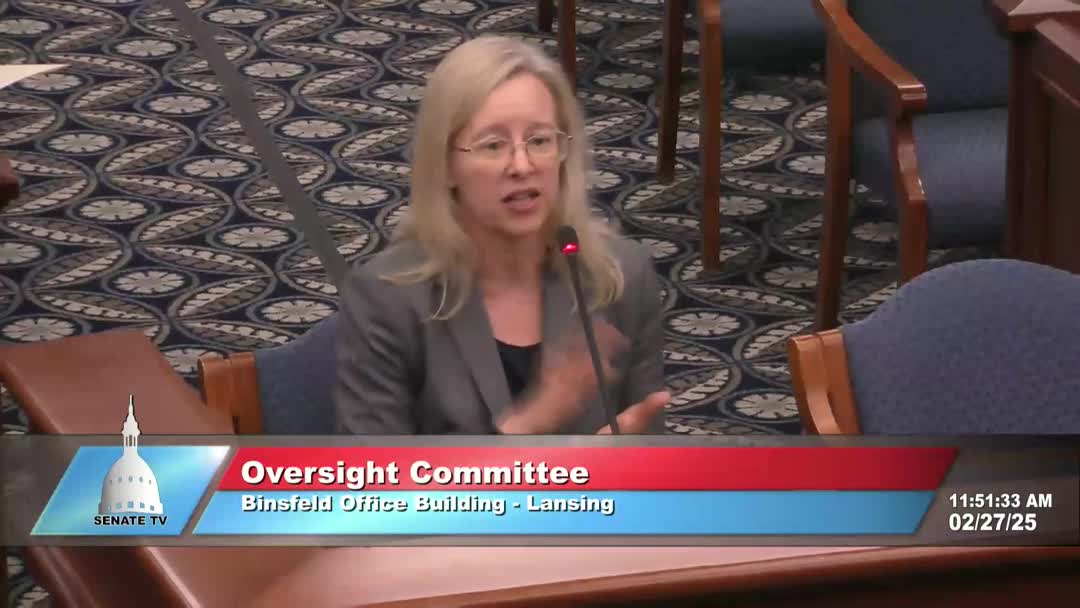
The Michigan Senate Committee on Oversight voted unanimously to report Senate Bill 94 and Senate Bill 95 to the full Senate after testimony from hospitals, federally qualified health centers, pharmaceutical industry groups and patient advocates about changes to the federal 340B program and state-level transparency measures.
The Michigan Senate Committee on Oversight on an unspecified date voted to send Senate Bill 94 and Senate Bill 95 to the Senate floor with a recommendation that both bills pass after a public hearing featuring hospital systems, federally qualified health centers, pharmaceutical trade groups and patient advocates.
Supporters told the committee the 340B drug-pricing program — created by Congress in 1992 to help safety-net providers stretch resources — has been an important revenue source for rural hospitals, community health centers and cancer hospitals, but that recent commercial and contractual changes have sharply reduced program savings for some providers. Jeff Larson, chief growth and development officer at Great Lakes Bay Health Centers, said his organization “has been a loss in nearly $2,000,000 in savings” tied to recent changes and that those funds pay for services such as transportation and community health workers. Matt O’Brien, vice president of pharmacy at Great Lakes Bay, said 340B savings help provide low-cost medications and free delivery to patients.
The bills take two approaches. Senate Bill 95, sponsored by Senator Lindsey, focuses on price-transparency measures for health care and includes provisions intended to incentivize compliance with federal transparency standards and to prevent collections actions against patients when providers are out of compliance. Senator Lindsey told the committee that price transparency is “an important step” toward addressing high health-care costs and noted the state-level role in encouraging compliance with federal standards.
Senate Bill 94 would limit certain contract-pharmacy arrangements and add state-level nondiscrimination requirements, while also including reporting provisions supporters say will increase transparency about how covered entities use 340B savings. Hospital and health-center witnesses said the bills would preserve access to services in rural areas, citing examples such as rural obstetrics, cancer screenings and local pharmacy delivery programs that rely on program savings.
Opponents — including the Pharmaceutical Research and Manufacturers of America (PhRMA), the Healthcare Distribution Alliance (HDA), and advocacy groups — argued the bills as written would lock in practices that shift costs elsewhere, reduce oversight where needed, or create legal conflicts. Morgan Halloran, director for state policy at PhRMA, said SB 94 “locks in exactly what is broken in the 340B program” and criticized the bills for not requiring covered entities to disclose how much revenue they earn through the program or how much is paid to third-party actors. Travis Bucello, state government affairs director for HDA, asked the committee to clarify or remove references to wholesale distributors to avoid conflicts with national settlement obligations and federal contracts.
Patient and community advocates urged guardrails to ensure program benefits reach vulnerable patients. Calvin Pugh, 340B state policy director at Community Access National Network, said 340B “provides essential funding” but warned that growth in program revenue has not clearly translated into more charity care or more services for intended patients in all cases.
After roughly two hours of testimony and questions, the committee voted to report both bills. The clerk recorded a 5-0 vote in favor of reporting SB 94; Senator Geiss moved the motion. The clerk recorded a 5-0 vote in favor of reporting SB 95; Senator Lindsey moved that motion.
Supporters said the bills restore or codify earlier state practices and improve transparency; opponents said state legislation cannot fully fix program-wide issues and urged federal reform and tighter reporting on revenue flows to third-party actors. The committee chair said federal concerns remain in Congress’s purview but that the committee’s actions seek to codify and clarify state rules.
The bills will next be scheduled for consideration on the Senate floor.