Get Full Government Meeting Transcripts, Videos, & Alerts Forever!
Get email alerts on the Dtmb Budget topic
No spam. Unsubscribe anytime.
DTMB recommendation cuts contingency authorizations; funds IT upgrades, HRMS and special maintenance uses
Summary
The governors FY2025-26 recommendation for the Department of Technology, Management & Budget reduces contingency authorizations compared with last year and includes funding for IT upgrades, HR system modernization, special maintenance authority, and multiple one-time facility and IT investments.
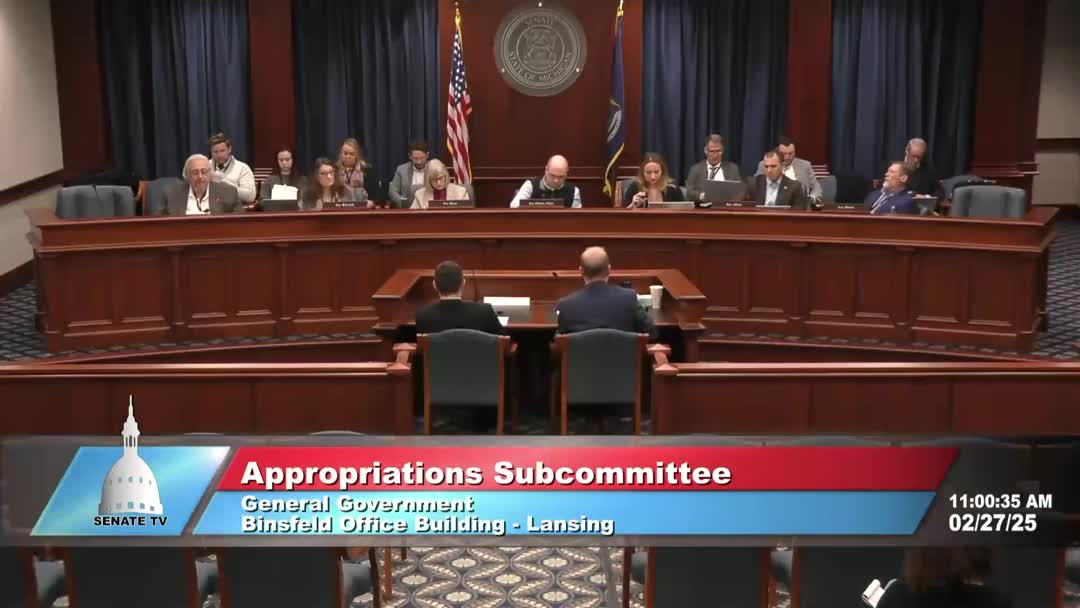
The Appropriations Subcommittee reviewed the governor's recommendation for the Department of Technology, Management & Budget (DTMB), which the Senate Fiscal Agency said carries notable adjustments to contingency authorizations, technical charges, and several new program and one-time requests.
Senate Fiscal Agency analyst Elizabeth summarized the proposal as an increase of about $119.5 million gross and roughly $74.4 million general fund/GP, driven partly by technical chargebacks (IT costs and building-authority rent) and several programmatic requests. She noted the governor proposed significant reductions in contingency authorizations from last year's unusually large totals: for example, a federal contingency authorization shown last year at $1 billion was revised down to $50 million in the recommendation; restricted contingency was lowered from $250 million to $200 million; and local and private contingency authorizations were reduced from $20 million to $5 million each.
The nut graf: the proposal pairs several one-time facility and IT investments with longer-term modernization requests. Notable requests include upgrades and maintenance funding, a deposit to a self-insurance fund for state-managed facilities, and funds for a Human Resource Management System (HRMS) upgrade.
Specifics: the recommendation included an 11-FTE increase to support additional State Budget Office staff (about $770,000 GF/GP) and funds (about $270,000 gross) to align staffing at the State Records Center after record transfers from the Department of Health and Human Services. It requested about $7.5 million restricted funding for the Civil Service Commission to begin an HRMS upgrade project, $1.3 million and 9 FTEs to support additional Civil Service human-resources staff, $42.6 million one-time plus an ongoing $35 million for an IT investment fund (ITIF), $25 million for facility upgrades and maintenance, a $10 million deposit to establish a DTMB-owned facility self-insurance fund, and a $5 million deposit for the Energy Efficiency Revolving Fund.
Members asked about the proposed boilerplate that would allow automatic appropriation of federal or state restricted funds earned from projects funded in Part 1 (special maintenance earnings). Elizabeth explained the provision would allow the department to spend earnings or matching federal funds without seeking a separate legislative transfer, saying it would function similarly to a department authority to spend modest fee revenues without additional approval. Members requested the staff report that lists current special-maintenance project funds and balances; a fiscal office analyst later provided a current projection of about $139 million remaining in special-maintenance work-project funds.
Ending: the subcommittee did not take formal action; members asked for additional documentation on special maintenance balances, fee authority, and contingency usage.