Get Full Government Meeting Transcripts, Videos, & Alerts Forever!
Get email alerts on the Land Use Zoning topic
No spam. Unsubscribe anytime.
Bill would set timelines and require training for county zoning permit reviews, prompting debate over local control
Summary
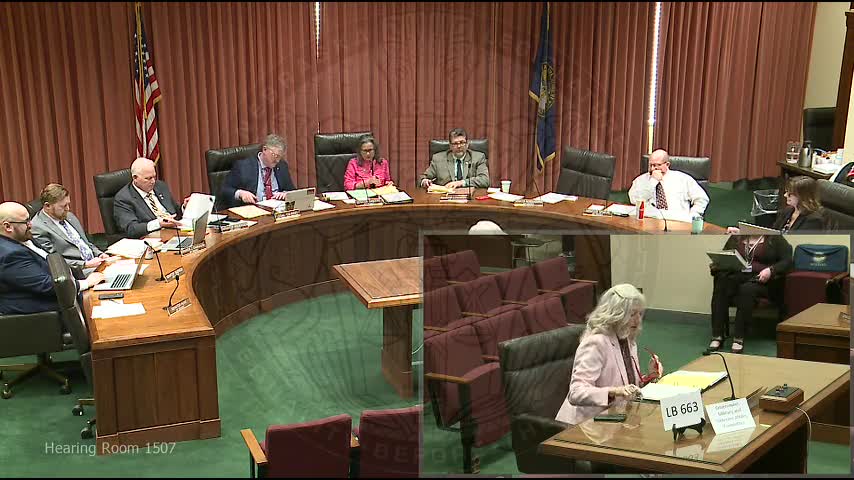
Sen. Tanya Storer introduced Legislative Bill 663 to require clearer timelines and training for county conditional-use and special-exception permit reviews, saying the changes would promote objective, timely decisions and reduce costly litigation.
Bill: Sen. Tanya Storer, who represents District 43, introduced Legislative Bill 663 to establish a timeline-driven process and training requirements for conditional-use and special-exception permit reviews handled at the county level. Storer said the bill aims to make decisions "based on facts and evidence" and reduce delays that she said have sent disputes to court.
Why it matters: Testimony showed a split between agricultural and development interests seeking predictable, timely permitting and residents and some county officials worried the bill would limit local control and make counties less able to consider local concerns. Witnesses repeatedly described long permitting timelines in some counties and argued that uncertainty raises costs for applicants.
Key provisions described by the introducer: Storer said her white-copy amendment (distributed to the committee) would require the zoning administrator or planning commission to determine application completeness within 30 days, with a 10-day notice to applicants if information is missing (which restarts the clock). Once an application is complete, the zoning administrator or planning commission would have 90 days to approve, deny, or forward a recommendation; the same 90-day window would apply to the county board. Storer said that in practice the process could allow up to about 240 days total and that if a board does not grant or deny by the deadline the application would be deemed approved. The bill also adds mandatory continuing education for planning commission members (Storer said two hours per term; the amendment clarified county attorneys or a designee could provide or designate training).
Supporters’ testimony: Several agricultural producers, consultants and industry groups testified in favor. Dean Settje, founder of Century Agri Services, said, "Zoning, again, done right, can be very, very good, but done incorrectly, can be very cumbersome," and argued that training and fixed timelines would make the permitting process more professional and predictable. Matthew Erickson, a Johnson County farmer who described a permitting process that took about 14 months, said the bill "would have given [us] a timeline to tell us that our application is incomplete in a timely fashion." Representatives of the Nebraska Farm Bureau and an agricultural leaders coalition said predictable timelines protect rural economic development and local tax bases.
Opponents’ testimony: Residents and some county officials warned the measure would weaken local decision-making. Nancy Meyer, a resident testifying in opposition, said LB663 is "an outright attack on local control" and argued local governments know their communities best. Jane Egan said giving county attorneys sole authority to determine training curriculum was problematic. Seward County Commissioner Misty Amick, who formerly served on a planning commission, said she supports education but asked, "What is the point of a hearing if nothing said by others can be considered?" and urged preserving the ability to require additional permits or plans when facts are incomplete.
County association and neutral input: The Nebraska Association of County Officials said it had been negotiating with the bill sponsor and supported some elements but sought clarification on timeframes and practical changes — for example, recommending some deadlines be written as business days or extended from 30 to 45 days in counties that meet monthly. NACO also reported that 83 of Nebraska’s 93 counties have zoning in place.
Clarifications and process notes: Committee members and witnesses discussed how state environmental permitting (the Department of Environment and Energy’s process, which some witnesses said uses a roughly 110-day review) interacts with county land-use reviews; witnesses said state permits are separate from county zoning and that applicants often need approvals at multiple levels. The sponsor said the bill does not eliminate public hearings and is intended to make county decisions more objective and timely.
Next steps: The sponsor distributed a white-copy amendment and asked the committee to advance the bill; the transcript records testimony from multiple proponents, opponents and neutral witnesses but does not show a committee vote on LB663 during this hearing.
Ending: The hearing drew extensive testimony for and against the bill, with supporters urging predictability and training to reduce litigation and opponents warning of weakened local authority and rushed decisions. The committee received both technical suggestions (for example, using business days and modest deadline extensions in some counties) and substantive objections that may be addressed in amendment work before any vote.