Get Full Government Meeting Transcripts, Videos, & Alerts Forever!
Get email alerts on the Maternal Health topic
No spam. Unsubscribe anytime.
Nebraska committee hears bill to require Medicaid coverage for doula services
Summary
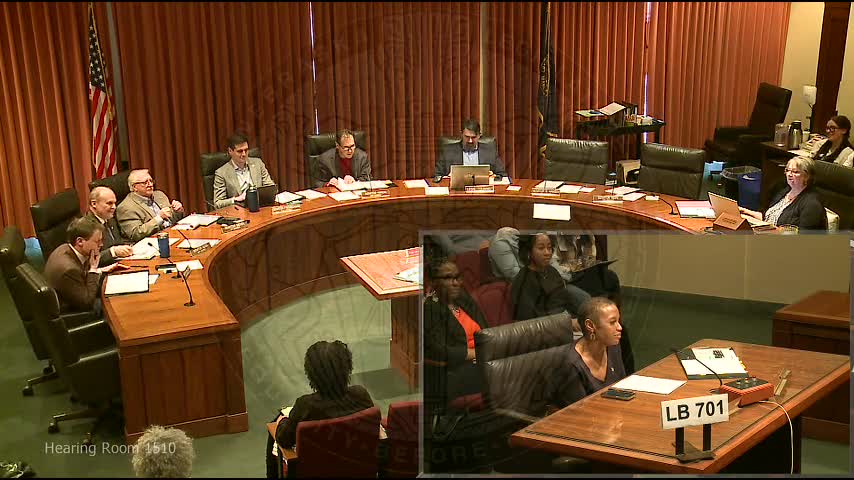
Senator Ashley Spivey, sponsor of LB701, told the Health and Human Services Committee LB701 would require Nebraska HHS to form a stakeholder group and seek a Medicaid state plan amendment to reimburse doula services for Medicaid enrollees.
Nebraska Sen. Ashley Spivey, sponsor of LB701, told the Health and Human Services Committee the bill would define full‑spectrum doula services and require the Department of Health and Human Services (HHS) to convene a statewide, multidisciplinary stakeholder group to develop and submit a Medicaid state plan amendment to reimburse doula services for people covered by Medicaid.
Spivey called the state’s maternal‑health statistics alarming and said doulas — trained, nonmedical birth companions who provide emotional, informational and physical support before, during and after childbirth — are an evidence‑based intervention that can improve outcomes for birthing people and infants.
Committee members heard about existing pilot programs and local training efforts and were shown a draft amendment that would narrow the coverage language to Medicaid‑reimbursed doula services. Proponents — including practicing doulas, nurses, a CHI Health OBGYN and representatives of DONA International and community health clinics — described doulas’ role in birth planning, support during labor, postpartum follow‑up and addressing social needs such as transportation and food assistance.
Supporters cited national and local evidence that continuous doula support is associated with reduced cesarean delivery rates, lower preterm births and higher rates of breastfeeding initiation. Senator Spivey and multiple testifiers said some states already reimburse doulas through Medicaid; as of January 2025, 13 states and Washington, D.C., had implemented Medicaid coverage for doula services and others were working on implementation. Spivey told the committee HHS and the stakeholder group would define the competencies, any approved trainings or certifications and the reimbursement structure before submitting the state plan amendment to the Centers for Medicare & Medicaid Services (CMS).
Several practicing doulas explained how they match with clients, provide prenatal visits, accompany clients for labor and delivery, and offer postpartum support. CHI Health representatives described a local pilot that enrolled roughly 50 patients and reported that doulas helped connect patients to care, improved attendance at prenatal visits and supported breastfeeding and postpartum recovery. DONA International urged the committee to involve the doula community in designing training, eligibility and reimbursement so the benefit is sustainable and aligns with market rates. Testimony included estimates of private pay rates for doulas that ranged up to about $2,000 and a TRICARE pilot reimbursement example at roughly $1,627.88.
On fiscal questions, Spivey said she had worked with the Legislature’s fiscal staff and expected a revised fiscal note showing a lower initial state cost than an earlier estimate; she cited an initial two‑year projection discussed with fiscal staff of about $16,000 in the first year and $120,000 for a subsequent year and said the bill would use a dedicated cash fund — the same cash fund used for the state’s prenatal program — as the intended pay source. She said HHS would have discretion to revert to general funds if the cash fund were exhausted.
Committee members asked procedural and programmatic questions: how doulas differ from midwives (midwives are licensed medical professionals; doulas are not), whether doulas can operate alongside midwives and OBs (yes), whether doulas must be credentialed under the Uniform Credentialing Act (no, because they are not medical providers), and how the workgroup would set competencies and reimbursement (HHS and the stakeholder group would decide and then submit the state plan amendment to CMS). Spivey emphasized the bill does not prescribe a single credentialing model; instead the stakeholder group would recommend eligibility and competency standards appropriate for Nebraska.
Supporters urged the committee to advance LB701 so that pilot data and local collaborations can inform the HHS workgroup and reimbursement design. Spivey closed by asking the committee to move the bill so she and HHS can continue work on the draft amendment and the funding source.
The committee did not take a formal vote during the hearing.
The hearing record includes dozens of proponent witnesses — practicing doulas, clinicians and advocates — who described clinical, social and economic rationales for Medicaid‑funded doula services. The bill as drafted directs HHS to form the multidisciplinary group, develop competency standards and submit a Medicaid state plan amendment; it does not itself set the reimbursement rate, certification list or an effective date.