Get Full Government Meeting Transcripts, Videos, & Alerts Forever!
Get email alerts on the Term Limits topic
No spam. Unsubscribe anytime.
Nebraska committee hears proposals to extend legislative term limits from two to three consecutive terms
Summary
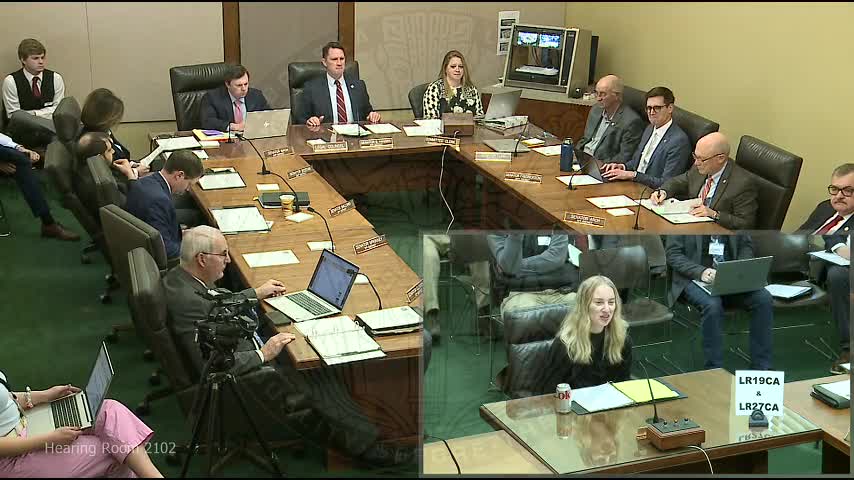
At a hearing of the Executive Board of the Nebraska Legislature, senators and a slate of business, municipal and policy witnesses testified on LR 27 CA and LR 19 CA, twin resolutions proposing a constitutional amendment to extend legislative term limits from two consecutive four-year terms to three.
At a hearing of the Executive Board of the Nebraska Legislature, senators and a slate of business, municipal and policy witnesses testified on LR 27 CA and LR 19 CA, twin resolutions proposing a constitutional amendment to extend legislative term limits from two consecutive four-year terms to three.
Proponents argued the change would give lawmakers more time to develop expertise and relationships needed to tackle complex, long-term issues. "Most of us who have served understand it takes a couple years... to kind of get your feet under you," said Senator Megan Hunt, who opened on LR 27 CA. Senator Robert Dover, the introducer of LR 19 CA, told the committee that conversations with current and former senators and staff highlighted "loss of institutional knowledge" under the current two-term limit.
The proposal drew wide support from business and policy groups. "This is not a big step to go to three terms instead of two terms, and it will increase the level of expertise on a myriad of complex issues," said Brian Sloan, president of the Nebraska Chamber of Commerce and Industry. Rebecca Firestone, executive director of OpenSky Policy Institute, said fiscal and technical topics such as tax policy and school finance require multi-year familiarity: "By the time [legislators] have become proficient in understanding state revenues, tax code, and implications of different fiscal policies, they're close to leaving office."
Researchers and faculty who testified also cautioned the committee. Jeff Lorenz, an assistant professor of political science at the University of NebraskaLincoln and a faculty affiliate of the National Center for Effective Lawmaking, summarized academic findings that term limits generally weaken legislative capacity and reduce lawmakers' incentives to build long-term policy expertise. He said expanding terms could mitigate some negative effects but warned that the academic consensus finds the drawbacks of term limits substantial.
Municipal and local-government groups framed the issue as one of institutional stability. Lynn Rex of the League of Nebraska Municipalities said the organization opposed term limits originally but supported the change as an improvement over the current two-term limit, arguing that frequent turnover "empower[s] the lobby" and reduces legislators' ability to learn complex policy domains.
Committee members asked procedural and implementation questions. Senators sought clarification on when a successful amendment would take effect and whether current members would be grandfathered; witnesses and other senators gave differing responses during the hearing. Senator Hunt said the proposal would take effect "the next election cycle," but committee members also discussed timing references to 2026 and 2028 during the hearing. The committee record shows proponents and opponents also filed written comments: for LR 27 CA proponents 25 and opposition 15; for LR 19 CA proponents 17 and opposition 18.
No formal floor action or committee vote on either resolution was recorded during the hearing. The session followed the committee's usual procedures: introducers gave opening remarks, followed by supporters, opponents, and neutral witnesses; introducers were offered closing remarks. Several senators who spoke on the record described mixed personal views: some favored the change as a way to preserve institutional memory, while others said they feared it could enable longer incumbencies without sufficient public benefit.
Supporters emphasized voter choice as a rationale: Brian Sloan told the committee that expanding the maximum consecutive service "still allows voters the power to reelect a person if they're doing well." Opponents and skeptical senators raised concerns about the perception of "career politicians," the possibility of diminishing turnover that brings fresh ideas, and unresolved technical questions about how the transition would apply to sitting senators.
The committee hearing closed after the introducers offered final remarks and the clerk reported the number of written comments on each resolution. No committee recommendation was recorded at the conclusion of the public hearing.
Looking ahead, both resolutions remain in the committee stage; the committee may hold further hearings, accept amendments, or take other procedural steps before any measure would reach the full Legislature or a ballot question for Nebraska voters.