Get Full Government Meeting Transcripts, Videos, & Alerts Forever!
Get email alerts on the Unfunded Mandates topic
No spam. Unsubscribe anytime.
Committee hears proposed constitutional amendments to require state funding for new local mandates
Summary
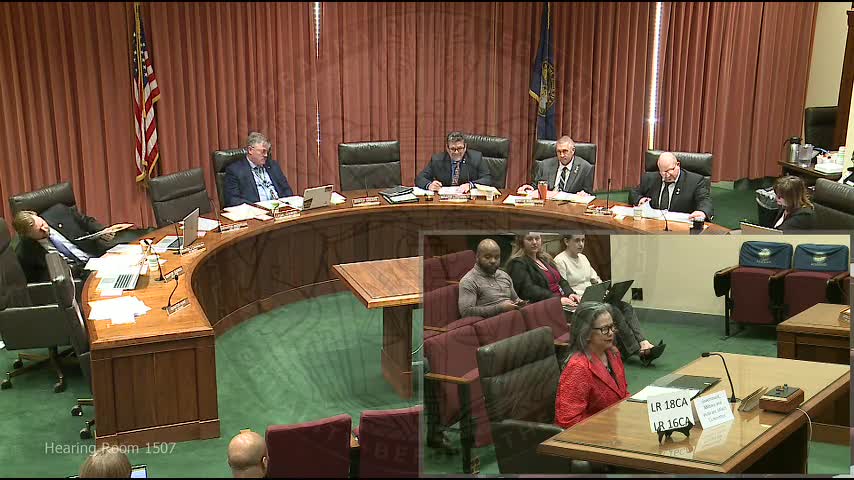
The Government, Military and Veterans Affairs Committee heard LR 18 CA and LR 16 CA, proposed constitutional amendments that would require the state to fund any new or expanded responsibilities it imposes on political subdivisions; school boards, municipalities and counties supported the measures, citing recurring property tax pressure from
Senator Rita Sanders introduced LR 18 CA and described it as a proposed constitutional amendment to require that new or expanded responsibilities the Legislature places on political subdivisions be funded by the state through an appropriation or an increase in state revenue distribution. “If this legislature is going to make serious efforts to reduce the property tax burden in Nebraska, unfunded mandates will have to be part of that conversation,” Sanders said.
Senator Terrell McKinney presented LR 16 CA with similar language; both resolutions would, if approved by voters, require state reimbursement when the Legislature imposes new mandates on cities, counties or other political subdivisions after 2026.
Supporters from education, municipal and county organizations told the committee the change is needed to prevent unfunded responsibilities from shifting costs to property taxpayers. Lisa Albers, representing the Nebraska Association of School Boards and Grand Island Public Schools, said unfunded mandates force districts to raise local property taxes, cut programs or use reserves, and that smaller districts disproportionately lack staffing and capacity to absorb new requirements.
Jack Moles of the Nebraska Rural Community Schools Association said he identified roughly 120 education bills this year and estimated 25–30 could impose costs on districts. Joe Donlinger, finance director for the City of Lincoln, and Christie Abraham of the League of Nebraska Municipalities provided lists of state requirements that municipalities must fund, including storage of DNA evidence and long retention of body‑worn camera footage. David Klug, Sarpy County Board chair, told the committee Sarpy County’s taxpayers paid about $15,000,000 in 2024 toward unfunded and underfunded mandates — about 15% of the county’s general fund expenditures, he said.
Proponents argued the proposed amendments would promote fiscal transparency, protect local control and give voters an opportunity to decide the tradeoffs. Of the groups testifying in support were the Nebraska Association of School Boards, the Nebraska Rural Community Schools Association, the League of Nebraska Municipalities, the Nebraska Association of County Officials and several cities and counties.
Committee members asked for examples of mandates and cost impacts. Witnesses pointed to past interim studies (including work following LB 299 in 1996 and an interim study in 2014), property tax cap legislation such as LB 34, and economic development incentives that redirect local option sales tax (testimony cited local impact from a Nebraska Advantage/Imagine Act program as an example). Committee staff logged counts of testifiers: LR 18 CA drew eight proponents and no opponents or neutrals at the hearing; LR 16 CA drew six proponents and no opponents or neutrals.
Senator Sanders closed by urging the committee to advance LR 18 CA to the floor for debate. No committee vote was recorded at the hearing.