Get Full Government Meeting Transcripts, Videos, & Alerts Forever!
Get email alerts on the Property Tax Cap topic
No spam. Unsubscribe anytime.
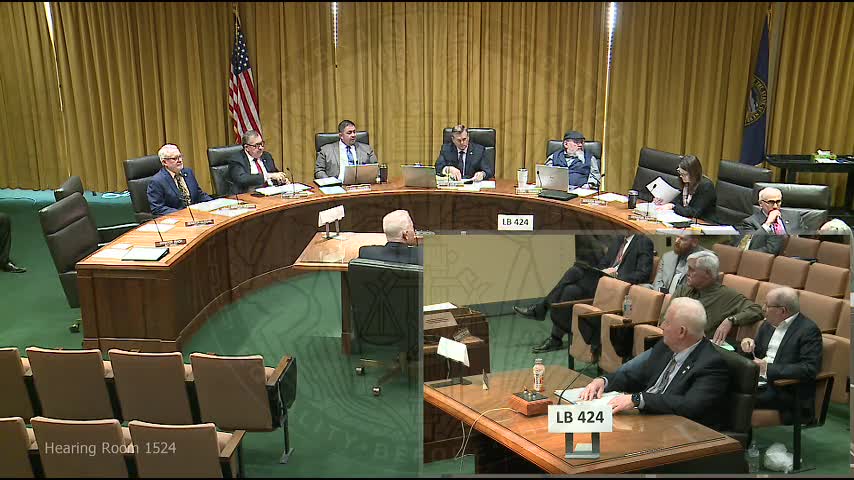
Senate revenue panel hears bill to cap annual property-tax bill increases at 3% or inflation
Summary
Senator Bob Anderson introduced LB 424, a proposal to cap annual increases in individual property-tax bills at the lesser of the rate of inflation or 3 percent, saying the change would give homeowners and small businesses predictable property-tax bills and prevent valuation-driven "sticker shock."
Senator Bob Anderson, sponsor of LB 424, told the Revenue Committee that the bill would cap annual increases in an individual property owner’s property-tax bill at the lesser of the current rate of inflation or 3 percent, a limit he said is needed to stop rising assessments from forcing Nebraskans from their homes. "We need to stop punishing people for simply owning a home," Anderson said during his introducer remarks.
The bill would limit the yearly change a homeowner or business sees on their tax bill, regardless of increases in assessed valuation beneath that top-line bill, Anderson said. "If the first year your taxes were $10,000, next year's going to be $10,300," he said, describing predictability as the bill's central aim.
Why it matters: supporters said high and uneven assessment increases have produced "sticker shock" for many taxpayers and harmed housing affordability and small businesses. Opponents — including county officials, municipal associations, school superintendents and other local entities — said the proposal would create legal and practical problems for Nebraska’s property-tax system, could shift costs or revenue unpredictably across parcels and political subdivisions, and in some cases would reduce local governments’ ability to fund essential services.
Supporters’ arguments: Doug Kagan of Nebraska Taxpayers for Freedom said Nebraska lags other states on assessment and levy reforms and urged adoption of a cap tied to a CPI index; he recommended using a Midwest urban CPI. Alan Seyvert, also representing Nebraska Taxpayers for Freedom, warned that current assessor processes can leave some individual parcels exposed to extreme valuation jumps and said a cap tied to allowable revenue growth would need safeguards to protect individual homeowners.
Opponents’ arguments and technical concerns: John Cannon, executive director of the Nebraska Association of County Officials, argued LB 424 raises constitutional and equalization concerns under Nebraska’s uniformity requirements. Cannon walked the committee through a simplified numerical example to show how capping the tax increase on an individual parcel could force recalculation of levy rates and produce unintended shifts of the tax burden between parcels.
Lynn Rex of the League of Nebraska Municipalities said LB 424 would layer a new cap on top of existing caps (including the limits embodied in LB 34 and municipal levy limits), making compliance "unworkable on its face" for many smaller local governments and urging the legislature to seek a single, reconciled cap rather than multiple overlapping limits. Jason Buckingham, superintendent for Ralston Public Schools, and Gary Kubicek of the Norris Board of Education said the bill could reduce school districts’ state aid under the TEOSA formula because state aid calculations assume local capacity to raise revenues; they urged holding the bill until interactions with the state aid formula are resolved. Dean Edson of the Nebraska Association of Resource Districts said the bill would create the wrong incentive for entities that use multi‑year, project‑based budgets and could force them to "take the maximum amount every year."
Committee discussion focused on several implementation details that are not specified in LB 424 as introduced: which CPI index would be used (several testifiers suggested a Midwest urban CPI), how the cap would interact with existing levy limits and bond or other authorized overrides, how political subdivisions would prioritize or reconcile combined levy requests that would exceed the capped amount, and whether the measure creates constitutional equalization problems. Senator Jacobson and other members repeatedly asked about the mechanics of levy recalculation and how a consolidated cap on the taxpayer’s bill would be administered by counties and local levying authorities.
Fiscal and scale context: committee members cited estimates that consolidating allowable increases across all political subdivisions could imply $240 million to $300 million a year in additional state funding would be required to hold taxes flat statewide — a sum the state has not pledged to provide. Multiple representatives of cities, schools and special districts said LB 424 as drafted does not specify how that gap would be filled.
Outcome and next steps: the hearing concluded with Senator Anderson saying he would work with committee members and stakeholders on unresolved technical issues. No committee vote or formal action on the bill was recorded in the hearing.
Ending note: proponents framed LB 424 as protecting homeowners and small businesses from volatile valuation-driven tax increases; local officials and school representatives urged the committee to address constitutional equalization concerns, state-aid interactions and practical mechanisms for levy recalculation before advancing the measure.