Get Full Government Meeting Transcripts, Videos, & Alerts Forever!
Get email alerts on the Superintendent Pay topic
No spam. Unsubscribe anytime.
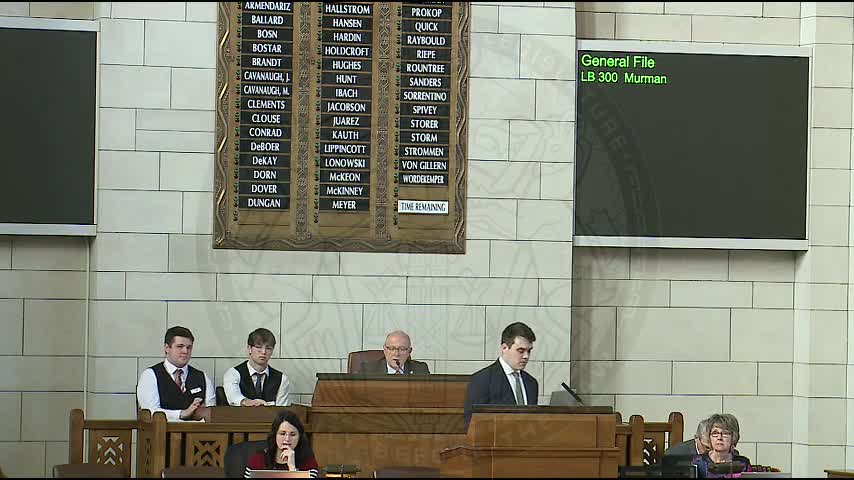
Long debate on superintendent pay limits pits local control against efforts to prioritize teacher pay
Summary
Lawmakers spent an extended floor session debating LB300 and amendment AM168, which would tie beginning teacher pay to superintendent compensation and add exemptions for longevity; the measure drew broad opposition from school districts and supporters emphasizing taxpayer concerns but no final vote was recorded in the transcript.
Senator Merman opened LB300, proposing a statutory rule tying superintendent pay and teacher pay together so that a beginning teacher’s salary would be at least one‑fifth of the superintendent’s compensation; the committee amendment reversed the original cap and framed the policy as requiring that a beginning teacher make at least one‑fifth of the superintendent’s pay. The amendment also includes exemptions for longevity in a district and for long‑serving superintendents.
Sponsor Senator Merman said the objective is to redirect a greater share of limited education funding toward classroom teachers: “My goal isn’t totally to reduce superintendent pay. It’s actually to direct more of our limited funding toward the classroom teachers,” he said on the floor.
The bill prompted broad and sustained floor debate. Opponents included school boards, school administrative groups and many individual senators who argued the proposal would undermine local control, hamper recruitment of experienced leaders in large districts and could have unintended budget impacts for districts that would be required to raise pay across multiple administrator ranks. Senator Brandt warned that different districts face different needs and that a statutory multiplier could hamstring local hiring and negotiating practices. Several senators cited Omaha Public Schools (OPS), Lincoln Public Schools (LPS) and other large districts to illustrate the complexity and scale of urban systems.
Supporters, including several senators who framed the bill as one tool among many to address teacher pay and property tax concerns, said administrative pay has grown faster than classroom pay and that the state — which funds a substantial share of larger districts’ budgets — has a role in ensuring public dollars prioritize instruction.
During debate senators raised constitutional and statutory questions, including whether the Legislature’s action could run afoul of provisions regarding local control and contract law; Senator Hallstrom noted possible conflicts with the state tenure act and the contracts clause as issues flagged by opponents. Several speakers suggested a deeper study into administrative headcount and growth of administrative costs would be a better path than a statutory cap.
No final recorded floor vote on LB300 or the pending amendments appears in the provided transcript; the debate continued with many members speaking for and against the amendment. The discussion concluded for the day when the Legislature adjourned to the next session date.