Get Full Government Meeting Transcripts, Videos, & Alerts Forever!
Get email alerts on the Juvenile Probation Reform topic
No spam. Unsubscribe anytime.
Nebraska bill to move juvenile probation to executive branch draws sharp debate over transparency and public safety
Summary
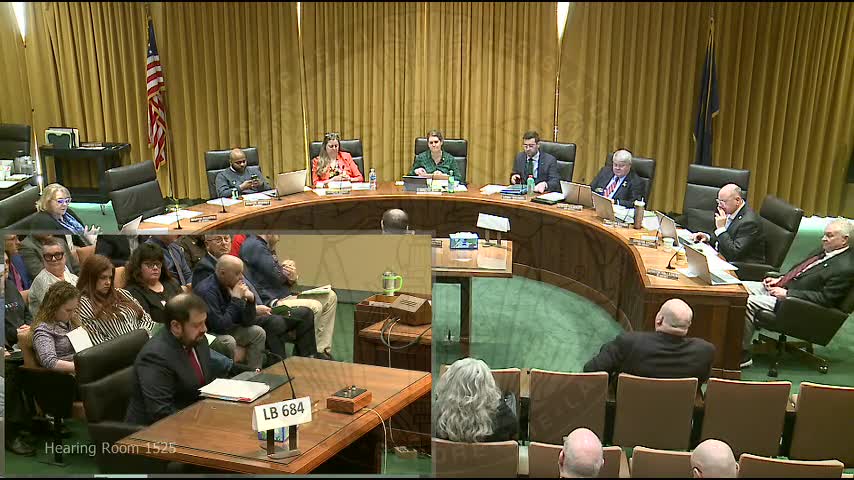
Sen. Eliot Bostar’s bill to move juvenile probation from the courts to a new executive‑branch agency prompted a large, sometimes tense Judiciary Committee hearing focusing on transparency, detention decisions and whether the move would improve public safety.
Senator Eliot Bostar introduced LB684 to the Judiciary Committee, proposing to move administration of juvenile probation from Nebraska’s judicial branch to a new juvenile probation agency in the executive branch.
Bostar told the committee that transferring probation would increase transparency, restore information‑sharing with law enforcement, and allow judges to decide felony arrest detention after a hearing. ‘‘Under the administration of the judicial branch, we have seen a continuous lack of transparency,’’ Bostar said. He cited county statistics showing rising juvenile felony referrals in some jurisdictions and argued the executive branch could coordinate probation with child welfare services.
Law enforcement and prosecutors offered broad support. Patrick Dempsey, president of the Omaha Police Officers Association, and Lincoln Police Union President Joe Villamontae said officers have lost routine access to probation information, including GPS monitor locations, and described high‑profile violent incidents involving juveniles they said were on probation. Douglas County Attorney Don Kleine said judge review of felony detention and a different administrative structure could provide options for dangerous youth and help resolve placement shortages.
Proponents from community providers and former juvenile offenders urged better funding and faster contracts so treatment providers can accept youth instead of leaving them in detention. Several former probationers and program staff told the committee that voucher‑style payments have made it hard for community programs to staff and respond quickly.
Opponents and skeptics included the State Court Administrator Corey Steele, juvenile court Judge Roger Heideman and former probation administration chief Deb Menardi, who cautioned that moving probation risks undermining judicial procedure and the unique role judges play in juvenile cases. Steele highlighted existing legal limits on sharing court data and said the broader statutory data‑sharing question may be the real bottleneck. Defense and civil‑liberty witnesses urged caution against politicizing supervision and called for targeted law changes, better data sharing and more placements rather than wholesale transfer of administration.
Committee members pressed both sides on details: how behavioral‑health placements and caseloads would be managed, why prior moves had been made, and whether the executive branch has the capacity to administer complex juvenile services. Several witnesses said the current system is ‘‘not working for anyone’’ while others warned that moving probation won’t itself create beds, nor will it automatically fix interagency coordination.
No committee decision was recorded. Sponsors and stakeholders said they will continue working on statutory language and implementation questions; the proposal is likely to return for additional drafting to resolve concerns on data access, placements and statutory authority for detention decisions.
The committee heard more than two dozen in‑person proponents and dozens of written statements; testimony reflected a broad coalition of law enforcement, prosecutors, service providers, advocacy groups and former clients.