Get Full Government Meeting Transcripts, Videos, & Alerts Forever!
Get email alerts on the Recycling Policy topic
No spam. Unsubscribe anytime.
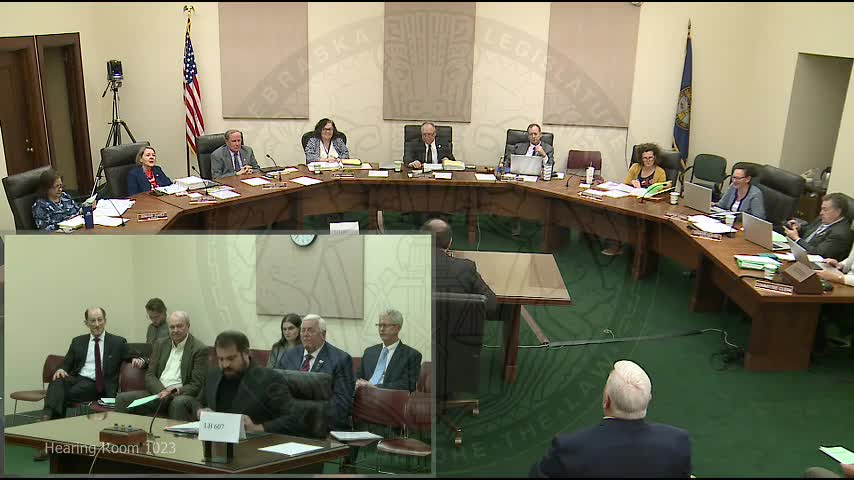
Nebraska Natural Resources Committee hears sweeping bill on recycling, batteries and fees
Summary
Senator Eliot Bostar, introducer of LB607, told the Natural Resources Committee that the bill would create a comprehensive recycling framework for Nebraska, including recognition of advanced plastic‑recycling technologies as manufacturing, a statewide battery stewardship program, higher landfill disposal fees and expanded producer data reporting.
Senator Eliot Bostar, introducer of LB607, told the Natural Resources Committee that the bill would create a comprehensive recycling framework for Nebraska, including recognition of advanced plastic-recycling technologies as manufacturing, a statewide battery stewardship program, higher landfill disposal fees and expanded producer data reporting. "LB607 will help bring new innovative recycling technologies to Nebraska," Bostar said in his opening remarks.
The bill’s sponsor told senators the measure is intended to expand the state’s ability to recycle plastics, strengthen local manufacturing and reduce pollution. "These facilities will still be subject to important environmental protections, including oversight under the Federal Clean Air Act, Clean Water Act, and Nebraska Department of Environment and Energy regulations," Bostar said. He also described a planned, incremental increase to the statewide disposal fee: from the current $1.25 per ton to $2.25 in 2026, $3.25 in 2027 and $4.25 in 2028.
Why it matters: LB607 aims to reshape Nebraska’s recycling infrastructure and funding at a time when several speakers said the state has low recycling rates and rising landfill costs. Supporters argued the bill could attract private investment and create markets for hard‑to‑recycle plastics; opponents warned the measure includes new mandates and reporting that could impose costs on manufacturers, retailers and small businesses.
Supporters from industry and nonprofits described technical and economic benefits. Marcus Branstad of the American Chemistry Council said the bill’s definitions would allow facilities using pyrolysis, depolymerization and similar processes to be regulated as manufacturing rather than solid‑waste handling, making Nebraska the 26th state to recognize those technologies. "These facilities purchase sorted, cleaned, post‑use plastic … to remanufacture into new materials," Branstad said. Andrea Elbersheim, also with the American Chemistry Council, told senators these technologies “use heat in the absence of oxygen” and are not incineration; she said more than a dozen U.S. commercial facilities process nearly a billion pounds of plastic per year.
Experts described the technologies’ yields and residuals in questions from the committee. A witness summarized that pyrolysis can yield about 75% pyrolysis oil and about 5% or less residue that may be landfilled or used in other products, and that the remaining gases are often reused to help fuel the process.
Recyclers and processors described existing capacity and markets. Dale Goebbels, CEO of First Star Fiber in Omaha, said his company keeps nearly 100,000 tons a year out of landfills and sells hard‑to‑recycle plastics to downstream processors, including a chemical‑recycling plant in Indiana. "We can take these otherwise hard to recycle … and put it into plastic lumber," Goebbels said, and argued that stronger end markets are needed.
Opponents from retail, beverage and packaging sectors raised concerns about specific bill components. Blair Macdonald, representing the Nebraska Beverage Association, said his group opposes the extended producer responsibility (EPR) data‑collection and minimum recycled‑content provisions as written and called the reporting an "unfunded mandate" for businesses. The Nebraska Grocery Industry Association echoed concerns about EPR, battery stewardship implementation and recycled‑content mandates, arguing the state’s waste characterization study — under way with EPA funding and due in 2026 — should inform next steps.
Packaging trade groups also disputed parts of the bill. Andrew Hackman of AmeriPen said the bill’s recycled‑content schedule would require substantial amounts of recycled material in some categories that currently lack reliable supply chains, and he urged amendments and alignment with other states’ definitions. Joey Adler Ruane of the Recycled Materials Association warned that exempting chemical recyclers from solid‑waste oversight without careful parity could distort existing recycling markets.
On batteries, retailers and trade groups supported safe collection but urged clarity. Rich Otto of the Nebraska Retail Federation said he appreciated the sponsor’s willingness to consider amendments that would, for example, exclude automotive lead‑acid batteries from the stewardship program because those batteries already are widely recycled.
Officials with Douglas County and with the Association of Plastic Recyclers testified in a neutral capacity that Nebraska needs better data and infrastructure and that a package of policies — collection, safety, data and demand creation — will be required to raise the state’s recycling rates. Kent Holm, Douglas County’s Environmental Services Director, highlighted the ongoing statewide waste‑characterization study and recommended aligning any new programs with updated data and the state’s integrated solid‑waste planning.
No final committee vote on LB607 was recorded during the hearing; the sponsor said he is still receiving and drafting amendments and will return with revised language. "There are things in the bill that need to be fixed and changed and we'll… bring amendments," Bostar said at the close of the hearing.
What’s next: Senators took testimony from numerous proponents and opponents and asked technical questions about permitting, residual streams and collection logistics. Bostar said he will work with stakeholders to refine amendments and that the bill is a work in progress.
Ending note: The hearing drew extensive stakeholder participation and highlighted trade‑offs between encouraging investment in advanced recycling and protecting existing recycling markets and small businesses. Committee members signaled interest in amendments and further technical review before any final action.