Get Full Government Meeting Transcripts, Videos, & Alerts Forever!
Get email alerts on the Jail Medical Costs topic
No spam. Unsubscribe anytime.
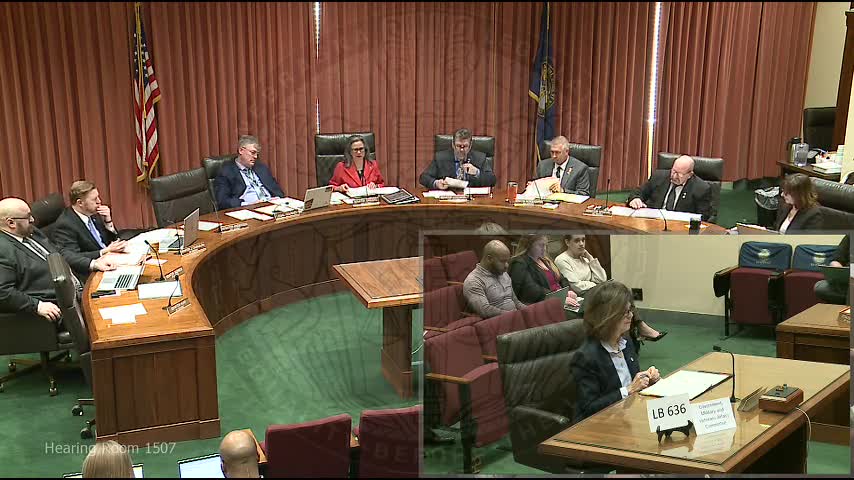
Senate committee hears bill to shift county jail medical costs to state, raises sheriff service fees
Summary
Senator Teresa Ibach introduced LB 636 to the Government, Military and Veterans Affairs Committee, proposing state reimbursement for county jail inmate medical costs and increases in statutory sheriff service fees.
Senator Teresa Ibach, the bill's introducer, told the Government, Military and Veterans Affairs Committee that LB 636 would require state reimbursement for medical costs incurred when counties provide medical services to county jail inmates and would raise certain sheriff service fees. “LB 636 is a simple bill that seeks to lower the tax burden our property taxpayers face,” she said.
The bill’s proponents said costs for inmate medical care have grown unpredictably and can force counties to cut services or raise property taxes. Neil Miller, the Buffalo County sheriff, told the committee Buffalo County’s jail medical spending rose from about $195,000 in fiscal 2021–22 to about $450,000 in fiscal 2023–24 and that the county had already spent $441,917 in the first seven months of the current fiscal year. “These kind of increases are not sustainable for county budgets,” Miller said.
Brad Johnson, director of the Lancaster County Department of Corrections, gave larger-scale figures: Lancaster County’s inmate medical costs totaled $4,320,543 in fiscal 2023–24, including roughly $3.8 million contracted to the county’s medical provider. He said Lancaster’s average daily jail population rose from about 539 in 2015 to 692 in fiscal 2024 and that inmates required more and costlier constitutionally mandated care. “Property tax growth cannot be controlled without a well designed and reliable state plan for funding services that counties are mandated to perform, like inmate medical services,” Johnson said.
Senator Ibach and sheriff witnesses said the proposal’s $21 million appropriation was calculated using county cost estimates and that the bill also updates long‑unchanged fee amounts paid to sheriffs for serving court documents and other process. Witnesses and the introducer said some statutory fees have not been adjusted in decades.
Opponents urged caution on the fee increases. Spike Eicholt, speaking for the Nebraska Criminal Defense Attorneys Association, said the association opposes sections 2 and 3 of the bill that raise sheriff fees because the added costs are frequently assessed against defendants as court costs, which would disproportionately affect people with limited means. “The reality is many people who are caught in the criminal justice system are already poor,” Eicholt said.
Tessa Stevens, representing the Nebraska Collectors Association, said the proposed increases for civil service of process were unreasonably large in some cases—by her calculation, some proposed changes would raise fees by hundreds or thousands of percent—and warned higher service fees could make small claims and debt collection uneconomical.
Douglas and Lancaster county officials also testified in support. William Winn, chief deputy of administration for the Douglas County Sheriff’s Office, described process‑serving in a large metropolitan office as often requiring multiple deputies for safety, and said current statutory reimbursement does not cover the expense. Lancaster’s Johnson and other proponents said state reimbursement for inmate medical care would stabilize county budgets and provide property tax relief.
Committee members pressed witnesses on details the bill does not specify. Senator John Kavanaugh asked whether reimbursement would cover all county medical spending or only catastrophic costs; Sheriff Miller said the counties sought relief for large, volatile expenses but that the bill’s mechanics would need negotiation. Committee members also asked whether medical costs are higher for pretrial detainees than for sentenced inmates; Lancaster’s director said his office did not have a ready breakdown but suggested pretrial detainees often present higher immediate medical needs.
Senator Ibach acknowledged opponents’ concerns about fee amounts and said sponsors are willing to negotiate statutory fee levels. She also disputed aspects of the bill’s fiscal note that the Department of Correctional Services had supplied—specifically the need for 16 new full‑time employees and a leased facility—saying the departments are already performing the essential work and that the fiscal estimate was overstated.
The committee record includes county cost snapshots cited by witnesses: Buffalo County reported budgeted medical lines of $150,000 (2021–22) rising to $400,000 (current budget), with actual spending as high as $450,000 in one year; Lancaster County reported $4,320,543 in inmate medical costs for fiscal 2023–24; Douglas County’s 2023 estimate was described in testimony as nearly $11,000,000. The introducer referenced variance examples from the Nebraska Association of County Officials, including a $142,000 variance in Adams County and a $120,000 variance in Buffalo County between fiscal years, and a reported large percentage swing in Thayer County on a small base.
No committee vote was recorded at the hearing. The committee closed testimony on LB 636 and paused the hearing to reset the room for later agenda items.