Get Full Government Meeting Transcripts, Videos, & Alerts Forever!
Get email alerts on the Foreign Owned Real Estate topic
No spam. Unsubscribe anytime.
Legislature adopts technical fixes to foreign‑owned land law, clarifies that Native American tribes are not foreign entities
Summary
Senators adopted committee and floor amendments to LB7, updating federal citations, expanding a CFIUS safe harbor, and adding a legislative notice requirement for court-ordered divestments; the bill advanced to E & R initial.
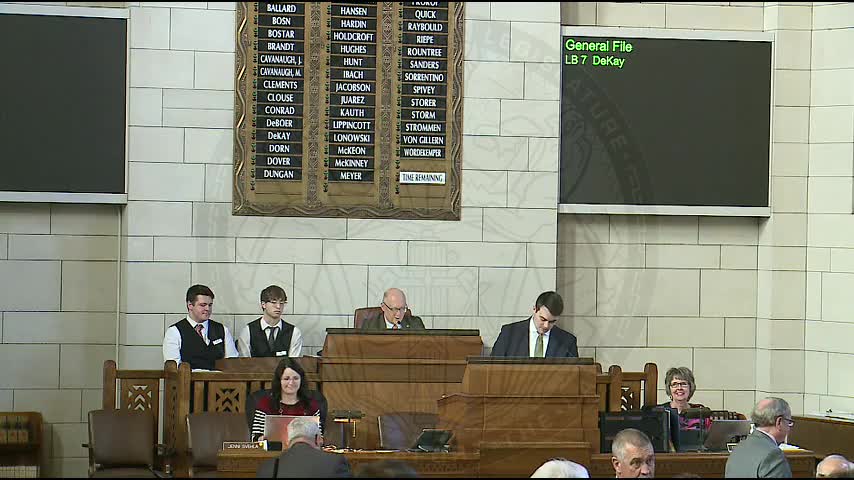
Senator DeKay introduced LB7 as a technical cleanup to last year’s foreign‑owned real estate statutes, saying the bill updates federal citations, clarifies definitions and broadens limited safe‑harbor language while ensuring Native American tribes are not treated as foreign governments.
The measure, described by sponsor Senator DeKay as a set of clarifications to LB13‑01 and LB1120, would: (1) define “foreign corporation” and tighten the definition of “nonresident alien,” (2) update the federal citations used to identify foreign adversaries, (3) expand a safe harbor to include properties for which the Committee on Foreign Investment in the United States (CFIUS) has found no ongoing national‑security concern, and (4) require that the Legislature be notified by the Clerk if a court orders divestment under the foreign‑owned real estate act. “This change would ensure that our state’s Native American tribes are not inadvertently subject to the provisions of the foreign owned real estate National Security Act,” Senator DeKay said during the introduction.
A committee amendment (AM77) and a subsequent floor amendment (AM310 / AM3310 white copy) refined definitions and explicitly excluded entities formed under U.S. tribal or territorial law from the bill’s definition of “foreign corporation.” Another amendment (AM310) simplified the bill’s definition of “Indian tribe” to mean a federally recognized tribe or one formally acknowledged by the state, a change offered after tribal feedback at the hearing.
Floor votes on the amendments were unanimous. The body adopted AM310 (floor amendment to the committee amendment) and AM77 with no recorded nays, and advanced LB7 to E & R initial by voice vote and recorded counts. The bill was reported out of the Agriculture Committee unanimously at its public hearing prior to floor action.
Supporters framed the package as a narrowly targeted cleanup to prevent unintended application of the foreign‑owned real estate national security provisions to tribal governments and to reflect recent federal regulatory changes. Senator DeKay noted the bill updates references to 15 CFR 791.4 and 31 CFR 800.21 to match current federal citations and to incorporate CFIUS review outcomes into the state safe harbor.
No opponents testified at the committee hearing; the bill carried unanimous committee support and proceeded on the floor with multiple technical clarifications added by amendment.
Outcome: Committee amendment AM77 and floor amendment AM310 were adopted; LB7 advanced to E & R initial.