Get Full Government Meeting Transcripts, Videos, & Alerts Forever!
Get email alerts on the Ethanol Industry topic
No spam. Unsubscribe anytime.
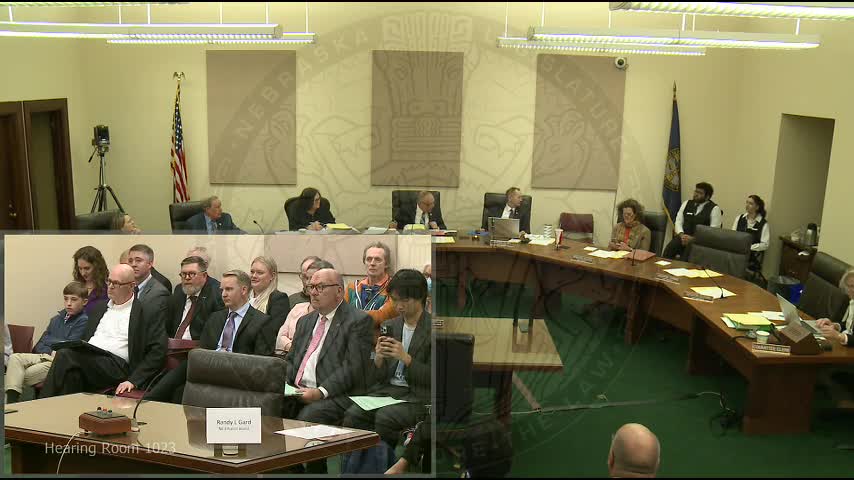
Nebraska Ethanol Board nominee Randy Gard stresses blending, export risks at confirmation hearing
Summary
Randy Gard, reappointment nominee to the Nebraska Ethanol Board, told the Natural Resources Committee the state's ethanol industry supports thousands of jobs and faces federal policy risks including small refinery waivers and tariffs. Industry groups backed his reappointment; one member of the public opposed on water-quality grounds.
Randy Gard, the petroleum representative nominee for reappointment to the Nebraska Ethanol Board, told the Natural Resources Committee that Nebraska is the nation’s second-largest ethanol producer and that federal policy decisions could sharply affect blending economics and exports.
Gard, chief operating officer of Bossman Enterprises, gave the committee a brief overview of Nebraska’s ethanol sector and the board’s role in promoting ethanol production and consumption. "Nebraska is the second largest ethanol producing state in the nation, only second to Iowa," Gard said, and he described about "24 ethanol plants in Nebraska that produce just north of 2,000,000,000 gallons of ethanol per year," which he said "equates to over 8,000 jobs in the state."
The nominee and industry witnesses told senators they worry about two federal threats. Gard said small refinery waivers issued by the U.S. Environmental Protection Agency (EPA) can collapse the market value of a Renewable Identification Number (RIN) attached to a gallon of ethanol, changing blending economics; he warned that could make higher blends less competitive. He also said proposed tariffs on exports could "change the pricing of our product and could significantly hurt our ability to export ethanol to either border." Ben Rhoades, interim executive director of the Nebraska Ethanol Board, seconded Gard’s view and described Gard as "one of the most active members of our board" and credited his work expanding retail access to E15 fuel.
Renewable Fuels Nebraska Executive Director Dawn Caldwell also supported Gard’s reappointment, saying his retail perspective helps create markets for higher ethanol blends and that he is engaged in board research and promotion programs.
Committee members asked Gard technical and policy questions. Senator Margo Juarez asked whether Gard had concerns about the current federal administration’s renewable-energy and electric-vehicle policies; Gard replied that uncertainty in Washington, D.C., was “a lot of uneasiness” and pointed to the effects of small refinery waivers on RIN values and blending economics. Senator Raimo asked about tariffs and exports; Gard said Nebraska produces enough ethanol to supply the state and to export surplus, and that tariffs would "change the pricing of our product." Senator Barry DeKay asked whether the board deals with biodiesel; Gard said the Nebraska Ethanol Board does not and described retail-level biodiesel blending and the temperature constraints that affect biodiesel blends.
A single member of the public spoke in opposition. Nancy Packard told the committee she had observed reduced mileage when using ethanol blends, expressed concern about aquifer use and long-term food sustainability, and said she opposed Gard's reappointment. Committee clerks corrected her testifier designation from proponent to opponent when she noted the error on her sheet.
The committee closed Gard’s hearing after proponents and opponents spoke and committee members asked questions. No formal committee vote was recorded in the hearing transcript provided.
Why it matters: The Nebraska Ethanol Board advises and promotes the state’s ethanol industry; members representing producers, retailers and agriculture influence research, market development and state testing programs for higher blends. Federal policy changes—EPA waivers, RIN market shifts, and trade tariffs—can affect local retail prices, blending incentives and export markets, with downstream effects on Nebraska farmers and fuel retailers.