Get Full Government Meeting Transcripts, Videos, & Alerts Forever!
Get email alerts on the Tort Reform Settlement Mechanics topic
No spam. Unsubscribe anytime.
Judiciary Committee hears bill to restore joint-and-several effect after Tadros ruling
Summary
Sen. George Duncan introduced LB416 to reverse what proponents call a settlement disincentive created by the Nebraska Supreme Court's Tadros ruling; plaintiffs' attorneys said the change would increase settlements, while defense groups warned of uneven results and taxpayer exposure.
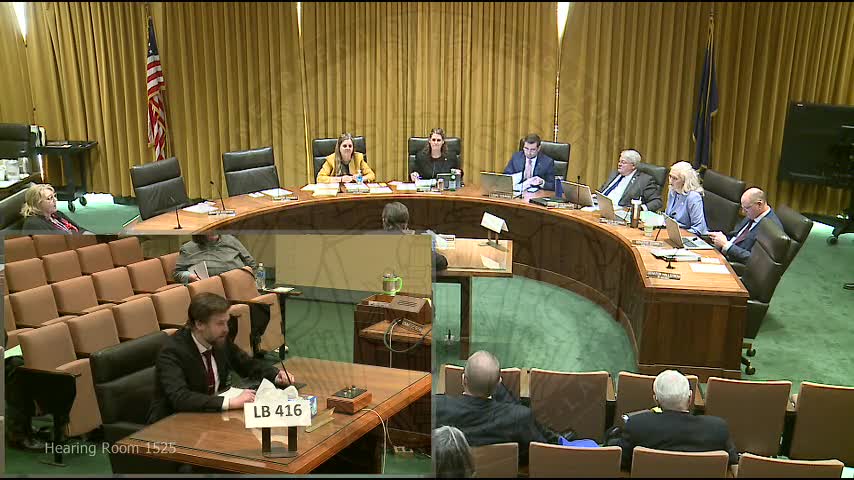
Senator George Duncan, state senator for Legislative District 26, introduced LB416 at the Judiciary Committee hearing, saying the bill is a “much needed fix” to the effect of the Nebraska Supreme Court’s Tadros decision and an obstacle to settlements in negligence cases.
The bill would narrow the Tadros consequence that, in practice, has discouraged some plaintiffs from settling with one defendant out of concern that a later verdict against another defendant would be reduced. “Tadros unquestionably serves as an obstacle to settlement, not an encouragement,” Duncan said during his opening remarks.
Supporters told the committee the change would allow plaintiffs to resolve some claims earlier and get needed money to injured people. Mark Richardson, speaking for the Nebraska Association of Trial Attorneys, said the current rule forces plaintiffs to keep all defendants in litigation rather than resolve otherwise reasonable settlements. “If that case were brought today, the only difference in that case would be that first defendant that settled out would not have been allowed to be settled out,” Richardson said while explaining the Tadros facts to the committee.
Cameron Gunzel, a trial attorney who described representing a child severely injured in an accident, urged passage on humanitarian grounds. Gunzel said his client, a girl who is now quadriplegic and fed by a G-tube, could benefit from a relatively small settlement from one defendant that would be “life changing” while preserving claims against more culpable parties. “Instead of resolving this case and getting money to my very desperate client ... this party will spend that money on attorneys and litigation,” Gunzel said.
Defense-side witnesses described mixed effects. Rob Keith, a defense lawyer and mediator, said Tadros creates a practical barrier to settlement in many low-to-moderate-value cases because smaller-policy defendants can’t safely tender limits and leave the case. He told senators that LB416 would “help get more cases resolved, informally, without court intervention.”
Opponents warned LB416 could shift losses to parties or entities with deeper pockets. Melanie Whittamore Mansios, testifying for the Nebraska Defense Counsel Association, said the 1992 comparative‑negligence reforms were a negotiated compromise and that Tadros reflects that statutory scheme. She described the court’s interpretation as a pro rata reduction (a percentage offset) rather than a pro tanto dollar-offset and warned LB416 would “undo the compromise intended by the 1992 statutory scheme.” Jeff Davis, for BNSF Railway, presented a hypothetical in which settlement by a minimally responsible driver could leave another defendant paying more than its fair share unless offsets are applied.
Committee members asked detailed questions about how offsets, contribution claims, and jury apportionment would work under LB416. Several witnesses explained contribution and indemnity remedies remain available after judgment, but they acknowledged litigation over allocation can be lengthy. The attorney general’s office submitted a written letter cited in the hearing that expressed concern about “over recovery” scenarios and asked whether statutory language could prevent plaintiffs from recovering more than the total damages.
No committee vote was taken at the hearing. Senators and witnesses indicated willingness to continue working on technical language; the introducer said he would follow up with interested parties.
As presented, LB416 would not change Nebraska’s allocation of non‑economic damages, which the 1992 tort reform package already limited, but would address how prior settlements affect joint economic‑damage exposure at trial.
While the hearing included strongly worded examples from both plaintiff and defense counsel, the committee did not adopt a final amendment or set a date for further action at the hearing’s close.