Get Full Government Meeting Transcripts, Videos, & Alerts Forever!
Get email alerts on the K 12 Assessments And Budget topic
No spam. Unsubscribe anytime.
Nebraska Department of Education warns $1.5M cut to ACT funding would disrupt mandated assessments; asks legislature to preserve teacher-certification reserve
Summary
Commissioner Brian Maher told the Appropriations Committee the Department of Education relies heavily on federal funds, warned a $1.5 million proposed reduction for the statewide ACT appropriation would force the state to find an alternative college-entrance assessment, and urged against sweeping the teacher certification cash fund reserve.
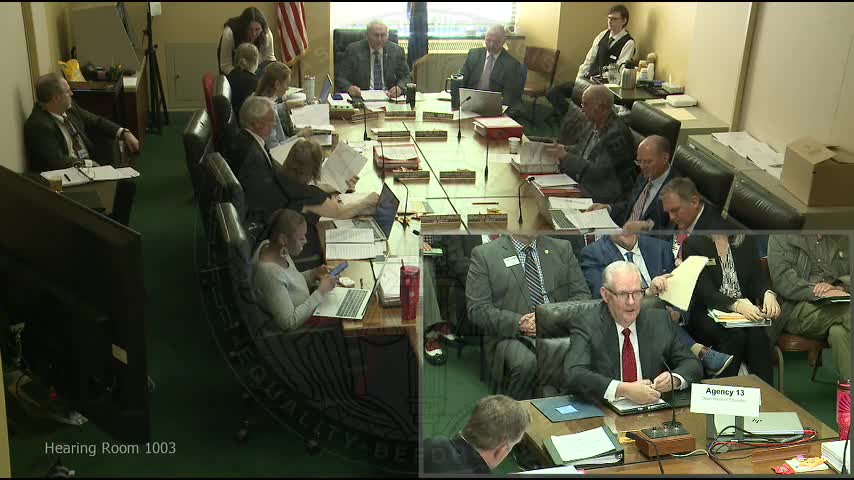
Brian Maher, commissioner of the Nebraska Department of Education, told the Legislature’s Appropriations Committee on Feb. 18 that the department’s staffing and programs depend on a mix of state, local and federal dollars and raised two specific budget concerns: a proposed $1.5 million reduction to the ACT appropriation and a possible sweep of the teacher certification cash fund.
Maher said the department has about 500 employees, and that more than two-thirds of its operating funds come from federal sources. He described four core agency areas — education services, operations, vocational rehabilitation, and disability determination services — and said almost half of NDE employees work in vocational rehabilitation and disability determination services.
Maher described the ACT appropriation as the line that, since 2017, has allowed Nebraska to use the ACT as its statewide eleventh-grade instrument that satisfies both state statute and federal assessment requirements. He said the preliminary committee report and the governor’s budget each reduce that appropriation by $1,500,000. “By contracting at the state level, we save our state approximately a half a million dollars through that economy of scale,” Maher said, and warned that without the appropriation the department “will be unable to fulfill that requirement, at least as we use as we currently do.” He added the department is required to give a college-entrance assessment at the high school level but is not statutorily bound to the ACT itself; changing instruments would still carry a cost and implementation lead time.
Maher also asked the committee not to sweep the teacher certification cash fund. He said the department reduced certification fees last year after legislative restructuring of the Professional Practices Commission and relied on the cash fund reserve to hold the lower fee; a sweep of roughly $1,000,000, he said, would effectively raise fees back for teachers. He requested that the committee avoid using those reserves so the fee reduction can be sustained.
Committee members pressed Maher on likely impacts. Maher said an unfunded assessment still would be required by federal and state law; the department would need to find an alternate assessment or funding source. He also confirmed the department is monitoring federal policy and potential changes in U.S. Department of Education leadership that could affect federal grant flows.
Other witnesses at the hearing reiterated the operational and cost questions. Jeremy Henniger, lead policy analyst at ACT and a former NDE assessment director, testified that custom tests would likely cost considerably more and take years to field-test, and that discontinuing the ACT could disrupt Nebraska’s ESSA accountability reporting. Maher closed by asking the committee to maintain the requested assessment funding and restore the teacher-certification cash reserve.
The committee did not take a vote on those requests at the hearing; Maher and agency staff stood by for committee questions and indicated they would provide follow-up material if requested.