Get Full Government Meeting Transcripts, Videos, & Alerts Forever!
Get email alerts on the State Budget topic
No spam. Unsubscribe anytime.
Banking regulator backs governor on LB261 as industry warns against sweeping assessment funds
Summary
At a Nebraska Legislature Appropriations Committee hearing, Kelly Lammers, director of the Nebraska Department of Banking and Finance, told the committee the department supports the governor's recommendation and LB261 sections 70 and 71 while industry groups warned caution about a separate proposal in LB264 to sweep assessment funds into the general fund.
At a Nebraska Legislature Appropriations Committee hearing, Kelly Lammers, director of the Nebraska Department of Banking and Finance, told the committee the department supports the governor's budget recommendation and specifically "LB261 section 70 and 71." The committee also heard testimony from banking trade groups urging caution about a separate proposal in LB264 that would sweep financial-institution assessment cash funds into the state general fund.
The issue matters because the Department of Banking and Finance is cash-funded by fees assessed on state-chartered banks, mortgage loan originators, money transmitters and securities registrations. Industry witnesses said those cash funds currently hold temporary surpluses that were intended to cover cyclical work and, in one recent instance, to pay for implementing supervision of digital-asset activity.
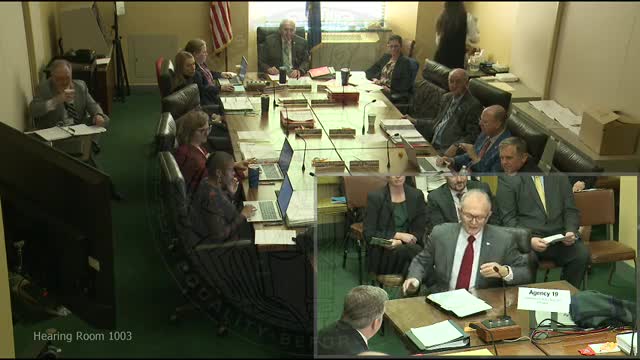
"This department appreciates the committee's review of the department's new issues and supports the governor's recommendation," Director Kelly Lammers said while introducing the agency's budget. Lammers described the agency's two divisions'the Financial Institutions Division and the Bureau of Securities'and explained the department relies on fees paid by the entities it supervises.
Registered lobbyist Ryan McIntosh, speaking for the Nebraska Banks Association, told the committee the banking industry values its partnership with the department and urged caution before authorizing a sweep of the financial-institution assessment cash fund under LB264. McIntosh testified that mortgage loan originator licensing spiked during a recent low-rate cycle and has since fallen by more than 30 percent since 2023, and that some of the present higher cash balance reflects a prior $2,000,000 transfer from the securities fund under the Nebraska Financial Innovation Act (LB649).
"We do very much appreciate the partnership that we have with the Department of Banking and Finance and Director Lammers," McIntosh said, adding that the department has been "very prudent in the way that they've expended funds." He and other witnesses urged the committee to consider the department's upcoming supervisory work, including oversight of a newly chartered digital-asset depository institution.
Dexter Schrodt, president and CEO of the Nebraska Independent Community Bankers Association, likewise opposed the cash transfers proposed in LB264 and asked the Legislature to preserve the assessment funds that come from the regulated industries. Schrodt cited the department's recent budget figures showing annual revenues of roughly $6.76 million and expenditures of about $6.13 million, leaving modest annual surplus relative to operating needs.
Industry witnesses and the director gave the committee several specific figures during testimony. Representatives said there is an approximate $3,000,000 balance in the financial institution assessment cash fund and about $1,000,000 in the finance settlement cash fund; they also said approximately $2,000,000 of the current balance stems from a prior transfer tied to LB649'the Nebraska Financial Innovation Act'that funded initial work on digital-asset supervision. Director Lammers told senators the proposed sweep would leave the department with roughly four months of operating cash, based on the agency's annual assessment cycle.
Senators on the panel questioned whether reducing the cash balance would force future increases in assessment fees for regulated entities should revenues drop or supervisory costs rise. Industry witnesses responded that if the fund were reduced and later needed to be replenished, those increases would fall to the state-chartered banks and other regulated entities rather than to state general funds.
There were no formal committee votes recorded at the hearing. Committee members closed testimony on Agency 19 after hearing from the director and three trade representatives; the Appropriations Committee did not take immediate action on LB261, LB264 or related budget proposals during the session recorded in the transcript.
The hearing record shows the department explaining that the cash-funded model and cyclical fee revenue are used to pay examinations, licensing and enforcement, and industry groups emphasizing two supervisory drivers: returning in-person examinations after COVID and a new, first-of-its-kind digital-asset depository charter that the department approved earlier in the month. Testimony asked the committee to weigh short-term budget needs against the department's ability to supervise expanding and evolving financial activities.
The Appropriations Committee proceeded to other agency hearings after closing testimony on the Department of Banking and Finance; any legislative movement on LB261 or LB264 would be decided by the Legislature in later steps.