Get Full Government Meeting Transcripts, Videos, & Alerts Forever!
Get email alerts on the Property Tax Credit Gap topic
No spam. Unsubscribe anytime.
Revenue committee hears calls to fix ‘gap year’ left by LB34 with LB81
Summary
Senators and dozens of proponents told the Revenue Committee that LB34’s change to the school property tax credit left some taxpayers without relief for tax year 2024; proponents urged passage of LB81 to make 2024 eligible, while fiscal and policy groups warned of large state budget impacts.
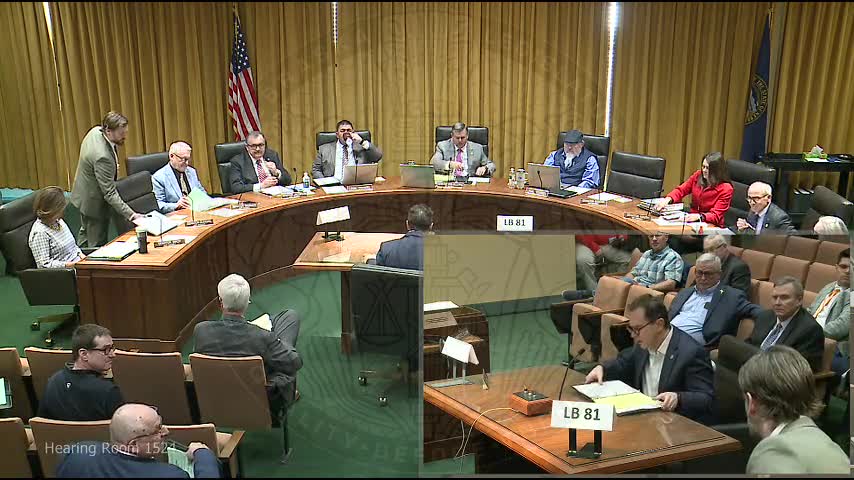
Senator Brian Hardin, the bill’s introducer, told the Revenue Committee that LB 81 would “make 2024 eligible for the property tax credit fund” to correct what he described as an unintended gap caused by last year’s LB 34 special‑session changes.
The bill drew more than an hour of public testimony nearly all in support, with homeowners, farmers, business groups and tax professionals urging the committee to repair what they called a one‑year loss of property tax relief. Proponents described families and farmers who expected a refundable income‑tax credit but now see a larger net tax bill because the credit was shifted to automatic credits on property statements for a different year.
Why it matters: LB 34 moved most of the school property tax credit from a refundable income‑tax credit to an automatic credit applied at the time of property tax billing. Supporters of LB 81 told the committee that change produced timing winners and losers — in particular taxpayers who paid 2023 school property taxes in 2024 and therefore did not receive a 2023 income‑tax credit. Because many Nebraskans pay property taxes in arrears, proponents said, those taxpayers lost a year of relief and are now seeing higher taxes this budget year.
Senator Hardin opened by saying the special session’s reform was “a necessary fix to an unintended gap in property tax relief,” and he acknowledged his own vote for LB 34 while urging corrective action. Dozens of individual taxpayers recounted their personal losses. Rod Armstrong said his family received a $2,000 reduction on the December property statement but ‘‘when I filed our 2024 taxes a couple of weeks ago, the amount of the tax credit was 0. So 2,000 credit, 2,000 credit, 0 dollars — 2,000 reduction in the current year. So there's your gap.’’ Merlin Nielsen of the Ag Leaders Working Group provided a parcel‑level illustration he said showed a roughly $3,000 loss for a single parcel and an $11,000 loss across his family’s holdings.
Several organizational proponents framed the problem as fairness and predictability. James Greisch, speaking for the Nebraska Society of CPAs and chambers of commerce, testified that the implementation of LB 34 “retroactively eliminated the refundable income tax credit for most property tax owners who pay their 2023 school property taxes in 2024,” and estimated the one‑year increase at more than $550 million in aggregate. John Gage of Americans for Prosperity urged lawmakers to “make things right” even while acknowledging the fiscal challenge.
Opponents and fiscal analysts warned the committee that LB 81 carries a large fiscal cost. Dr. Rebecca Firestone of the OpenSky Policy Institute said the state's budget entered the session with a multihundred‑million dollar shortfall and that the fiscal note for LB 81 — which witnesses and senators discussed in the hearing as being in the hundreds of millions — would worsen the state’s structural balance and likely require cuts to core services. Several senators pressed witnesses on cash‑flow vs. permanent loss distinctions; Senator Mike Jacobson argued that some of the shifts were timing differences and asked whether the state had in practice “written a check” to cover prior obligations.
Committee members discussed possible technical edits: multiple senators asked whether LB 81 needs an amendment to prevent “double dipping” (taxpayers claiming both a refundable income credit and a new property‑statement credit for the same tax year). Senator Hardin acknowledged that an amendment to address that 15% of taxpayers who might otherwise double‑claim could be appropriate.
No formal action was taken; the hearing closed after extended public testimony. Witnesses and senators repeatedly emphasized two constraints: the desire to correct what many called an unfair outcome for affected taxpayers, and the difficulty of funding a sizeable fix amid a projected state shortfall.
Proponents urged quick committee action to advance LB 81 to the Legislature’s floor; budget‑conscious witnesses urged caution or alternative timelines for compensation. The committee did not make a motion on the bill during the hearing and will decide next steps in future committee work.