Get Full Government Meeting Transcripts, Videos, & Alerts Forever!
Get email alerts on the State Budget Revenue Forecast topic
No spam. Unsubscribe anytime.
Panel Warns High Uncertainty for New York Revenue Forecast as Federal Policy Risks Loom
Summary
State budget and legislative leaders met with outside economists and university modelers and agreed the New York revenue outlook is currently uncertain; panelists urged caution, citing federal fiscal changes, proposed tariffs and immigration policy as major downside risks.
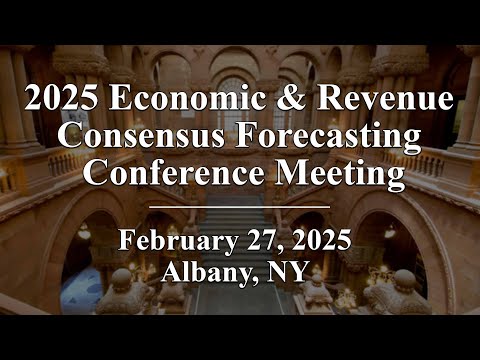
Blake Washington, director of the New York State Division of Budget, and legislative budget leaders met with outside economists on Feb. 1 for the annual economic and revenue consensus forecasting session and emphasized a shared goal of producing an on‑time budget while warning that revenue projections face unusually large uncertainty.
"We are all committed to meeting the state's statutory, March 1 deadline for a consensus revenue agreement," Washington said, opening the meeting and framing the forecasts as an input to a timely budget. The Division of Budget (DOB) reported that New York tax receipts strengthened in 2024 but that the department expects growth to moderate in fiscal 2026 as employment and income growth cool.
Why it matters: New York's budget planning relies on an accurate consensus forecast; panelists said this year's forecasts carry unusually wide error bands. Panelists flagged several federal policy actions — possible large federal spending cuts, proposed tariffs on trade partners and stricter immigration and deportation policies — that could materially reduce federal funding to the state and slow economic activity, putting pressure on revenue and services funded by Medicaid, education and public safety.
Experts' reading of the data
Professor Kajal Lahiri of the State University of New York described a high‑frequency, mixed‑data forecasting model his team developed to estimate year‑over‑year tax growth. He emphasized the model's explicit uncertainty ranges and said those bands remain wide now. "The key is the estimated uncertainty of this forecast that you cannot get otherwise," Lahiri said, adding that his model's current 14‑month‑ahead projection for fiscal 2026 implies essentially flat to modest revenue growth relative to the near‑term nowcast.
Economist Tara Sinclair summarized the U.S. macro backdrop as "resilient" entering 2025 but dominated by an overriding theme of "uncertainty." She noted the national labor market remains tight and inflation has cooled from its 2022 peak but remains above the Federal Reserve's 2% target longer than many forecasters expected. Sinclair highlighted higher‑for‑longer interest‑rate risks and housing affordability pressures that could restrain consumption and investment.
Hugh Johnson echoed those concerns and urged special caution. "The risks are far higher than I've ever seen," he said, pointing to the combined effects of prospective federal tax changes, planned tariffs and immigration policy shifts as sources of downside risk that could slow growth and push up inflation in the near term.
Federal actions and fiscal risks
Panelists discussed several federal developments they said should be monitored closely. Washington and others noted a recently passed U.S. House budget blueprint that lawmakers described as proposing about $2 trillion of federal spending reductions over the next decade; Lahiri and Sinclair said the budgetary details and resulting effects on Medicaid and other federal funding streams remain uncertain. Johnson flagged estimates from the Congressional Budget Office cited in the meeting that extending the 2017 Tax Cuts and Jobs Act could raise the federal deficit by roughly $3 trillion over 10 years and increase federal interest costs substantially.
Johnson and Lahiri also raised the near‑term risk of proposed tariffs that, if implemented, could raise U.S. import prices and produce short‑run inflationary pressure while also dampening global trade and growth. Lahiri and other panelists said uncertainty about the scope and timing of these federal measures is a major reason the forecast bands are wide.
Revenue outlook and model comparison
Lahiri reported his team's current forecast for fiscal 2026 revenue growth as modest, near flat on a year‑over‑year basis in real terms (he cited a 0.15% figure in his presentation) and said that outcome is similar to the DOB projection once certain tax‑specific adjustments (Lahiri's work models the state tax department series and excludes some DOB technical add‑backs) are reconciled. He repeatedly emphasized that uncertainty bands around those point estimates remain large and narrow only as more of the fiscal year is observed.
Panelists described different analytic approaches but noted convergence in headline numbers this season; Lahiri said he found it "pleasing" that his university model, the DOB's forecast and other independent projections are similar this cycle despite differing methods.
What the panel recommended and next steps
No formal policy actions or votes were taken at the session. Panelists and budget officials urged fiscal prudence: several speakers recommended maintaining or increasing rainy‑day reserves and cautioned against adding recurring spending that could be difficult to sustain if federal funding were cut or if national growth slowed. Marie Dulos, identified at the meeting as the Deputy State Controller, emphasized the value of statutory rainy day funds and said they should be used to protect services should federal funding decline.
Panelists also recommended that legislative and executive budget staff continue close monitoring of both national policy shifts and incoming high‑frequency state data so the consensus forecast can be updated ahead of the March 1 deadline. Washington said the DOB and legislative staff will continue to work with federal delegations to protect funding streams important to state services.
Concluding note
Panelists agreed on one clear point: the data and models point to a real‑time forecasting exercise with larger than usual error bands, and that fiscal planning should reflect that uncertainty. The Division of Budget and legislative budget offices will reconvene as needed in the coming days to finalize the consensus revenue estimate required under state law.