Get Full Government Meeting Transcripts, Videos, & Alerts Forever!
Get email alerts on the Alaska Reads Act topic
No spam. Unsubscribe anytime.
State education officials outline implementation steps, funding and data for Alaska Reads Act
Summary
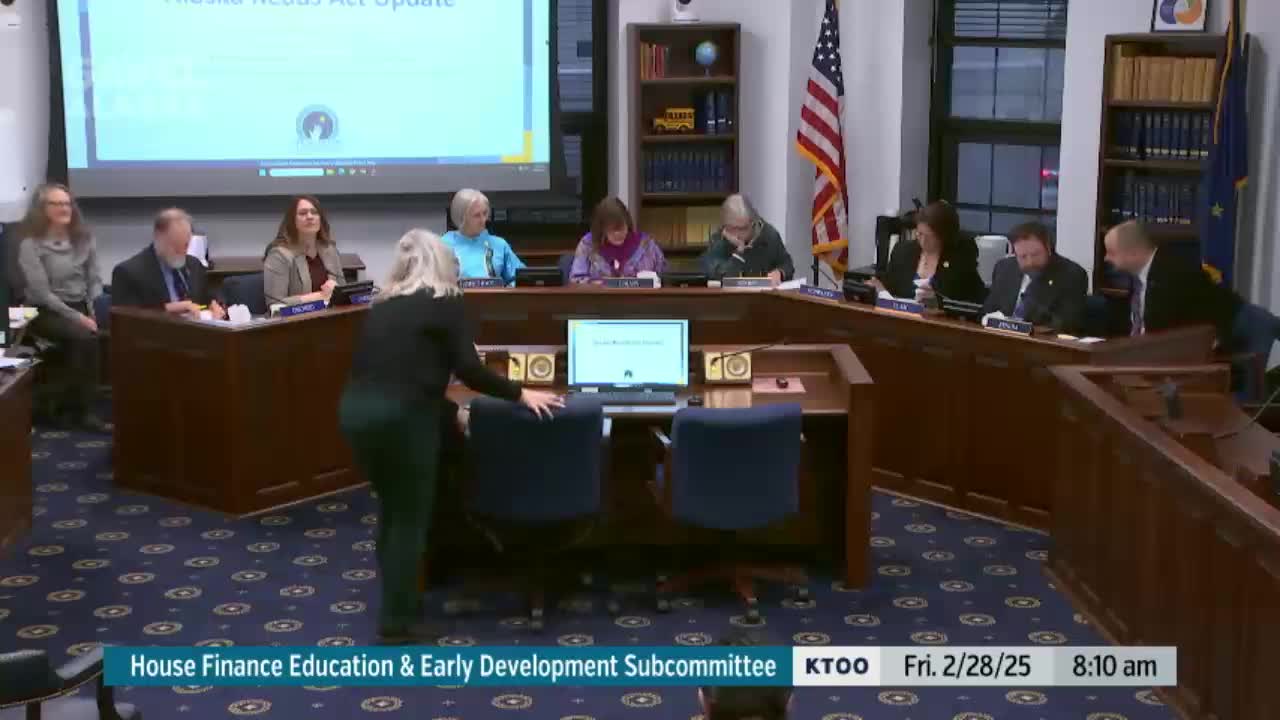
Department of Education and Early Development officials updated the House Finance Education Subcommittee on the Alaska Reads Act, describing screening schedules, individualized reading plans, professional development, federal grants and outstanding data requests from legislators.
Commissioner Dina Bishop of the Alaska Department of Education and Early Development told the House Finance Education Subcommittee on Feb. 20 that the Alaska Reads Act, enacted July 1, 2024, is now being implemented statewide with new screening, individual reading plans and teacher training.
The department described three annual universal screening windows for K–3 students, use of individualized reading improvement plans (iRIPs) for students who fall below benchmarks, and a statewide push to certify K–3 teachers in the “science of reading.” Commissioner Bishop said the law establishes “a multi tiered system of support” and requires monthly progress-monitoring communications with families for students on iRIPs.
The update included details on funding and technical supports. Kathy Moffitt, director of innovation and education excellence, said the federal Comprehensive Literacy State Development (CLSD) grant was awarded in October 2024 “with a total amount of 10,000,000 per year for 5 years.” Bishop and staff told legislators the state previously ran a roughly $5 million-per-year grant series and that districts may tap federal Title I, Title II-A and other sources, local district funds, and new state allocations to cover costs.
Bishop described typical components of iRIPs: targeted, often minute-long curriculum-based measures administered by a classroom teacher three times annually; specific interventions tied to skill gaps (for example, letter-sound fluency or ending-sound work); monthly family communication; and a statutorily required parent conference in third grade if a child remains below proficiency. “Reading should not be considered an unfunded mandate in no way, shape, or form,” Bishop told the panel, describing initial state-paid endorsement coursework in year one and ongoing funding avenues including grant dollars and adjustments in the governor’s omnibus bill.
Officials said the department is providing a mix of synchronous and asynchronous statewide professional development, a virtual learning consortium and curricular adoption grants. Bishop said more than 2,800 registrants had used the virtual consortium for professional development or student resources, and the department has run statewide training, webinars and a science-of-reading symposium.
On accountability, Bishop said the K–3 universal screener is administered three times per year (beginning, middle and end of year). She described statewide results from the first full year of screenings: marked gains in kindergarten and first-grade measures across the year, smaller net movement in some first-through-third grade windows, and that roughly half of third graders were on grade-level at the end of the first full year of accountability. Bishop told the committee that about “1 percent of all third grade parents decided to have their students remain in third grade” to receive the statutory 20 hours of targeted summer instruction; she said 99% of third-graders continued to fourth grade.
Representatives asked for data the department agreed to provide: (a) counts of K–3 teachers who have completed science-of-reading training and estimates of how many students are in classrooms taught by trained teachers; (b) a list of elementary schools that receive Title I funds and the amounts; (c) details on how many districts offered the 20-hour summer support and how those summer programs were funded; and (d) the department’s forthcoming external evaluator report, scheduled for March, that will include teacher-certification counts and other implementation metrics. Director Moffitt said the CLSD grant will be administered through a competitive request-for-application process planned for April and that the department will provide technical assistance for applicants.
Committee members raised implementation burdens for districts and teachers, including time required to prepare iRIPs and conduct monthly communications, the need for reading coaches or redistributed staff time in some districts, and variability between urban and rural districts. Several members expressed concern about class size in early grades; Bishop noted research emphasizing teacher effectiveness and collective teacher efficacy while acknowledging working-condition concerns about large classes. The commissioner said class-size decisions remain local and that the department will supply requested data showing training status and related counts.
The department also flagged language- and context-specific development: Alaska Native language screeners are in development for immersion classrooms, and regional technical assistance is being coordinated with stakeholders, tribal partners and regional education labs. Bishop and Moffitt said the department will follow up quickly on the committee’s “homework” requests and that additional funding opportunities — including state formula adjustments and federal grants — are part of the plan to support districts.
The subcommittee set follow-up expectations: the external evaluator’s March report, details requested by legislators on teacher training and student coverage, grant application timelines and clarifications on how summer programs and software/licensing were paid for. Chair Galvin closed by confirming the next meeting and amendment deadlines related to the committee’s budget work.
Ending: The presentation and discussion concluded without formal committee votes; committee members asked for written follow-ups and data, and the department committed to provide the external evaluator report and district-level training and funding details in writing.