Get Full Government Meeting Transcripts, Videos, & Alerts Forever!
Get email alerts on the Energy Policy topic
No spam. Unsubscribe anytime.
Iceland’s heavy‑industry power strategy offers lessons for Alaska, presenters say
Summary
Presenters from ASAP Alaska Center for Energy and Power told Alaska legislators that Iceland’s long-term power contracts, industrial recruitment and large hydropower investments drove rapid regional development but carried environmental and market risks Alaska should weigh as it plans generation and transmission.
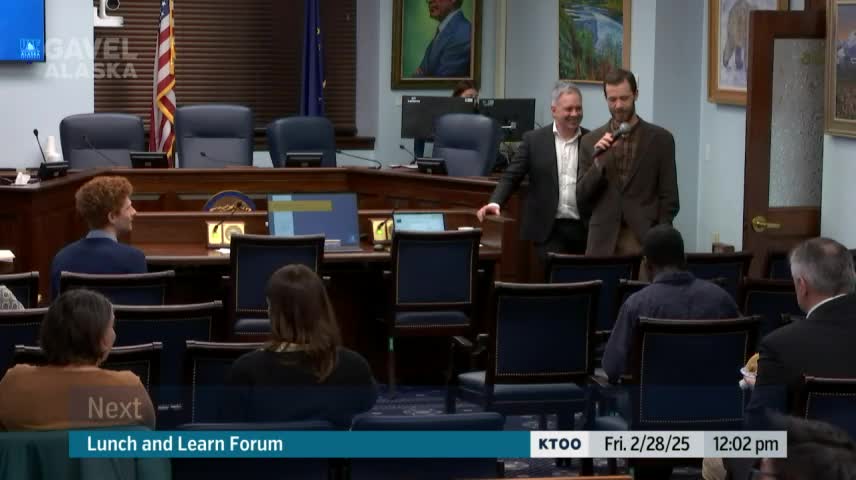
Gwen Holdman, founder and head of ASAP Alaska Center for Energy and Power, and Eli Gurlifson, an ASAP energy researcher, told Alaska legislators at a Juneau briefing that Iceland’s decades‑long strategy of building large generation and long-term power contracts to attract heavy industry provides both economic benefits and cautionary lessons for Alaska.
The presenters said Iceland’s “ring grid” and its policies helped attract aluminum smelters and other energy‑intensive industries by offering large, stable supplies of cheap electricity. Holdman noted that Iceland is “about half the size of Alaska” by population but has substantially higher per‑capita electricity sales because of heavy industry.
The lesson matters, presenters said, because Alaska’s Railbelt grid serves a large share of the state’s population and state policymakers are debating how generation, transmission and contracting should be organized to serve households, industries and future development.
Gurlifson described how Iceland’s major smelter projects were financed and contracted. He said the largest project involved about 690 megawatts of installed hydropower capacity and roughly 5,000 gigawatt‑hours of annual generation. According to Gurlifson, the power purchase agreements (PPAs) underlying those projects were “take‑or‑pay” arrangements that obligated offtakers to pay for a large share of installed capacity (he said up to roughly 85 percent of installed energy) and that many PPAs lasted 40 years with a price revision after 20 years.
Gurlifson said the state power company financed the generation with a mix of equity and long‑term debt and sought funding from international lenders; he described a financing structure that relied heavily on borrowed funds. He recounted that negotiations with potential industrial partners could move rapidly once a counterpart signed a memorandum of understanding, citing a sequence in which Norsk Hydro withdrew and Alcoa stepped in and a contract was signed within months.
Presenters stressed economic outcomes that followed the investments: job creation in host regions, population growth in impact areas and extensive ancillary infrastructure such as roads, harbors and housing. Gurlifson said the smelter project “created opportunities somewhere else than in the capital area,” reducing migration pressure on Reykjavik.
At the same time, presenters noted environmental and market risks. Gurlifson described local opposition during project development and said some landscape features were irreversibly altered: “they just blew it apart,” he said of a canyon that was removed during reservoir construction. He also described silting and bank erosion on reservoirs and changes to local wildlife habitat. Holdman and Gurlifson said such environmental tradeoffs were part of the political debate in Iceland as projects advanced.
Market risk was also discussed. Gurlifson explained that many Icelandic PPAs had components linked to the London Metal Exchange (LME) and that such linkages exposed electricity revenues to metal‑price swings. He said Landsvirkjun, Iceland’s state power company, has been “phasing out” LME links in newer contracts and that the company is pursuing shorter PPAs to reduce long‑term exposure.
Speakers answered questions from the audience about alternatives and other industries. Gurlifson said Iceland has diversified some demand beyond aluminum, citing data centers and alloy producers as additional off‑takers, and that Icelandic planners have considered—but not pursued at scale—projects such as plastic recycling to fuels. He also described remaining technical constraints: transmission limits that make it costly to move power from remote generation to large Southwest demand centers and seasonal reservoir variability that has required curtailment at times.
On potential non‑hydro resources, the presenters noted substantial geothermal resources and interest in advanced geothermal drilling projects. Gurlifson said theoretical hydro potential in Iceland could be many times current production but cautioned that developing more sites raises harder permitting, environmental and transmission challenges.
Holdman told legislators ASAP has produced analysis on these topics: “We wrote a white paper on that. We’d be happy to share that,” she said, indicating ASAP will make more material available on its website.
The presenters did not propose specific legislation during the briefing; instead they framed Iceland’s experience as a case study for Alaska to consider when weighing long‑term contracts, financing options, transmission upgrades and environmental tradeoffs.
For further information, the presenters referenced a white paper available from ASAP Alaska Center for Energy and Power and cited prior exchanges between Icelandic officials and Alaska legislators, including a recent policy tour mentioned in the briefing.