Get Full Government Meeting Transcripts, Videos, & Alerts Forever!
Get email alerts on the Artificial Intelligence Policy topic
No spam. Unsubscribe anytime.
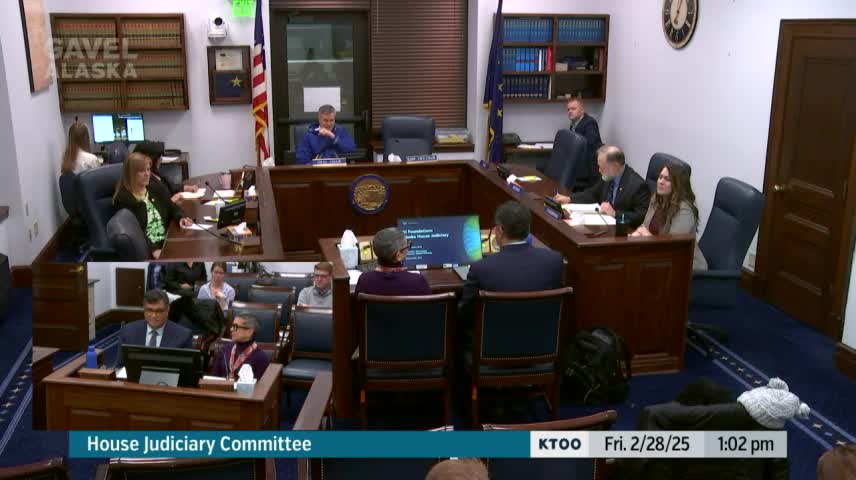
Alaska House Judiciary Committee hears briefing on artificial intelligence benefits, risks and possible rules
Summary
The Alaska House Judiciary Committee on Feb. 28, 2025, heard a two‑hour briefing on artificial intelligence from a Cisco data scientist and TechNet’s Northwest director, who described AI’s strengths, known failure modes and options for narrowly targeted state rules.
Juneau — The Alaska House Judiciary Committee on Feb. 28, 2025, heard a two‑hour briefing on artificial intelligence from Dr. Gaurav Khanna, a senior data‑science manager at Cisco and AI instructor at Stanford University, and Rose Feliciano, executive director of TechNet for the Northwest. Chair Rep. Gray opened the meeting at 1:01 p.m. in the Gruenberg Room, Capitol (Room 120), and the presenters discussed how AI is already used across government and industry, known failure modes and where states might step in to regulate.
Dr. Gaurav Khanna told the panel that the core strength of current AI systems is detecting patterns and anomalies in very large data sets. “What they’re really fundamentally good at is finding patterns,” he said, adding that pattern recognition enables machines to spot deviations humans can miss. Khanna also warned that generative models can confidently produce incorrect outputs and be “tricked” by certain prompts — he demonstrated how small changes in phrasing can change a model’s answer and showed examples where tuned models bypassed built‑in safety filters.
The scope of the technology, Khanna said, is large and fast moving: he cited widely reported estimates that AI could add trillions of dollars to the global economy and noted an International Monetary Fund estimate that roughly 40% of jobs worldwide could be exposed to AI effects. He urged lawmakers to focus on practical tradeoffs as they consider policy, saying states can serve as “laboratories” to test beneficial uses such as traffic management, chatbots for constituent services and tools that improve medical or public‑safety work.
Rose Feliciano described TechNet’s guidance for state legislators and urged narrowly tailored regulation. “Policymakers should avoid blanket prohibitions on artificial intelligence, machine learning, or other forms of automated decision making,” she said, recommending that restrictions be reserved for specific, demonstrable high‑risk use cases that create “unacceptable harm” or national‑security threats. Feliciano suggested leaning on existing state and federal authorities (including civil‑rights and consumer‑protection laws) and on national or international technical standards to avoid a costly patchwork of inconsistent state rules.
Both presenters and committee members discussed areas that commonly draw legislative attention: disclosure requirements for AI‑generated political advertising and media (including proposals for watermarking or content provenance), rules for algorithmic decision tools that affect life, liberty or significant legal rights, and industry cooperation on illicit content. Feliciano said TechNet tracks state activity and noted that her organization followed 476 AI bills nationwide last year and that Colorado’s Artificial Intelligence Act is undergoing implementation work after enactment.
Committee members pressed on specific policy mechanics. Representatives asked how to distinguish alignment (making a model match an organization’s tone or brand) from safety (preventing toxic outputs), whether it is technically feasible to quantify the degree of AI used in an ad for disclosure purposes, how non‑HIPAA health‑related data should be treated, and how guardrails can be required or supplemented. Feliciano advised starting from a data‑privacy law and cataloging what data an agency considers confidential, public or permitted to share; she said some states already require reporting of suspected child sexual‑abuse material to the National Center for Missing and Exploited Children and that platforms and companies typically work with law enforcement on such material.
The presenters also addressed infrastructure and operational concerns. Committee members asked about energy and water use for data centers; Feliciano said state and regional electric planning entities should coordinate with potential users of large data centers and that some companies invest in renewables or hydrogen backup to reduce environmental impacts. Khanna and other witnesses noted that smaller, task‑specific AI models can perform needed functions with far lower energy costs than the largest general models.
No formal committee votes were taken; the hearing was informational. Chair Gray closed the session with administrative reminders of amendment deadlines for House Bill 74 (same day, 5 p.m.) and House Bill 101 (Monday, March 3, 5 p.m.) and adjourned the committee at 2:17 p.m.
Context: The session focused on policy choices facing states as AI spreads into government services and private platforms. Presenters urged lawmakers to balance opportunity and risk by targeting rules at demonstrable harms, relying on existing legal protections where adequate, and building standards for safety, transparency and technical feasibility.