Get Full Government Meeting Transcripts, Videos, & Alerts Forever!
Get email alerts on the Organized Theft topic
No spam. Unsubscribe anytime.
Alaska Senate Judiciary hears SB100 to create new organized-theft felony and expand penalties for stolen medical records, mail
Summary
At a Feb. 28 Senate Judiciary Committee hearing in Juneau, the Department of Law presented Senate Bill 100, a governor-request bill that would create a new class A "organized theft" offense, add heightened protection for stolen medical records, and create a misdemeanor mail-theft offense; the committee held the measure for further review.
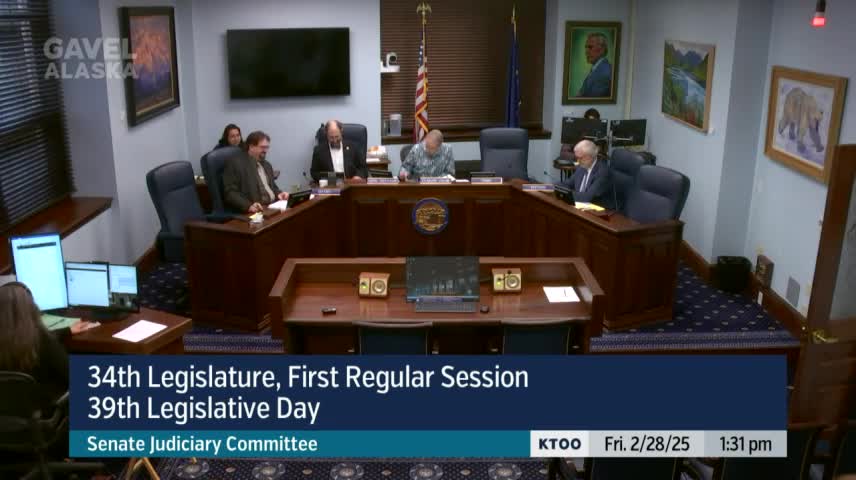
Juneau — The Alaska Senate Judiciary Committee on Feb. 28 heard testimony on Senate Bill 100, a governor-request measure that would create a new organized-theft offense, raise penalties for theft of medical records, and add a state-level mail-theft offense. The bill was presented by John Skidmore, deputy attorney general for the Alaska Department of Law, and was held for further review by the committee at the end of the hearing.
Skidmore told the committee the bill targets coordinated, recurring thefts in which multiple people steal merchandise to fence or sell for profit. "Organized theft is a pattern of behavior," Skidmore said, describing the proposed offense as one that requires multiple felony-level thefts and the involvement of several people. Under the draft legislation the committee reviewed, the organized-theft provision would apply where there are two or more separate felony incidents and would require at least three people to be involved for the higher-level organized-theft offense.
The bill would classify organized theft as a class A felony, above Alaska's existing theft-in-the-first-degree threshold (greater than $25,000, currently a class B felony), Skidmore said. He told senators the state has an existing aggregation statute in Alaska Statute 11 46 9 80, subsection e, that aggregates thefts between $750 and $25,000 within a six-month period; SB100 instead seeks to capture repeated, coordinated conduct as a distinct offense.
Skidmore framed the measure as addressing both economic harm to retailers and public-safety risks for loss-prevention staff. He cited national and state figures during his presentation: a nationwide estimate of $121,000,000,000 in organized-retail-theft-related proceeds in 2023 and a projected $145,000,000,000 for 2025; and, for Alaska, combined retailer losses and fraudulent returns Skidmore summarized as about $422,000,000 per year. He also said surveys show 85% of small businesses have been affected by organized retail theft and that 65% of those report average losses of about $1,000 per month; he added that about 76% of loss-prevention staff reported being injured in the last year while trying to stop thefts, a trend he said has increased.
The committee questioned how the organized-theft formulation would operate in practice. Senators asked whether the same three people must appear together in multiple incidents or whether overlapping groups could trigger the offense. Skidmore said prosecution would depend on the evidence: an individual who appears in multiple qualifying incidents could be charged even if all members of the larger network did not participate in every incident, and investigators would look for links such as fencing activity or coordination.
Several senators raised sentencing and fiscal concerns. Members asked whether existing aggravators and sentencing tools could address group-based theft without creating a new offense. Skidmore said there are aggravators in current law that reference leadership roles or larger groups, but cautioned that an aggravator cannot be used to "double count" the same factual conduct that forms the elements of an offense. He also said the Department of Law filed a fiscal note of $0 for prosecutorial costs, explaining that the investigative work and prosecution steps do not change simply because the statutory classification changes; he said correctional costs would be the primary fiscal consideration if sentences increased.
SB100 also includes a section aimed at theft of medical records. Skidmore told the committee the change is intended to recognize the sensitivity of medical records and the harms that can follow theft of those records. "The theft of medical records should be classified at a higher level because of the sensitive nature of information within it," he said, citing concerns about identity theft and privacy. Senators asked about definitions: the bill text does not define "medical records" or "medical information," and Skidmore said the department would rely on commonly understood meanings unless the committee voted to add statutory definitions to narrow or clarify the scope.
On mail theft, Skidmore said the Anchorage Police Department raised concerns about recurring mail thefts and argued for a state-level misdemeanor offense to cover repeated or organized patterns that the U.S. Attorney's Office does not routinely prosecute. "If the U.S. attorney's office decided they wanted to get involved, the good news is that we coordinate with that office," Skidmore said, but added that federal prosecutors typically reserve resources for cases that meet their thresholds. The committee discussed investigatory challenges in cases with limited surveillance and the types of evidence that might support a state prosecution.
No formal vote was taken on SB100. At adjournment, Senator Klayman, chair of the Senate Judiciary Committee, announced, "At this time, we will hold this bill for further review," and the committee recessed until its next scheduled meeting. Committee members asked the Department of Law to follow up with additional information, including comparisons to other states' approaches, federal thresholds for mail or related prosecutions, and a review of existing aggravators and sentencing options that might address group-based theft behavior.
The committee hearing began at 1:30 p.m. and concluded at 2:30 p.m. The committee's next meeting is scheduled for Monday, March 3, at 1:30 p.m.