Get Full Government Meeting Transcripts, Videos, & Alerts Forever!
Get email alerts on the Agdc Backstop topic
No spam. Unsubscribe anytime.
AIDEA describes conditional $50 million backstop for AGDC feed work; lawmakers raise legal concerns
Summary
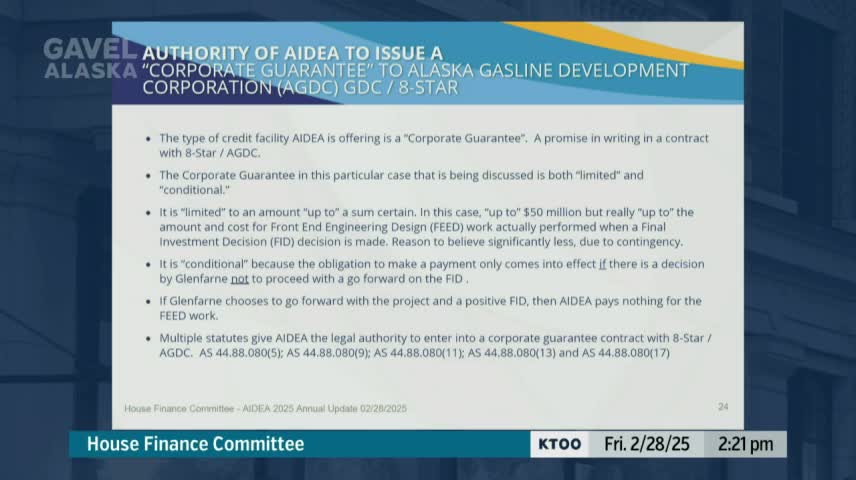
The Alaska Industrial Development and Export Authority told the House Finance Committee on Feb. 28 it has negotiated a conditional corporate guarantee related to AGDC pipeline feed work, limited to actual feed costs and invoked only if a final investment decision is not taken.
The Alaska Industrial Development and Export Authority told the House Finance Committee on Feb. 28 that it has negotiated a conditional corporate guarantee — described by witnesses as a backstop — related to the Alaska Gasline Development Corporation’s (AGDC) pipeline work. AIDEA said the backstop would be limited to actual feed-work costs and would be invoked only if the project’s final investment decision (FID) is not taken.
“It's a contract,” Executive Director Randy Ruraro said of the guarantee. “The guarantee in this case is somewhat unique in that it's both limited in amount and conditional on the occurrence of whether FID is taken or not. So it is limited in an amount up to… up to 50,000,000, but really up to the actual amount and cost for feed work actually performed.” He added that AIDEA would not pay more than actual costs and that if FID is taken, “not even a penny that would leave AIDEA’s accounts and reserve funds.”
Committee members asked how feed work would be handled if a private sponsor chose not to proceed. Ruraro said feed work is paid by 8star/Glenfarn/AGDC while work proceeds and that contractual terms would allow AIDEA to retain the feed-product if the sponsor walked away. “As feed work is being performed, it's paid for through the funds of 8 star and Glenfarn and AGDC. So no dollars leave 8's accounts, until and unless, FID is not taken,” Ruraro said. “If Bridal is not taken, there are… contract terms that we put in place to where we would retain the feed work product.”
The backstop and AIDEA’s broader authority prompted legal questions from committee leadership. Co-chair Josephson said he had received a legal opinion arguing that certain cases (he cited De Armond and Laverty) support the legislature’s continued appropriation power and that unobligated AIDEA receipts remained subject to legislative control. “I have a legal opinion that suggests that De Armond is… there are other decisions, for example, Laverty… that says public corporations ‘must meet constitutional mandates,’” Josephson said, adding that he believed unobligated dollars remain within legislative prerogative.
Ruraro responded that AIDEA believes the statutes and case law support segregating AIDEA receipts from the state treasury in many respects, but he acknowledged there is room for difference of opinion. “We don't disagree that the legislature… is a creature of the legislature, and subject to some legislative control. But we feel like, in this case, prior legislatures have set up a system to segregate from state funds,” he said.
The committee also heard that AIDEA seeks to retain feed work product and would structure guarantees so exposure is limited to actual costs and conditional on FID. Lawmakers asked for follow-up on contract terms and the precise limits of the guarantee; AIDEA staff said those negotiations are ongoing and that final numbers are not yet set.
Ending: The committee recorded the discussion for legislative oversight; lawmakers asked AIDEA to provide contract-level clarifications and documentation about the backstop and any potential exposures.