Get Full Government Meeting Transcripts, Videos, & Alerts Forever!
Get email alerts on the Aidea Finance topic
No spam. Unsubscribe anytime.
AIDEA reports $1.49 billion net position, board declares $20 million dividend for 2026
Summary
Alaska Industrial Development and Export Authority told the House Finance Committee it has $1.49 billion in net assets, but much of that is loan receivables and committed to projects; the board approved a $20 million dividend for fiscal 2026 (about 32% of statutory net income).
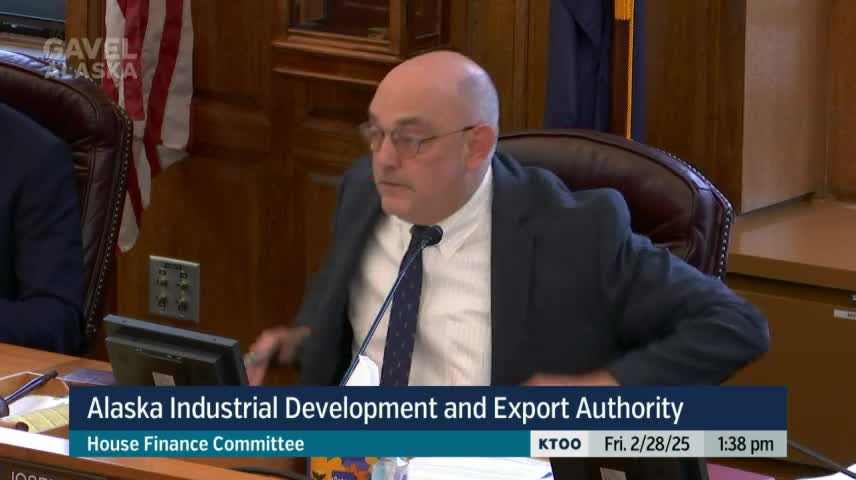
The Alaska Industrial Development and Export Authority told the House Finance Committee on Feb. 28 that it has a $1.49 billion net position and that its board approved a $20 million dividend for 2026, a level the authority said amounts to roughly 32 percent of statutory net income.
Executive Director Randy Ruraro summarized AIDEA’s balance sheet and recent activity for the committee. “ADA has a roughly 1,490,000,000.00 net position,” Ruraro said, adding that “almost half of that net position is accounts receivables or loan receivables. It’s not cash.” He told lawmakers that the authority’s cash balances are lower than in recent years because the board committed roughly $200 million to several projects in 2024 and that some assets are invested on a six-year time horizon.
The nut of the presentation for legislators was the dividend and the agency’s near-term cash commitments. Ruraro said the board declared a $20,000,000 dividend for the next fiscal year. “This year’s dividend, mister chair, is, approved at 20,000,000,” he said. Committee members pressed for context on how the board decided the level: the executive director said the board is statutorily limited to declaring between 25 and 50 percent of statutory net income and that this year’s payout equated to “roughly 32%.”
Lawmakers sought more detail on AIDEA’s available cash and pipeline. Ruraro presented a pie-chart breakdown showing many assets are capital assets or loan participations rather than cash-on-hand. “The left hand side of the pie chart… roughly half our assets are definitely not cash,” he said. He described an investment portfolio of about $357 million and an enterprise fund of roughly $345 million, but said pending commitments reduce readily available cash.
Committee members also pressed AIDEA on which projects drove recent spending. Ruraro named several large commitments: the Alieschem (methanol) North Slope project, a $50 million revolving facility for Hex Energy/Hex Cook Inlet activity, and a number of resource-development projects. He said the board committed funds to projects including Red Dog and other energy and hospitality projects and that activity this past year was “about a roughly 8 times average output of funds from AIDEA onto the street to get things moving.”
Representative Galvin asked whether the board factored the state’s fiscal gap into dividend decisions. Ruraro said board members consider near-term demand for AIDEA funds — including large road and energy projects that could require “hundreds of millions of dollars” — when setting dividend levels. Representative Hannon asked whether the observed pattern of dividend fluctuation by odd and even years was structural; Ruraro said an out-year charge (the Mustang project write-off) was responsible for a lower number in one year rather than an intentional alternating pattern.
The presentation also covered AIDEA’s loan participation program, revolving lines of credit and conduit revenue bonds used to finance hospitals and other facilities. Ruraro told the committee that loan participation makes up a substantial portion of the authority’s assets and that the agency runs programs administered by the Department of Commerce that target small businesses and rural loan recipients.
Ending: AIDEA staff told legislators they can provide further project-level revenue and job estimates by request. Ruraro said staff are assembling expected revenue and job counts for larger projects and that the authority intends to provide more detail to the committee on anticipated returns and timelines.