Get Full Government Meeting Transcripts, Videos, & Alerts Forever!
Get email alerts on the Wolf Depredation Compensation topic
No spam. Unsubscribe anytime.
Senate committee hears hours of testimony on SB 777 compensation changes, SB 985 $2M funding request for wolf conflicts
Summary
The Senate Natural Resources and Wildfire Committee held a joint public hearing Feb. 27 on Senate Bill 777, which would change how Oregon compensates ranchers for wolf depredation by limiting payments to confirmed and probable losses or injuries, applying specified multipliers to fair market value and capping compensation at $25,000 per animal, and on Senate Bill 985, an accompanying $2,000,000 general-fund appropriation to the Wolf Management Compensation and Proactive Trust Fund. The committee took testimony but did not record a committee vote during the hearing.
The Senate Natural Resources and Wildfire Committee held a joint public hearing Feb. 27 on Senate Bill 777, which would change how Oregon compensates ranchers for wolf depredation by limiting payments to confirmed and probable losses or injuries, applying specified multipliers to fair market value and capping compensation at $25,000 per animal, and on Senate Bill 985, an accompanying $2,000,000 general-fund appropriation to the Wolf Management Compensation and Proactive Trust Fund. The committee took testimony but did not record a committee vote during the hearing.
Why it matters: the bills would alter who qualifies for payments, how much is paid for direct and indirect losses, and how much grant funding is available for nonlethal measures counties can use to work with producers. Supporters said current compensation does not cover the cascading costs ranchers face; opponents said the bill reduces local committee discretion and diverts money away from prevention and agency capacity.
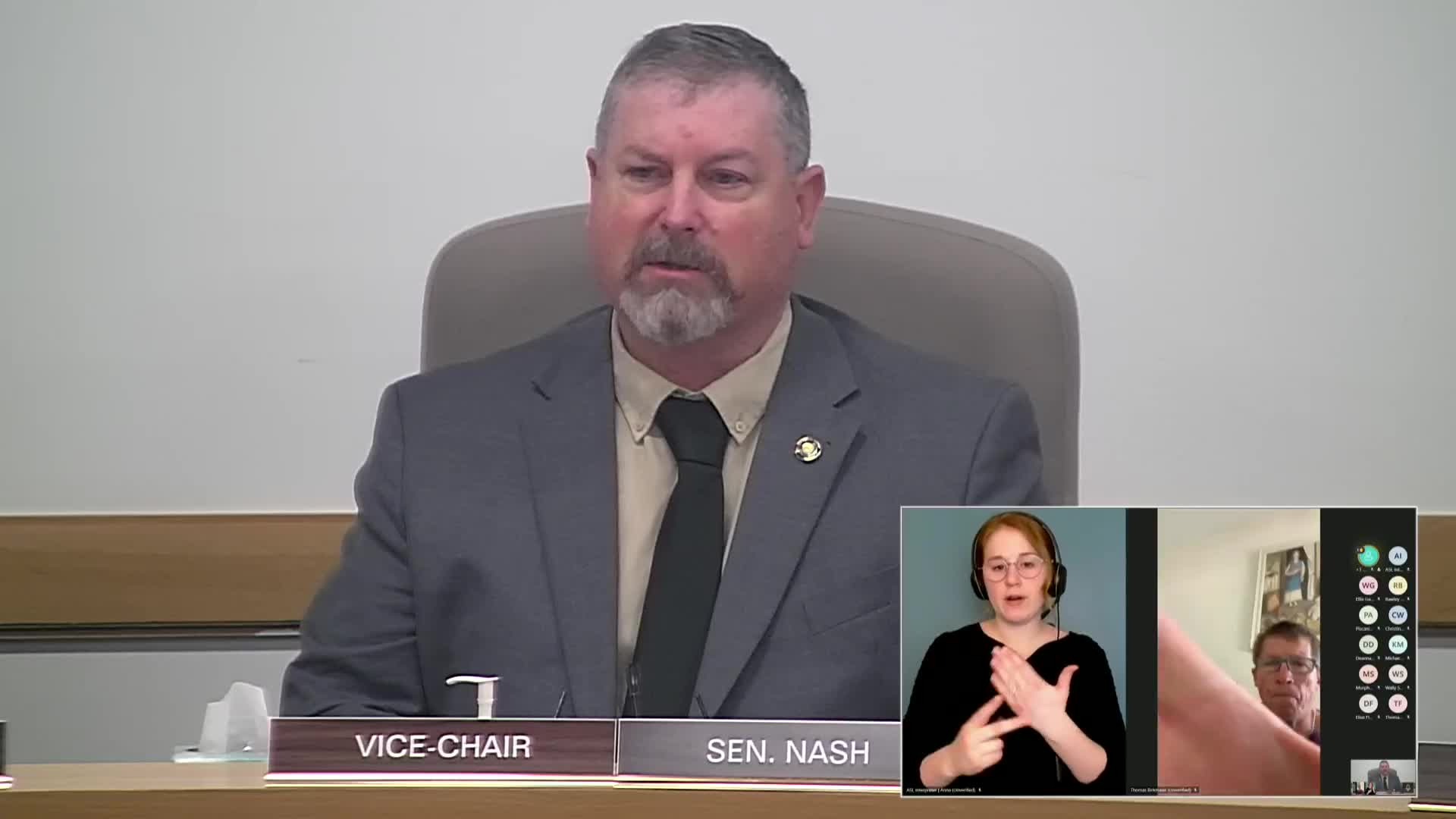
Vice Chair Todd Nash, sponsor and senator for District 29, framed the bills as a pair: SB 777 defines the compensation structure and SB 985 requests funding for it. "We're not trying to capture those other dollars. If we were going to do that, it would be exponentially more than what we're asking for," Nash said, describing the proposal as targeted at direct and some indirect losses so ranchers will remain in the program and invest in nonlethal deterrence.
Ranchers described financial and nonfinancial harms. Sky Krebs, a Gilliam and Wallowa County sheep and cattle producer, recounted an October attack that killed eight sheep and wounded two: "They were wounded so bad that I had to put them down on the spot." Several ranchers and county commissioners said one confirmed kill can produce ongoing herd stress, reduced conception rates and lower weaning weights that compound losses over multiple years.
Proponents urged a multiplier to reflect indirect costs. Many testifiers said a 7:1 multiplier — included in the bill as a means to account for broader losses — would better match impacts than the current ad hoc payments. Avery Schaller of Western Landowners Alliance and Ellie Gage, WLA Oregon resource coordinator, pointed to other Western states where multipliers coincide with producer uptake of nonlethal tools and greater acceptance of coexistence programs.
Conservation and wildlife organizations opposed the bills as written or urged more work on fixes before changing the compensation framework. Bethany Cotton, conservation director for Cascadia Wildlands, urged investment "in prevention, not band aids," arguing that program funding should bolster ODFW staffing, carcass management and anti-poaching efforts rather than primarily expand compensation payments. Colin Reynolds of Defenders of Wildlife and Michael Dotson of Klamath-Siskiyou Wildlands likewise urged renewed stakeholder talks.
An ODFW deputy administrator, Brian Wolfer, summarized the agency's role: "The Oregon Department of Fish and Wildlife is responsible for managing wolves in Oregon" and staff investigate depredations, categorize events (confirmed, probable, unknown, not a wolf) and work with producers on nonlethal deterrents. Wolfer confirmed that ODFW and, at times, U.S. Department of Agriculture Wildlife Services staff perform depredation confirmations.
Local committees and county officials emphasized county-level review. Wally Sykes, a long-time compensation committee member, warned that automatic multipliers would override local committees' ability to adjudicate claims based on local knowledge, citing a recent Wallowa County vote that reduced two missing-stock claims by 64% (about $183,850) and disallowed a $25,000 nonlethal expense claim. Baker County Commissioner Christina Witham described a county-run carcass compost program and supported limiting compensation to probable and confirmed losses while increasing the nonlethal grant share from the statute's 30% minimum toward the proposed 50% in the amendment.
No formal committee vote or referral was recorded in the hearing transcript. Representative Greg Smith (House District 57) asked committee members to move the bills to Ways and Means so funding could be considered; committee leadership closed the public hearing after testimony.
The hearing brought contrasting recommendations: some asked the Legislature to approve SB 777 and fund SB 985 immediately to support affected ranchers; others asked for funding and staffing to be directed toward prevention, standardized statewide criteria, training, and stronger agency capacity.
What’s next: the committee closed the hearing and did not take a floor vote at the Feb. 27 session. Sponsors and some county officials asked for rapid movement to budget deliberations; conservation groups urged additional stakeholder negotiations before statutory changes are enacted.