Get Full Government Meeting Transcripts, Videos, & Alerts Forever!
Get email alerts on the Revenue topic
No spam. Unsubscribe anytime.
Revenue committee hears risks if federal Tax Cuts and Jobs Act sunsets; opens hearing on HB 2,092 reconnect bill
Summary
The Oregon House Committee on Revenue received an informational briefing Feb. 27 on how the federal Tax Cuts and Jobs Act (TCJA) sunsetting could affect the state forecast and opened a public hearing on House Bill 2,092, the annual “reconnect” bill and a proposed amendment to fix Oregon’s connection to federal taxable income as of Dec. 31, 2024.
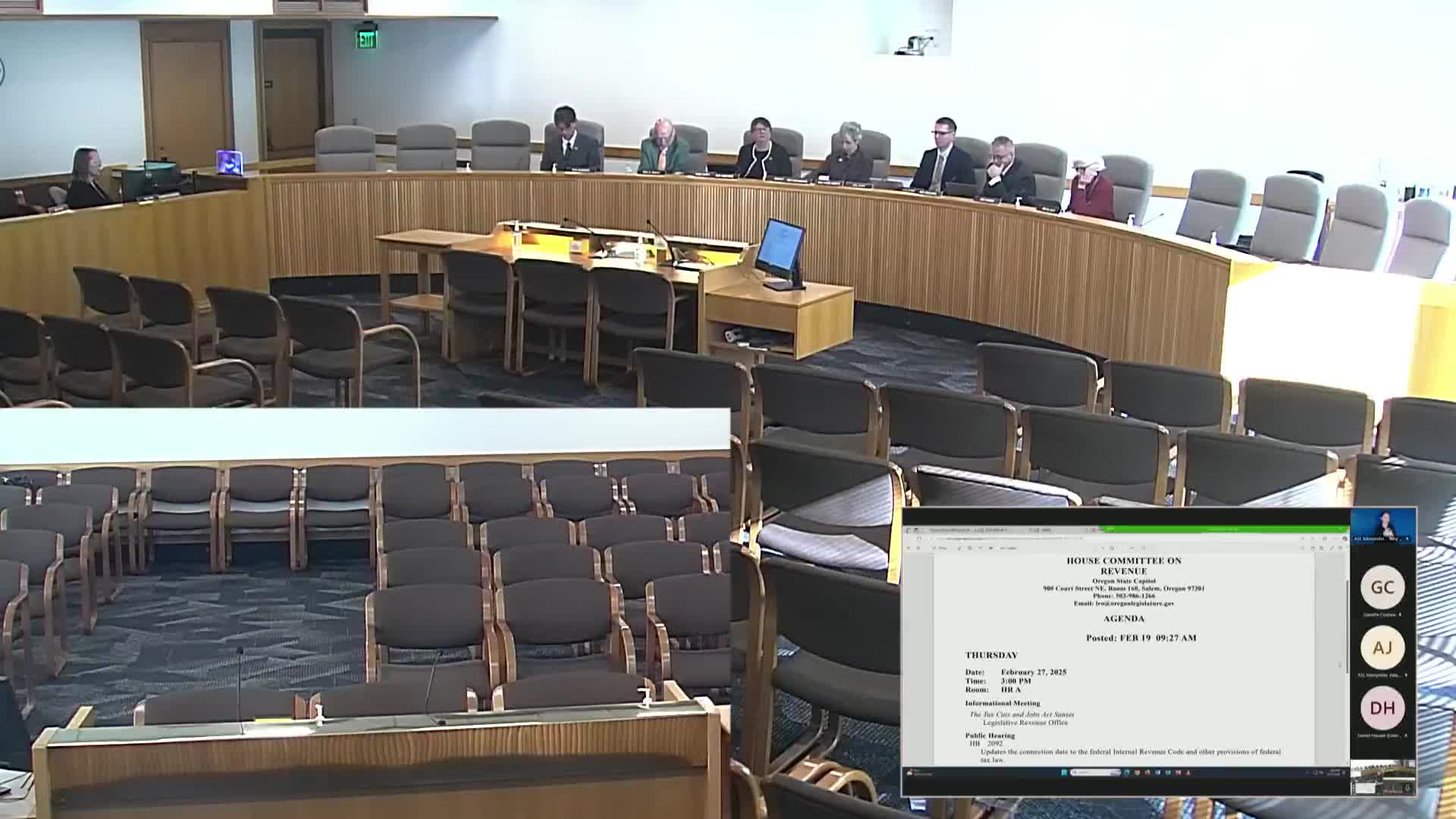
PORTLAND, Ore. — The House Committee on Revenue on Feb. 27 heard an informational report on the potential state revenue impact if the federal Tax Cuts and Jobs Act (TCJA) is not extended and opened a public hearing on House Bill 2,092, the annual bill that updates Oregon’s connection to federal tax law.
Legislative Revenue Office staff said the office’s current forecast assumes the TCJA will continue; if the law were to sunset, the forecasted revenue for 2026 could decline by about $200 million, rising to roughly $280 million in later years, according to the briefing presented to Chair Nathanson and the committee. Staff emphasized a distinction between direct impacts (changes to deductions that would flow directly into Oregon taxable income) and indirect impacts (changes that alter the federal subtraction and therefore reduce Oregon tax collections).
The briefing was framed as a narrow first step to make the federal landscape tractable for state planning. Committee staff said federal tax policy change is broad and uncertain, and focusing on the TCJA’s scheduled sunset provides a clear binary to discuss possible state responses. The report also noted that the Office of Economic Analysis (OEA) and LRO commonly use a ‘‘current law’’ forecasting approach and that the TCJA assumptions were carried into the most recent forecast.
Committee staff described two broad policy tools used in Oregon: a rolling reconnect, which automatically updates Oregon law to follow the federal definition of taxable income, and a point-in-time (static) connection, which fixes Oregon’s reference to the federal code as it stood on a specific date. The dash‑1 amendment to HB 2,092 would replace a rolling reconnect for the definition of taxable income with a fixed connection to the Internal Revenue Code as of Dec. 31, 2024.
During public testimony, labor and education groups urged caution and supported a static connection. Louis DeSitter, representing the Oregon Education Association, testified that the central concern is “uncertainty” and said a static connection “allows us to alleviate a little bit of that uncertainty.” Courtney Graham, political director at SEIU Local 503, said the dash‑1 would help “protect services” and give the state more control to make budget choices rather than having federal changes automatically flow into Oregon law.
Business and tax‑practice interests urged preserving the rolling reconnect. Derek Sangston, policy director for Oregon Business and Industry, asked the committee to “preserve Oregon’s rolling or automatic connection to the Internal Revenue Code,” saying the automatic connection reduces taxpayer and administrative burdens and supports compliance. Members of the Oregon Society of CPAs cautioned that a static date can create administrative and filing challenges, for example if the federal government enacts retroactive changes after Oregon has fixed its connection; they said that could require mass extended filings, more notices, and a higher error rate for returns.
The Oregon Center for Public Policy supported a static connection, arguing 18 states use some form of static conformity and that a point‑in‑time approach would allow Oregon to assess fiscal and equity impacts before adopting federal tax changes.
Chair Nathanson closed the public testimony and said Legislative Revenue Office, Legislative Council and the Department of Revenue would review the dash‑1 amendment carefully for fiscal and administrative consequences. No committee vote occurred during the hearing; the chair said members could consider further amendments or a targeted approach later as more information becomes available.
The committee adjourned after the informational briefing and the public hearing on HB 2,092. The chair said the committee would weigh additional analysis and advice from LRO, Legislative Counsel and the Department of Revenue before further action.