Get Full Government Meeting Transcripts, Videos, & Alerts Forever!
Get email alerts on the Veterans Budget Odva topic
No spam. Unsubscribe anytime.
ODVA presents 22 budget requests to expand veteran housing, behavioral health, technology and services
Summary
The Oregon Department of Veterans Affairs asked the Transportation and Economic Development Subcommittee to fund 22 policy option packages in the 2025-27 budget, focusing on veteran housing, emergency aid, behavioral health, technology modernization and operations.
PORTLAND, Ore. — The Oregon Department of Veterans Affairs on Thursday asked the Transportation and Economic Development Subcommittee for funding in the 2025-27 budget to expand housing, behavioral health, tribal services, technology and operations for veterans statewide.
Director Dr. Nikia Council Daniels presented the governor's recommended budget and a set of 22 policy option packages (POPs), describing requests that include $35.35 million in bond proceeds to advance construction of a third Oregon Veterans Home in Roseburg, funding for emergency financial grants, positions for grants and IT, and money to modernize loan origination and servicing systems.
The budget matters because the agency aims to address homelessness, housing instability, long-term care needs and gaps in behavioral health and outreach to underserved veteran groups. Daniels told the committee the packages are intended to make services more accessible, improve customer service and strengthen the agency's ability to manage federal grants and technology transitions.
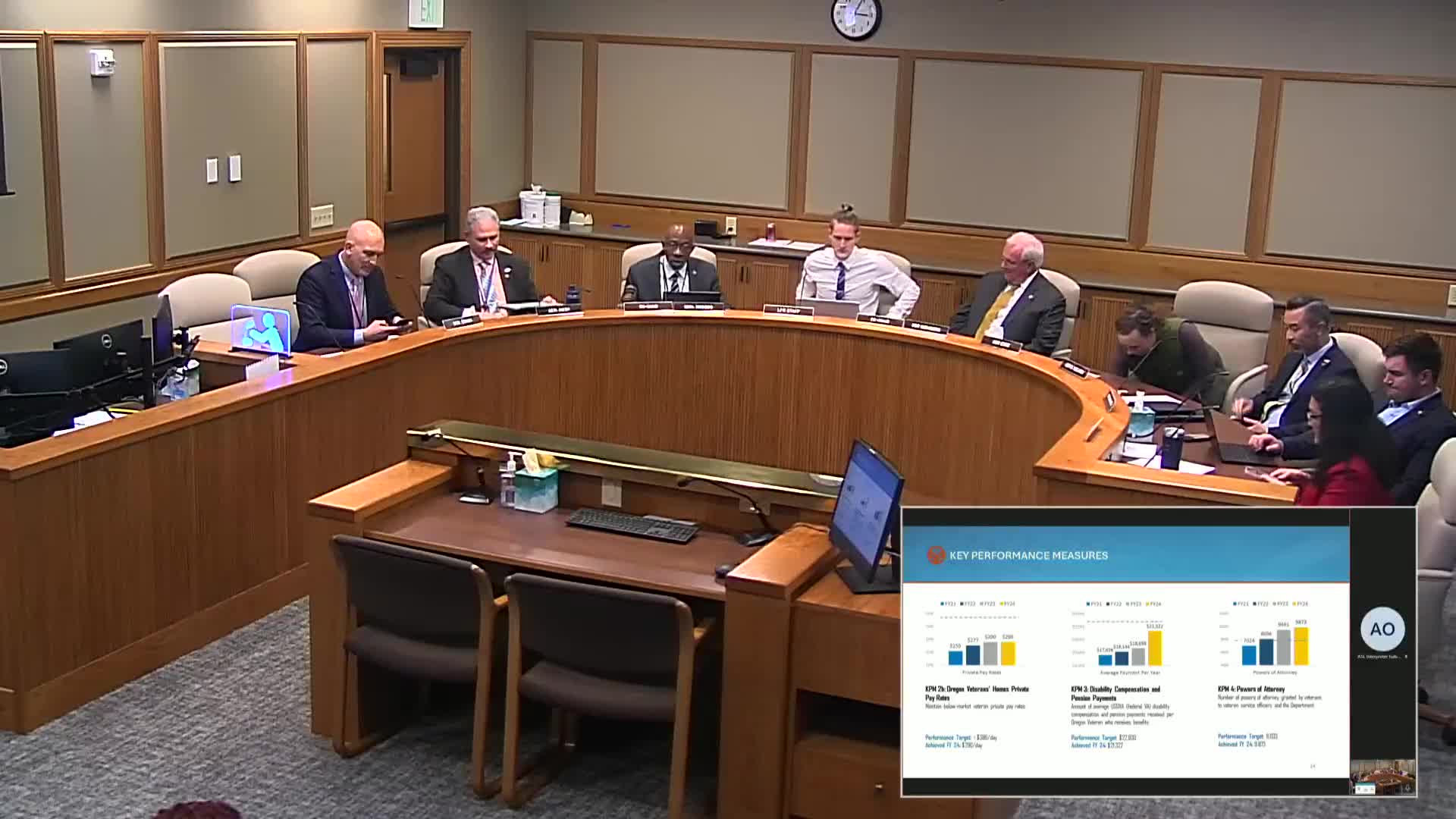
Daniels and Nicole Dolan, ODVA chief financial officer, walked lawmakers through key performance measures (KPMs) and a range of POPs. On KPMs, Daniels said ODVA tracks private pay rates at Oregon Veterans Homes to keep them below private-market long-term care costs; the homes currently bill a private-pay rate of $290 per day compared with a stated performance target of $386 per day. She also noted Oregon veterans' average federal benefit payments in 2024 were $21,332.322, below a 2024 performance target of $22,830.
On a recurring committee concern, Daniels clarified the paperwork often described as a "power of attorney." "The VA Form 21-22 is commonly referred to as a power of attorney, but it's legally an appointment of representation only," Daniels said, adding the appointment is limited to giving a veteran service officer (VSO) authority to assist with VA claims and does not cause a claimant to "forfeit any right whatsoever." Several committee members urged ODVA to change the KPM label to reduce confusion; Daniels said she would carry that suggestion back to agency staff and bring revised KPM language in future testimony.
Lawmakers pressed for additional detail and context for several measures. Committee members asked for raw counts in addition to percentages for homelessness transitions (KPM 7) and for data showing the number and success rates of claims worked by county VSOs versus private providers. Daniels said each of Oregon's 36 counties has a VSO office and offered to return with additional claims and outcomes data.
Major POP highlights presented to the committee included: - POP 125 (bond request): $35,350,000 in other funds from an 11Q bond sale to support construction of a third Oregon Veterans Home in Roseburg and sustain the state's 35% match while awaiting a federal State Veterans Home Construction Grant that would supply the remaining 65% of construction funding. - POP 115: $1,000,000 in lottery funds to expand the Veterans Emergency Financial Assistance Program, which provides one-time grants for rent, mortgage, utilities, vehicle repairs and other immediate needs; ODVA reported more than 500 applications requesting nearly $2,000,000 in 2023-25. - POP 502: $400,000 general fund to establish grants supporting veterans transitioning out of Oregon Department of Corrections facilities, plus POP 501: $221,000 to fund a grants and training coordinator position to administer those grants and expand the incarcerated veterans assistance program. - POPs funding behavioral health and prevention: positions to coordinate veteran behavioral healthcare, expand suicide prevention postvention work in partnership with the Oregon Health Authority, and capture federal grant opportunities. - POPs for transportation and rural access: continuation and expansion of the Rural Veteran Health Care Transportation Grant (RVHTG) with a total request of roughly $400,000 in lottery funds and funding for an ODOT position to administer the program under an interagency agreement. - Technology and operations: requests to modernize the home loan origination and servicing system (POP 100) with $1,000,000 in other funds for ongoing maintenance, funding for system staffing (POP 105), and roughly $10 million in other funds (POP 126) for capital and deferred maintenance at ODVA facilities and veteran homes. ODVA described a need to replace or maintain legacy applications (AS/400) and to evaluate MetroSpec, the statewide claims system. - Tribal and campus grants: continuation and expansion of tribal veteran services pass-through funding (POP 114) and campus veteran resource center grants (POP 117), and continuation of the Veterans Educational Bridge Grant (POP 116). - World War II Memorial work (POP 122): $115,000 in other funds to modify the Oregon World War II Memorial on the State Capitol grounds and to reestablish a website and correct or add names that were omitted or misspelled.
Daniels told the committee most of ODVA's requested spending is funded from the agency's non‑limited revenue streams (home operations, loan program revenue) and Measure 96 lottery funds rather than general fund. Co-chair Gomberg noted the total package included a mix of general fund, lottery and other funds and asked Daniels to help prioritize the 22 requests given a tight state budget. Daniels said the agency identified reductions during the budget exercise and that many POPs are funded within the current forecast, but she acknowledged the legislature will determine final priorities.
Committee members asked ODVA for several follow-ups: data on the number of claims managed and success rates by county VSOs, revised KPM language to avoid the phrase "power of attorney," and more disaggregated homelessness and housing-outcome numbers (raw counts in addition to percentages). Daniels agreed to return with additional details in subsequent testimony.
The subcommittee opened and then closed the public hearing on the ODVA 2025-27 budget and then opened a public hearing on HB 5038 (related to the ODVA budget), which it closed without public testimony. The committee was briefed that next week's hearings will focus on the Oregon Department of Transportation.
Closing remarks from Daniels emphasized the agency's mission to "honor and serve every veteran in Oregon" and highlighted the agency's reliance on a mix of agency revenue, lottery funds and limited general fund support to deliver services.
The committee did not take final votes on the POPs during the hearing; lawmakers asked for follow-up materials and possible KPM revisions before further action.