Get Full Government Meeting Transcripts, Videos, & Alerts Forever!
Get email alerts on the Information Technology Modernization topic
No spam. Unsubscribe anytime.
Oregon health and human services IT leaders outline mainframe modernization, budgets and AI inventory to legislative committee
Summary
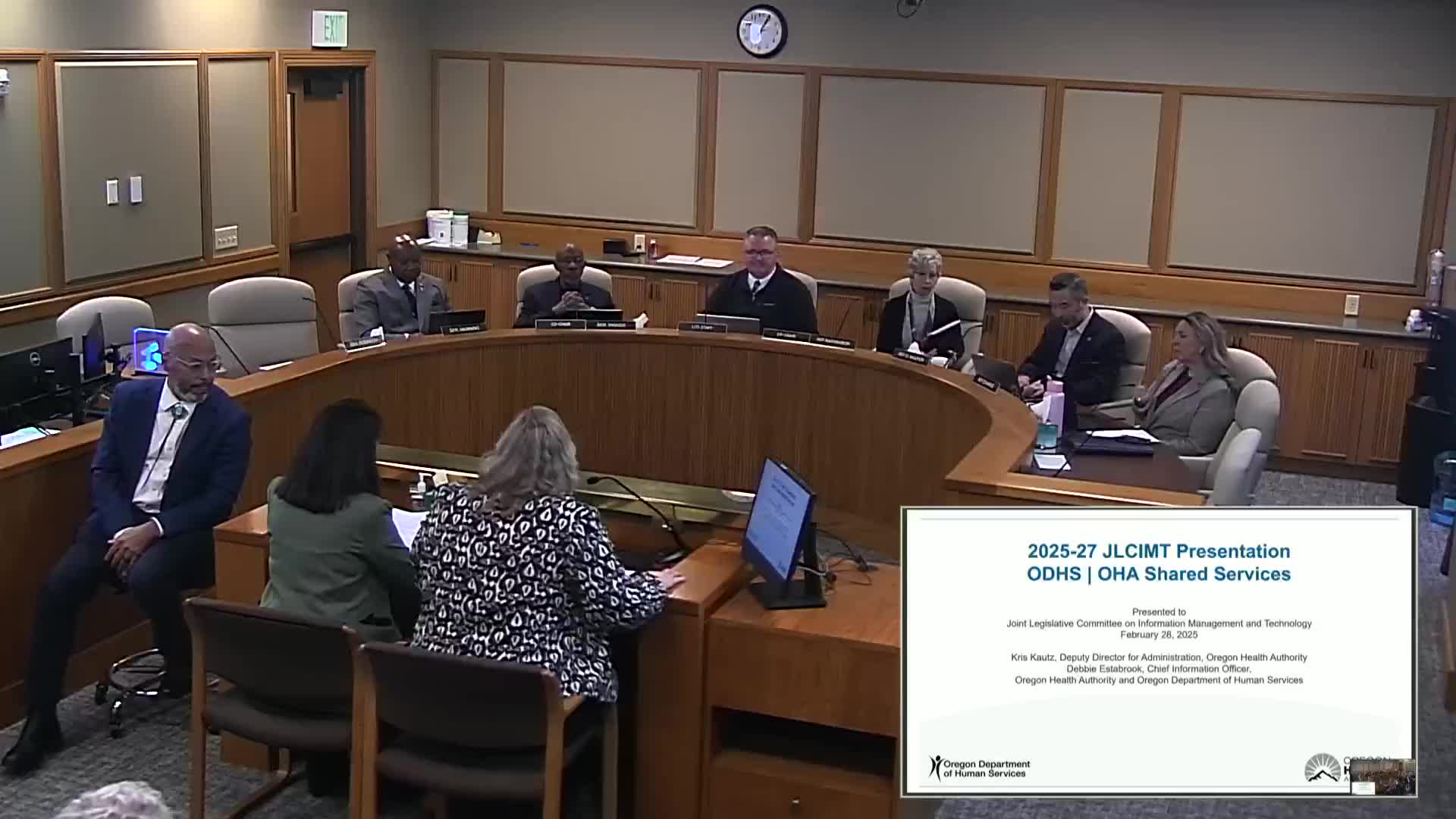
The Joint Legislative Committee on Information Management and Technology heard an informational briefing Feb. 28 on the Office of Information Services (OIS), which manages IT for Oregon Health Authority and the Department of Human Services and is seeking to modernize mainframe systems, align governance and account for AI use.
The Joint Legislative Committee on Information Management and Technology heard an informational briefing Feb. 28 on the Office of Information Services (OIS), the shared IT organization supporting the Oregon Health Authority (OHA) and the Oregon Department of Human Services (ODHS). Debbie Estabrook, chief information officer for OIS, and Chris Kautz, deputy director for administration at OHA, told the committee the office is managing a large modernization program that includes moving legacy mainframe applications to cloud-based systems.
OIS leaders said the work matters because their systems support delivery of food, medical and cash assistance for roughly 1,700,000 clients across Oregon. "We maintain IT systems supporting up to 1,700,000 clients," said Debbie Estabrook, chief information officer, Office of Information Services. Chris Kautz, deputy director for administration, Oregon Health Authority, said the OIS functions as a shared service across the two agencies and that the joint structure was retained after the agencies split in 2010 to preserve efficiency.
Committee members asked for details about legacy systems, governance and timelines. Estabrook said OIS runs a large portfolio: as of January 2025 the office reported 44 technical projects totaling $402,700,000 and 23 projects scheduled to finish in the biennium with a combined budget of about $78,000,000. She said several projects have been placed on remediation plans with the state Enterprise Information Services (EIS) and the Legislative Fiscal Office. Estabrook described a multi-year effort to migrate mainframe-hosted financial and benefits systems to cloud environments and said this is continuing in partnership with the state data center under EIS.
On timing, Estabrook told the committee OIS is in pre-initiation for the mainframe modernization project and expects implementation work across 2025–2027, with a cloud-based financial system implemented in 2028. The presentation noted the OIS governor's budget request of $288,000,000 for OIS operations, 669 positions supporting about 17,400 agency staff, with personnel, software maintenance and professional services as primary expenditures.
The committee discussed artificial intelligence. Estabrook said OIS submitted an inventory of generative AI and AI-enabled products and that the inventory has been posted to the statewide OIS site; the office identified roughly 30–35 products in use across OHA and ODHS. Kautz said the inventory is being shared with other agencies to broaden understanding of deployed AI capabilities and embedded models.
Committee vice chairs and members pressed on integration with the state CIO and the state data center’s plans. Kautz said the state data center is preparing a request for proposals for "mainframe as a managed service" to address aging hardware and the shrinking pool of mainframe specialists; he said the committee will be offered a follow-up presentation by the state data center administrator. Estabrook and Kautz said OIS is aligning investments under a joint Technology Council and working with EIS on network modernization and statewide cybersecurity controls.
The briefing closed with repeated emphasis that modernization is continuous and necessary to reduce security risk, improve scalability and maintain service delivery. OIS leaders invited follow-up questions and said they will continue coordination with EIS, the Legislative Fiscal Office and committee staff on timelines and remediation plans.