Get Full Government Meeting Transcripts, Videos, & Alerts Forever!
Get email alerts on the Property Tax Circuit Breaker topic
No spam. Unsubscribe anytime.
Committee approves second substitute to phase abatement into deferral for circuit-breaker property relief
Summary
The House Revenue and Taxation Committee voted Feb. 28 to recommend the second substitute to Senate Bill 197, a measure that would phase most property-tax abatements (the 'circuit breaker') toward a new deferral program with new eligibility tests, below-market interest on deferred amounts and protections for current beneficiaries.
The House Revenue and Taxation Committee on Feb. 28 approved the second substitute to Senate Bill 197, a comprehensive rewrite of Utah’s “circuit breaker” property-tax relief that would phase most abatement benefits into a new deferral program and change income, age and asset tests for eligibility.
Senator McKay, sponsor of the bill’s substitute, said SB 197 is intended to address an unintended tax shift caused by the abatement program: when a homeowner receives an abatement it reduces their assessed valuation but the tax rate floats for other property owners, creating small annual increases for the rest of taxpayers. The substitute keeps existing abatement recipients on the abatement schedule for a long transition while moving future or newly eligible recipients toward a deferral with different eligibility tests and lower interest on deferred amounts.
Key features described by Senator McKay and in the handout reviewed in committee: - Non-discretionary deferral: For qualifying homeowners age 65 or older with household income up to $60,000 and liquid resources within a statutory test, the bill would lock a taxpayer’s base-year property-tax liability and allow deferral of increases. Deferred amounts would carry interest set at 1 percentage point below the effective federal funds rate (sponsor cited roughly a 3.25% example) and be repaid when the property is transferred or otherwise comes due; a lien would be recorded on the property. - Discretionary deferral: For households with somewhat higher eligibility thresholds (example income up to $50,000 described for a different tier) the program allows freezing a portion of the tax (75% of prior tax in sponsor’s example), with deferral interest 2 percentage points below the federal funds rate for that tier. - Transition and grandfathering: Existing abatement recipients would remain on abatement for an extended period so they do not immediately lose benefits; the sponsor estimated a long phaseout (decades) for the abatement portion. - Renter credit: The substitute incorporates provisions from another bill (Senate Bill 224) to raise the renter credit income threshold (sponsor cited an increase from $40,000 to $46,000 and estimated a roughly $200,000 cost for the state portion).
Committee members questioned program mechanics, mortgage-lender coordination and fiscal effects. County auditors, treasurers and advocacy groups were the largest group of public commenters; their testimony included: - Support for keeping seniors in homes but concern that eliminating the indigent abatement would push vulnerable residents into a deferral program that has historically had very low uptake because of statutory interest and lien mechanics. - County officials asked for more implementation time and urged the committee to send the bill to interim for additional work rather than immediate passage. Several county auditors (Davis County, Utah County, Iron County) and the Utah Association of Counties were recorded in opposition to the substitute as drafted, citing administrative difficulty and fiscal uncertainty. - Senior-advocacy groups (AARP Utah, Utah Housing Coalition), anti-poverty groups and veterans’ advocates urged retention of some abatement features, or at least additional study, pointing to the program’s role in keeping low-income seniors and veterans housed.
Representative Kyle, sponsor of the committee motion to recommend favorably, argued the deferral approach better insulates taxpayers from annual tax shifts while allowing homeowners to remain in place; Representative Kristofferson, Representative Daley (Provo) and others expressed concern the change was too disruptive and asked for more study.
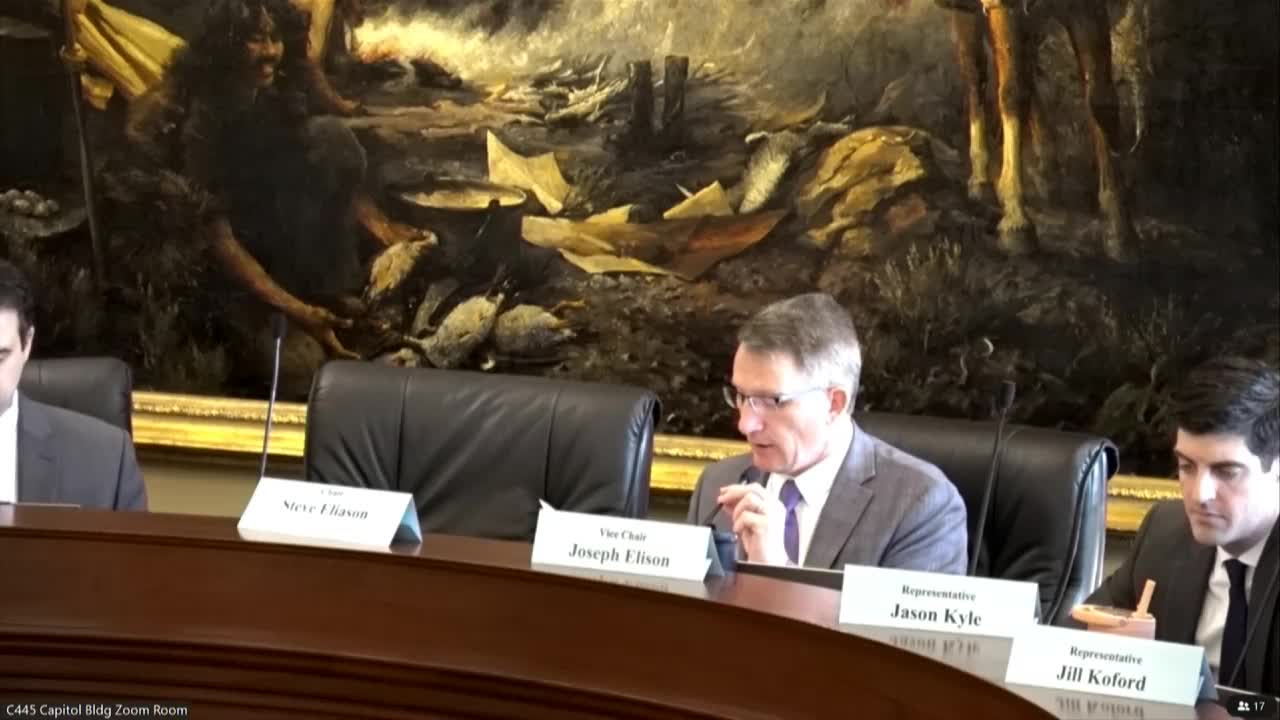
Committee process: a substitute was adopted and the committee debated a motion to send the bill to interim study; that substitute-to-interim motion failed on a recorded vote. The committee then approved the second substitute and voted to recommend the bill favorably on a roll-call vote. The committee recorded seven 'yes' votes and four 'no' votes; the transcript identifies Representative Daley (Provo), Representative Shepherd, Representative Wynne and Representative Daley (Provo) as among the negative votes (transcript lists Daley [Provo], Shepherd and Wynne; committee minutes should be checked for an authoritative roll call).
Because the substitute changes both property-tax abatement rules and income-tax credits, county officials urged additional implementation planning, including lender notification procedures, notice from auditors/auditors’ offices to affected homeowners, and clear guidance on how liens will be recorded and tracked. Several county auditors asked that implementation details be handled in interim so counties can test and plan administration.
The committee’s favorable recommendation sends the second substitute to the next stage in the Legislature with recorded dissent from several members.