Get Full Government Meeting Transcripts, Videos, & Alerts Forever!
Get email alerts on the Arts Grants topic
No spam. Unsubscribe anytime.
Metro Arts grants committee recommends $1.96 million in operating awards, OKs 75 Thrive projects; commissioners disclose conflicts
Summary
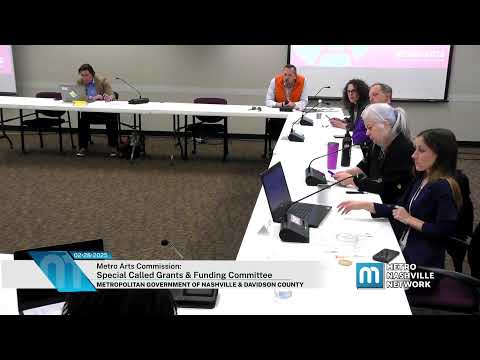
On Feb. 28, 2025, the Metro Arts Commission Grants & Funding Committee recommended funding for 94 operating grantees and 75 Thrive projects and approved the minutes of its Feb. 13 meeting.
On Feb. 28, 2025, the Metro Arts Commission Grants & Funding Committee recommended funding for 94 operating grantees and 75 Thrive project awards and approved the minutes of its Feb. 13 meeting.
The committee’s interim executive director, Ashley Batchelder, told members that staff completed technical reviews, held panel orientations and two days of panel scoring, and that 18 community panelists reviewed applications. She said staff used the panel scores and the commission’s funding formulas to generate award recommendations and that the commission plans to notify awardees within 48 hours of the full commission’s decision on Monday, with contracting and disbursement to follow; Batchelder said contracting typically takes four to six weeks and staff will hire temporary legal/paralegal support to manage that workload.
Legal counsel Tessa reviewed conflict-of-interest rules drawn from Metro code and ethics training, telling commissioners they must disclose relationships that could create actual bias or the appearance of bias and that when a conflict exists staff will remove the affected applicant from a blanket or group vote and bring that applicant up for a separate vote. Tessa said the conflicts form is a public record and advised erring on the side of over-reporting. The committee applied that approach: several organizations were pulled from group votes for separate consideration when commissioners reported recusal-worthy ties (for example, Tennessee Performing Arts Center and Belcourt Theatre were removed for individual votes when recusal was declared).
Batchelder summarized the review work: staff performed initial technical reviews (four staff members), one Thrive review panel reviewed 39 and another 38 Thrive applications, and a separate operating panel reviewed 45 operating applications. Based on panel results and the funding formulas, staff presented recommendations of 75 Thrive awards (one originally listed Thrive award was later found to have failed the technical review and will be removed and its funds redistributed) and 94 operating awards representing 60% of the operating grant budget ($1,957,920).
The committee voted by category. Where commissioners disclosed conflicts, the affected applicants were removed from group approvals and voted on individually. Commissioners used voice votes for group approvals and separate voice or recorded votes for the pulled items; where a recorded tally was given in the transcript it is reported below.
Votes at a glance
- Operating grants (grouped approvals by size): committee voted to recommend funding for 94 operating grantees totaling $1,957,920 (representing 60% of the operating grant budget). Major large-category recommendations approved as a group included Country Music Hall of Fame, Nashville Ballet, National Museum of African American Music, Nashville Symphony Association, Cheekwood Estate & Gardens and Nashville Opera. Tennessee Performing Arts Center and Frist Art Museum were removed from the group vote for separate action and subsequently recommended for funding (First Art Museum recorded as passing 3–0 when that tally was stated). The committee approved the remaining midsize, medium, small and micro operating grantees as presented; several individual organizations in each category were handled via separate vote when conflicts were disclosed (transcript lists each organization by category; see provenance and clarifying details for the full roster).
- Thrive grants: committee recommended funding for 75 Thrive projects (staff had initially listed 76 but later confirmed one applicant failed technical review and will be removed from the final slate; staff will redistribute those funds consistent with the Thrive guidelines). The committee read applicant names and fiscal agents for projects with declared conflicts and voted on those individually, then approved the remainder as a group.
- Administrative: minutes of the Feb. 13 meeting were approved by voice vote.
Conflict policy and practice
Tessa cited Metro Code section 2.2220.02 and the commission’s ethics guidance, emphasizing that conflicts can arise from direct financial gain, family or close personal relationships, shared staff or fiscal sponsorships, and from the appearance of impropriety. She instructed commissioners to disclose relationships on the conflicts form (a public record) and said a safe practice is to recuse from votes where the conflict exists or the appearance of bias is strong. The committee adopted a practical procedure used in this meeting: staff removed conflicted applicants from omnibus (group) votes and handled them separately so that the public record shows which applicants were decided apart from the group vote.
Fiscal agents and fiscal-sponsor model
Batchelder described the fiscal agent framework used for some Thrive awards: applicants that do not have 501(c)(3) status apply using a fiscal sponsor/agent that can legally receive Metro Arts funding. She noted that fiscal agents may take a fee (examples cited during the meeting ranged from 0% to roughly 10%) and that a commissioner who has a conflict with a fiscal agent should recuse from votes affecting projects for which that fiscal agent receives funds. Committee members asked clarifying questions about how to declare conflicts if a commissioner serves as a volunteer or has past relationships; counsel urged commissioners to weigh recency and closeness of the relationship and to disclose where there is doubt.
Next steps and schedule
Batchelder said staff will bring the committee’s recommendations to the full Metro Arts Commission on Monday and will notify awardees soon after. Staff will prepare contracts and begin disbursement; she said contracting usually takes four to six weeks and that staff intend to contract a paralegal to support that work. Batchelder also said staff will compile summary and descriptive materials for the full commission, gather feedback on the Thrive fiscal-sponsor approach, and hold one-on-one conversations with grantees to explain the new funding formulas and to collect process feedback. The committee scheduled its next meeting for March 27, 2025, 11 a.m.–1 p.m. to begin FY26 planning and related policy discussions.
Ending
Committee members thanked staff and panelists for the rapid review work and the public panel participation; the meeting adjourned after the votes were completed.
Sources: transcript, Feb. 28, 2025 Metro Arts Commission Grants & Funding Committee meeting (staff report by Ashley Batchelder; legal guidance by Tessa).