Get Full Government Meeting Transcripts, Videos, & Alerts Forever!
Get email alerts on the Public Art Youth Campus topic
No spam. Unsubscribe anytime.
Metro Arts outlines public art plans for Nashville Youth Campus for Empowerment
Summary
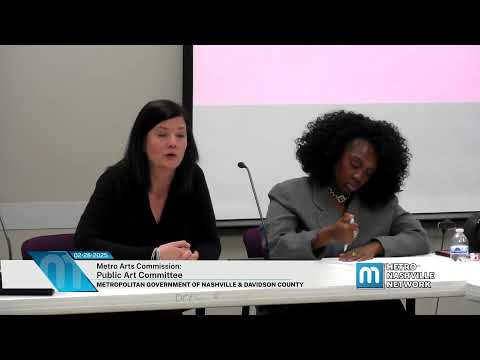
Metro Arts staff presented plans on Feb. 28 for several public-art components tied to the Nashville Youth Campus for Empowerment, a new juvenile-justice campus sited near Trinity and I‑65 on Brick Church Pike in North Nashville.
Metro Arts staff presented plans on Feb. 28 for several public-art components tied to the Nashville Youth Campus for Empowerment, a new juvenile-justice campus sited near Trinity and I‑65 on Brick Church Pike in North Nashville.
The projects are part of a broader campus redevelopment led by Metro General Services and the juvenile-justice court. "This is very exciting. It's the Nashville Youth, Campus for Empowerment," Atelio, a Metro Arts staff member, told the commission, adding that the campus sits on a 14‑acre site and that project completion is being targeted for January 2027.
Metro Arts described three potential public-art elements for the campus. The first is a comprehensive wall sculpture proposed as a national call to artists. The second is a direct selection for interior work on the second and third floors; staff named Stephanie Paragains as the intended direct selection because she previously worked with Judge Sheila Calloway and on prior grant applications tied to this campus. The third element is an "Empowerment Collection," a curated series of approximately 10–15 original works displayed in long corridors across three floors that will address themes such as empowerment, resilience, justice and growth and will be limited to artists from Nashville and Davidson County.
Metro Arts said all three projects would be funded from capital improvement project percent‑for‑art funds. "Theyare all generated from the capital improvement project," Atelio said. Staff emphasized the projects remain in early planning; exact commission amounts and selection-panel parameters will be set after Metro Arts and General Services identify final locations and technical constraints.
Commissioners and staff raised practical questions about timeline, materials and artist capacity. One commissioner asked whether the national call risks excluding local artists; Atelio said the commission would include provisions to favor local artists on selection panels and had considered a mentorship or "mentee" opportunity but was concerned staff capacity and the compressed timeline (roughly two years to January 2027) would limit ability to administer a formal mentorship program.
Staff outlined sensitivity and programming concerns for installing art in court-related spaces. "The First Floor ... is going to be a very highly sensitive area," Atelio said, noting that certain courtroom-adjacent areas need art that does not trigger or distress viewers. Commissioners also pressed on technical issues such as structural engineering for large installations, ultraviolet protection for artworks near glass, and long-term maintenance plans.
Metro Arts said the direct-selection artist would submit a proposal with dimensions, materials, fabrication and engineering plans; staff will review that proposal and present it to the commission for approval. For the corridor collection, artists will be asked for sketches, narratives and resumes; staff estimated 10–15 pieces would be selected for the corridor program.
Why it matters: the campus replaces an existing juvenile-justice facility and is intended as an "empowerment" campus with classrooms, therapy spaces and trade‑school components. Public art will be highly visible to families and court users and must balance creative ambitions with safety, durability and sensitivity to the population using the building.
Next steps: Metro Arts will confirm exact locations, ask artists for proposals, review budgets once sites are determined, and return to the commission with formal proposals for selection and funding approval. Staff warned that specific commission amounts and the feasibility of mentorship programming remain "not specified" until site parameters and budgets are finalized.