Get Full Government Meeting Transcripts, Videos, & Alerts Forever!
Get email alerts on the School Digital Materials topic
No spam. Unsubscribe anytime.
House committee advances bill to hold digital-content vendors accountable for 'sensitive' school materials
Summary
The House Education Committee advanced HB 473 (second substitute), a bill that creates a vendor-notice and removal process for digital school materials deemed "sensitive," adopts a three-strikes penalty for repeat infractions, and clarifies parental notice. The committee accepted a sponsor amendment and gave the bill a favorable recommendation.
Representative Karianne Peck, sponsor of HB 473, told the House Education Committee on Feb. 28 that the bill expands prior sensitive-materials rules to explicitly cover digital resources provided to schools through vendors and through the Utah Education and Telehealth Network (UETN). "This bill provides a way for parents to be notified ... a way for a teacher to report stuff, even a student to report stuff that they feel like might classify as sensitive materials to their district," Peck said.
The bill would require vendors who supply curricular databases and other digital materials to notify contract holders (for example an LEA, UETN or the state board) if material in their collection is identified as objective sensitive material; vendors would have 30 days to remove such material after notification. The bill creates a three‑strike enforcement approach: if a vendor receives three notices for objective sensitive materials and fails to remove them, UETN may terminate the contract. The sponsor also said the bill would require vendors to remove links in their materials that lead to outside sites containing objective sensitive material.
During committee questions, members pressed practical and scope issues: how broadly vendors operate, whether removals could be scoped to a district rather than statewide, whether existing Chromebook or local filters block the content, and how reporting would reach parents. Representative Hayes asked whether vendors serve multiple states; Peck replied that some are national conglomerates and that subscription roles can be tailored to a district's needs. Representative Miller asked whether local Chromebook filters stop the material; Peck replied that local filters block access to the database container but do not control vendor-hosted content once a user is inside the database, and that filters on vendors' systems are a separate control.
Public commenters were split. Rebecca Cummings of the Utah Library Association urged the committee to vote no and to "revisit this issue in interim session to look at the extensive audits that UETN has already conducted," saying UETN had repeatedly reported no known problematic content after audits. Brooke Stevens, civic engagement director for Utah Moms for America, said she supported the bill and singled out hyperlinks as a primary risk: "It's links because that's where the danger is." Other commenters included a parent who opposed the bill as unnecessary and a commenter who challenged factual claims in the sponsor's presentation.
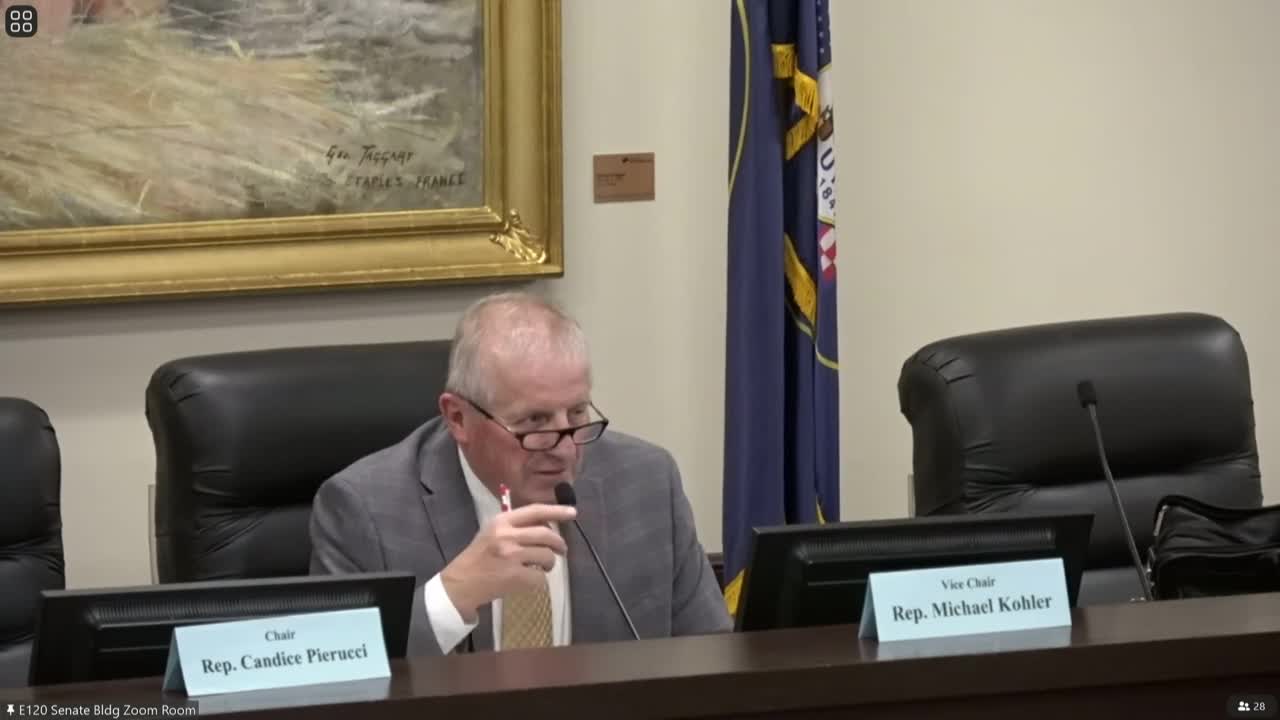
On committee procedure, the committee moved the bill as a second substitute, then adopted an amendment (amendment 1) that changed how parents are notified at registration (the substitute removed a prescriptive requirement to send a separate email and made the notification method non‑prescriptive). Representative Wilson moved the second substitute; Representative Miller moved and the committee adopted amendment 1; Representative Eliason moved that the committee give HB 473 (second substitute, as amended) a favorable recommendation. The committee voted by roll call and gave the bill a favorable recommendation.
The bill's sponsor said the second substitute removed an initial proposal for a regulator and that the fiscal note changed: the original draft included a fiscal note of $558,000 for a regulator, while the posted second substitute carried a fiscal estimate of $0 because enforcement and compliance work relies on contract obligations and vendor action rather than a newly funded regulator.
The committee discussion and public comment focused on how to operationalize vendor notice and removal, whether the three‑strike rule could penalize vendors based on multiple reports of the same item, and whether the proposed reporting process would reach parents and teachers. The sponsor and supporters said the bill adds clarity and a contractual lever to remove clearly objective (egregious) content; opponents said existing audits and processes may already address the risk and cautioned about unintended consequences.
Votes at committee: roll-call votes recorded in committee discussion show Representatives James Auxier (yes), Kevin DeFe (aye), Eliason (yes), Hayes (no), Miller (no), Moss (no), Peck (yes), Wilton (yes), Vice Chair Kohler (yes), Chair Perucci (yes). The committee adopted amendment 1, moved the second substitute, and voted to recommend the second substitute as amended.
The committee returned the bill to the committee with a favorable recommendation; next steps will be the bill's placement on the floor calendar.