Get Full Government Meeting Transcripts, Videos, & Alerts Forever!
Get email alerts on the Driver Credentialing Enforcement topic
No spam. Unsubscribe anytime.
Committee deadlocks on bill to criminalize and impound vehicles driven by unlicensed motorists
Summary
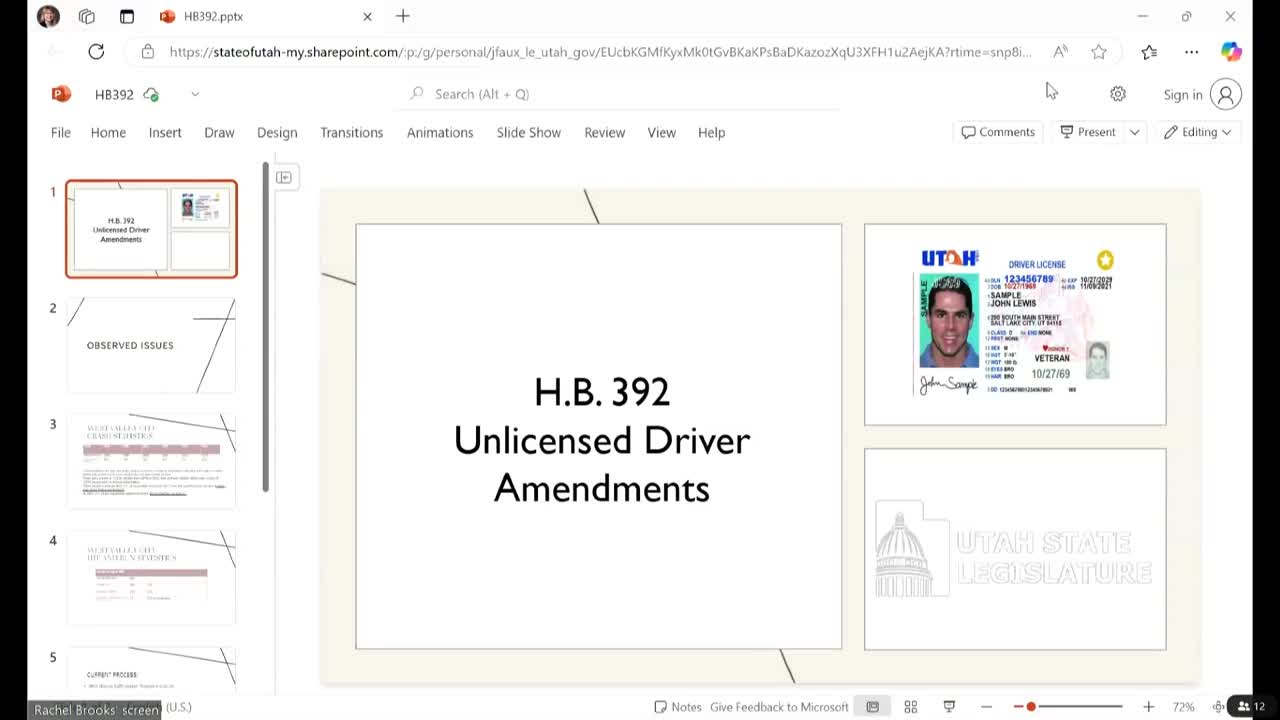
A substitute for House Bill 392 that would make driving without ever having been issued a license a class C misdemeanor, require mandatory impound and allow fingerprint scans for identification failed in committee on a 3–3 tie after debate and testimony from law enforcement and immigrant‑advocacy groups.
House Bill 392 (second substitute) would have added a class C misdemeanor penalty and a mandatory vehicle impound for drivers who have never been issued any valid driver credential, and it would have authorized rapid fingerprint scans when officers cannot confirm a driver’s identity.
Representative McPherson, the bill sponsor, said local law enforcement had tracked that 30–46% of drivers officers stop in certain jurisdictions lacked any issued driver credential, and that officers often had no legal tool to prevent those drivers from continuing to drive. He described the mandatory‑impound provision as a response to officers’ requests for a clear, uniform enforcement option and said the bill would create parity with other invalid credential offenses.
Colonel Michael Rapich of the Department of Public Safety and Nate Mudder, chair of the law‑enforcement legislative committee, testified in support and described technology and safeguards. Rapich said agencies can and do use in‑vehicle fingerprint scanners and that the Bureau of Criminal Identification has the systems to support checks. Mudder requested a clarification to ensure registered owners could authorize another licensed driver to retrieve an impounded vehicle.
Liliana Bolanos of Voices for Utah Children opposed the bill as written, arguing it focused on enforcement without addressing barriers—she said the driving‑privilege card test is only offered in English and that language access prevents many eligible people from obtaining lawful credentials. She warned the bill’s fines and impoundments would fall disproportionately on low‑income and immigrant communities.
The committee adopted the second substitute into the record and then voted on a motion to pass the bill out of committee with a favorable recommendation. The committee vote resulted in a 3–3 split and the motion failed. The chair announced the tally as a 3–3 tie; the motion to advance did not carry.
Law‑enforcement supporters emphasized public‑safety benefits and existing fingerprint tools; opponents emphasized language access, disproportionate economic harm, and urged a balanced approach that pairs enforcement with improved accessibility to licensing.