Get Full Government Meeting Transcripts, Videos, & Alerts Forever!
Get email alerts on the Legislation First Reading topic
No spam. Unsubscribe anytime.
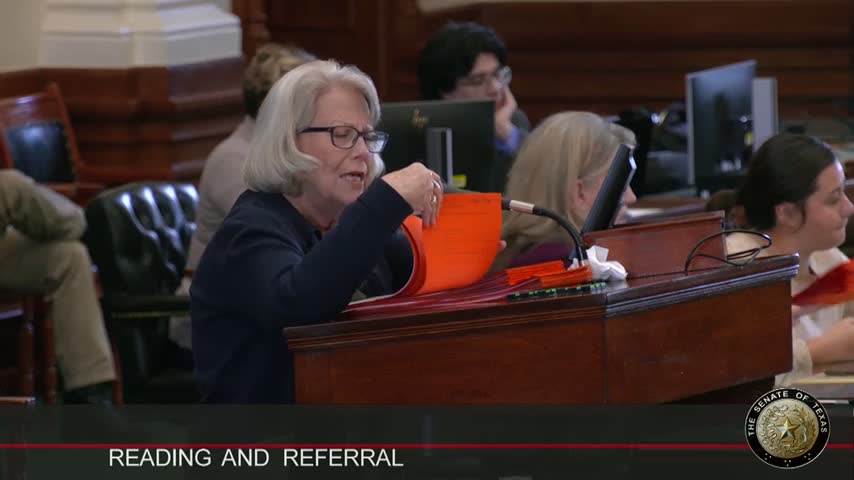
Texas Senate reads dozens of bills on first reading and refers them to committees
Summary
The Texas Senate convened to read a lengthy list of bills and resolutions on first reading; the secretary read titles and committee referrals and the Senate adjourned until 11 a.m. Tuesday, March 4.
The Texas Senate read a lengthy list of bills and resolutions on first reading and referred them to committee, the chamber recorded in a procedural session on March 3. The secretary read each measure’s short title and the committee assignment before the Senate stood adjourned until 11 a.m. Tuesday, March 4.
Why it matters: Reading and referral on first reading begins the formal legislative process for each measure, routing bills to committees where they may be scheduled for hearings, amended, or stalled. The list included proposals affecting education, natural resources, health and human services, criminal justice, transportation and local government.
During the session the secretary read dozens of Senate bills and concurrent or joint resolutions on first reading and announced committee references. Items read included (representative, in order presented) Senate Bill 27 (Creighton) relating to assistance provided to public school educators by the Texas Education Agency; Senate Bill 29 (Hughes) relating to business entities; SB 35 (Nichols) on design-build contracts to transportation; SB 51 (Blanco) on insurer review of third-party administrators to health and human services; SB 152 (Huffman) creating the offense of continuous manufacture/delivery of a controlled substance to criminal justice; SB 153 (Hughes) on Texas Department of Motor Vehicles authority related to astronomical events to transportation; SB 154 (Hughes) prohibiting certain weather and climate modification activities by governmental entities to natural resources; SB 155 (Eckhardt) prohibiting increases in rent for tenants in developments supported by Low Income Housing Tax Credits to local government; SB 156 (Hughes) on prohibited conduct of health benefit plan issuers to health and human services; and SB 157 (Eckhardt) on flaring and venting of methane on land dedicated to the Permanent University Fund to natural resources.
The reading continued through a broad slate of measures covering municipal zoning notices (SB 160), appraisal review board postponements (SB 163), emergency detention statutes (SB 164), county authority over recycling and salvage yards (SB 165–166), disaster identification systems (SB 168), provisions affecting public utilities, international cooperation agreements, compensation and standards for certain juvenile justice employees, and many others. Committees named for referral spanned Transportation; Natural Resources; Health and Human Services; Finance; Local Government; Education K–16; Business and Commerce; Water, Agriculture and Rural Affairs; Criminal Justice; and State Affairs.
The session also included the reading of a number of constitutional amendment propositions, Senate concurrent resolutions, and joint resolutions (for example, SJR 52 on gaming for the Kickapoo Traditional Tribe of Texas and various SJR proposals concerning the scheduling and scope of legislative subjects in special sessions). No committee hearings, votes on the measures themselves, or floor debates on the bills’ merits were recorded during the reading.
The Senate concluded the procedural reading and, pursuant to a motion previously adopted, stood adjourned until 11 a.m. Tuesday, March 4.