Get Full Government Meeting Transcripts, Videos, & Alerts Forever!
Get email alerts on the Middle Housing topic
No spam. Unsubscribe anytime.
Mill Creek planners review state 'middle housing' rules; staff to propose code amendments
Summary
At a study session the Mill Creek Planning Commission heard a staff presentation on state middle-housing laws (HB 1110, HB 1337, SB 5258). Staff will draft zoning and ADU code changes next month; if the city does not adopt its own amendments by July 1 the state Department of Commerce model code will apply.
At a study session, Planning Department staff reviewed recent state laws that change how cities must treat “middle housing” and described the code amendments staff will bring to the Planning Commission next month.
Staff said the state 2023 laws—HB 1110, HB 1337 and SB 5258—require changes to local code for housing types between two and six units (duplexes through six-plexes), accessory dwelling units (ADUs) and unit-lot subdivision. Staff said Mill Creek falls into Tier 3 under HB 1110 because the city’s population is under 25,000 and therefore has fewer mandatory changes than larger cities, but still must adopt minimum standards.
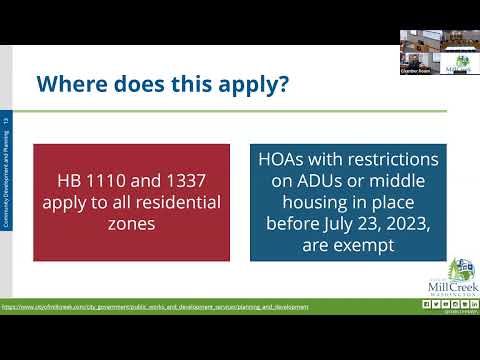
The presentation summarized required changes: allow at least two dwelling units per lot; convert middle-housing design review from review-board review to administrative design review; loosen parking requirements near frequent-transit stops; allow unit-lot subdivision under SB 5258; and increase ADU allowances under HB 1337 (permit up to two ADUs per lot and raise the ADU maximum size from 800 to 1,000 square feet). Staff also said impact fees for ADUs must be limited to no more than 50% of the fee charged for a single-family home. Staff noted that where an HOA or similar rule explicitly restricted ADUs or middle housing before July 23, 2023, that restriction remains in effect for those properties.
Staff gave local context: roughly 20% of Mill Creek’s housing stock already comprises middle-housing types, and the city’s 2024 comprehensive-plan and zoning update already allowed multifamily housing in most residential zones (though low-density zones retain density limits that can force very large lots to accommodate, for example, a fourplex).
Commissioners asked about specific implementation questions staff had not yet finalized. Topics raised included whether attached vs. detached ADUs would require separate utilities (staff replied utility service and trash collection are determined by utilities or contracts, not the city), how parking minimums apply near the city’s BRT lines (staff said no minimum parking would apply close to frequent transit but was uncertain about a specific quarter-mile vs. half-mile threshold and said staff would check the exact distance), and how unit-lot subdivision would work in practice (staff said subdivision is intended primarily for townhouses but can apply to ADUs, and a parent lot can be subdivided only into as many pieces as the parent lot’s maximum allowed density).
Staff also described other limits they plan to carry into draft code: ADUs remain limited to 1,000 square feet unless the city chooses otherwise; height limits remain those of the zone (typically 35 feet); administrative design review would replace board-level review for middle housing; and the Department of Commerce model code will apply on July 1 if the city does not adopt its own amendments by the end of June.
Staff told the commission it will return next month with proposed code amendments and that the city is aiming for City Council adoption in April. If the city does not adopt its own amendments by June 30, staff said the Department of Commerce model code will become the applicable standard on July 1.
The presentation included illustrative examples of local developments called out by staff—Nature’s Landing, Northpointe, the Masters and Amberley—to show how attached units can sometimes resemble single-family houses in form but qualify as middle housing.
Staff and commissioners agreed to continue the discussion when draft amendments are available for review.