Get Full Government Meeting Transcripts, Videos, & Alerts Forever!
Get email alerts on the Student Assessments Act 20 topic
No spam. Unsubscribe anytime.
Antigo schools report winter benchmark results, outline Act 20 reading plans and interventions
Summary
District administrators told the school board the first winter administration under Act 20 produced individualized reading plans for students who fell below the assessment threshold and identified next steps including expanded progress monitoring, summer school requirements for reading-plan students, and a districtwide transition to AIMSweb Plus.
Unified School District of Antigo administrators reported winter benchmark assessment results to the school board and described how they implemented Act 20 literacy screening, individualized reading plans and targeted interventions across the district.
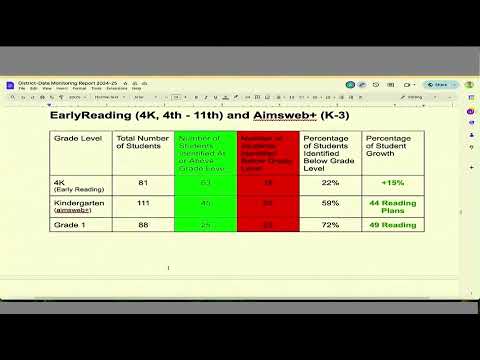
District administrator Ms. Stutzring said the winter administration was the district’s first use of AIMSweb Plus under Act 20 and that the new multi-step screening produced more detailed diagnostic data than the FastBridge system the district has used previously. “We have 81 students across our district. We have 22 below identified below grade level,” Stutzring said when summarizing the 4K results, and she explained the AIMSweb process and follow-up steps for students who fall below the screening threshold: “If they fell below the 20 fifth percentile, then we had to move on to step 2 of the Act 20 plan.”
Why it matters: district leaders said the AIMSweb Plus screeners plus the additional diagnostic subtests allow teachers to pinpoint specific deficits (for example nonsense-word decoding or phoneme segmentation) and place students into targeted small groups or more intensive tier-3 interventions. Those targeted supports are the basis for the individualized reading plans the district must produce under Act 20.
Key findings and immediate steps
- Screening and reading plans: Stutzring told the board that kindergarten had 44 reading plans written and that the district has 82 reading plans in total (district total reported during the presentation). She described reading plans as multi-page documents that include goals, progress monitoring and home support activities and said plans were sent to parents with an acknowledgement form.
- 4K and early literacy: the district reported 81 students in 4K and 22 identified below grade level in the winter screening; leaders celebrated a reported 15% district increase in a 4K metric displayed in the presentation and credited embedded coaching and shared reading practices.
- Exit and promotion questions: Stutzring said the reading plan includes criteria for how a student may exit the plan and that the district will bring a policy proposal to the board to clarify promotion and exit rules (for example whether a student who remains on a reading plan at the end of third grade advances to fourth grade and under what conditions).
- Percentile cut points and local policy: Stutzring explained the district chose an internal cut score for proficiency higher than the AIMSweb “proficient” threshold: “AIMSweb says thirtieth percentile is proficient. We decided as Antigo that we're going fortieth percentile,” she said, describing the district’s internal standard for determining who receives targeted supports.
- Assessment transition and schedule: the district will keep FastBridge in place for parts of this year while phasing in AIMSweb Plus. Stutzring said 4K will move to AIMSweb Plus in the spring, and that the district plans to switch to AIMSweb Plus for math and for the remainder of grades next year.
Interventions, coaching and family supports
Administrators described several steps to translate diagnostic data into instruction: (1) targeted small-group instruction in class, (2) tier-3 interventions for students with larger deficits, and (3) progress monitoring tied to the reading plans. The reading plans include suggestions for home practice; staff said teachers sent families specific activities aligned to each child’s goal and that schools plan family nights and ClassDojo videos to help parents support practice at home.
Instructional coaches, Title staff and reading specialists helped complete time-intensive testing and plan development so classroom teachers could continue daily instruction while the district completed required diagnostic work. Stutzring credited coaches and Title staff with allowing the district to meet Act 20 timelines without stopping instruction.
High-school and secondary follow-up (interventions and credit recovery)
High-school and secondary administrators described expanding intervention courses and moving credit-recovery work in person rather than primarily online. The high school reported that 15 students placed in intervention had graduated from intervention and reached grade-level targets, and that in-person credit recovery (for courses such as algebra and English 9) produced better subsequent results in later courses than purely online credit recovery.
Solution Tree coaching and instructional practices
District staff described ongoing work with Solution Tree coaches and in-house instructional coaches on strategies including gradual release, Cornell notes, small-group instruction varieties, vocabulary instruction and use of assessment data to plan instruction. Amy Clark, identified in the meeting as a Solution Tree coach, was listed by staff as a collaborating coach; administrators said Solution Tree staff have observed and praised the district’s implementation.
Other district-level items raised in the presentation
- Math pilot: elementary grades are piloting two math curricula. Administrators said pilot classrooms show increased student engagement and some winter assessment gains; the district will use winter and spring data to select a resource and plan professional development.
- Attendance and behavior: district and building leaders reported improved attendance and a multi-year decline in behavior referrals at several buildings. Administrators credited consistent expectations, PBIS-related routines (positive behavioral interventions and supports), and targeted adult support for students as factors in improved classroom climate.
- Special populations: administrators said reading plans include students with IEPs and that the district is coordinating reading plans and IEP goals. Staff noted English learners in 4K are not formally identified as ELs until kindergarten screening; the presentation indicated EL and IEP considerations may change the application of some Act 20 requirements on a case-by-case basis.
What the board was told next: staff said they will return with spring benchmark results and a proposed local policy that clarifies promotion/exit criteria tied to reading plans and Act 20 timelines. Stutzring also said summer-school or other remediation will be required for some students on reading plans: “If you are on a reading plan, you will be required to go to summer school,” she said, noting some exemptions exist for IEP or language plan considerations.
Ending
District administrators asked the board to note the staff and coaches they credited for carrying out the testing and planning work, and said they expect more detailed spring results once the district completes progress monitoring and targeted interventions.
(Reporting based on the Unified School District of Antigo board meeting winter benchmark presentation.)