Get Full Government Meeting Transcripts, Videos, & Alerts Forever!
Get email alerts on the Land Development Wetlands topic
No spam. Unsubscribe anytime.
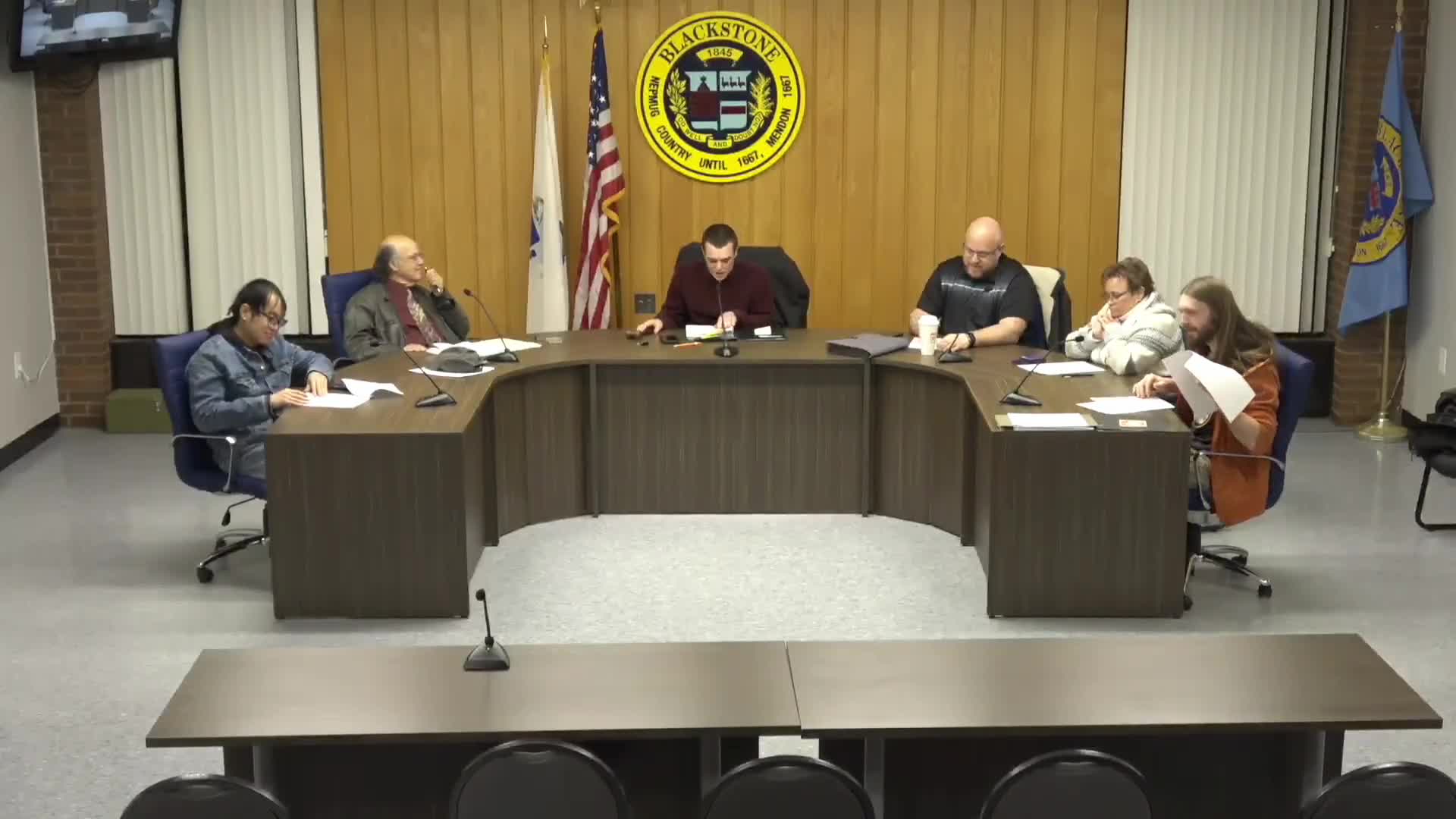
Blackstone conservation commission denies notice of intent for 0 and 3 Rocco Drive
Summary
After a public hearing and peer-review comments, the Town of Blackstone Conservation Commission voted to deny a Notice of Intent for development at 0 and 3 Rocco Drive, citing work in the buffer zone, regrading and drainage concerns; the applicant said it will appeal.
The Town of Blackstone Conservation Commission on Feb. 19 voted to deny a Notice of Intent (NOI) for work at 0 and 3 Rocco Drive after a continued public hearing in which commissioners raised concerns about fill, retaining-wall drainage and proximity to an intermittent stream.
The commission’s decision follows presentations by the applicant’s wetlands consultants and a town peer reviewer. Christina McEvoy, a wetland scientist with Goddard Consulting, introduced the project’s updated buffer-zone mitigation planting plan and told the commission the applicant had added measures in response to peer-review recommendations. “My name is Christina McEvoy and I’m a wetland scientist with Goddard Consulting,” McEvoy said during the hearing. Scott Goddard, owner of Goddard Consulting, told the commission the project team had added two subsurface dry-well infiltration systems “in the front of the building and immediately to the rear” to capture roof runoff and that the measures were voluntary: “This project is exempt from stormwater management standards under the Massachusetts Wetland Protection Act. So by state law, we’re not required to perform any mitigation for the stormwater management. However…we have voluntarily added soil water management to the site.”
Ed Avizanes of Avizanes Environmental Services, who conducted the commission’s peer review, confirmed in his written review and in remarks at the meeting that the stream on the site is classified as intermittent under the regulatory presumptions that reference current USGS maps. Commissioners repeatedly returned to two central concerns: the amount and location of regrading and fill required to build on the sloped lot and how roof and wall drainage would be managed where a retaining wall creates a level pad within the buffer zone.
Commission discussion touched on whether the retaining-wall drainage and underlying substrate had been reviewed in sufficient engineering detail and whether the conversion of the site’s grades would amount to a substantial fill within the buffer zone. One commissioner said a full cut-and-fill analysis had not been performed; Goddard replied that moving earth on the lot to create a buildable pad was occurring but that a formal cut-and-fill calculation was not prepared for the submittal.
After discussion, a motion to deny the NOI carried. The transcript records roll-call statements during the vote; among the named roll-call entries in the record, a commissioner identified as “Arsenal” voted in favor and Commissioner Roxanne recorded a vote against. The project’s representative said the team would appeal the commission’s action: “I will be appealing it and we’re gonna waste a lot of resources of energy and time to do something,” the applicant’s representative said.
The commission noted that denial of the NOI does not prevent the applicant from seeking review by the Massachusetts Department of Environmental Protection or pursuing further submissions; several commissioners commented that an appeal to DEP is an available path for the applicant. The commission did not set any additional conditions or direct staff to reopen the matter at a future meeting in the transcripted discussion.
The materials presented to the commission included a buffer-zone mitigation planting plan, two proposed subsurface dry-well infiltration units to capture roof runoff, a peer-review letter from Avizanes Environmental Services, and updated site plans showing the retaining wall and regrading. The applicant and consultants said the dry wells were added in direct response to the peer-review recommendation even though they stated the project is not subject to state stormwater-mitigation requirements under the Massachusetts Wetland Protection Act.
The applicant and their consultants signaled they would pursue an appeal; the commission’s denial stands pending any appeal or further filings.