Get Full Government Meeting Transcripts, Videos, & Alerts Forever!
Get email alerts on the Traffic Calming topic
No spam. Unsubscribe anytime.
NDOT proposes seven sets of speed cushions for Hickory Woods Drive; neighborhood to vote
Summary
NDOT traffic engineer and consultant Amy Burch presented a plan Wednesday to install roughly seven sets of speed cushions on Hickory Woods Drive and said the neighborhood will vote on the final design by mail.
NDOT traffic engineer and consultant Amy Burch presented a plan Wednesday to install roughly seven sets of speed cushions on Hickory Woods Drive and said the neighborhood will vote on the final design by mail.
Burch said the project was selected after NDOT reviewed data from a citywide prioritization process that ranks requests based on speed, volume, trip destinations, non-driver accommodations and crash history. "The 80th percentile speed was measured at 33 miles per hour," Burch said, and the street carries about "3,400 vehicles per day." She described Hickory Woods Drive as a 36-foot-wide collector that feeds to Murfreesboro Pike and noted the segment discussed runs between Murfreesboro Pike and Sunnyvale Drive.
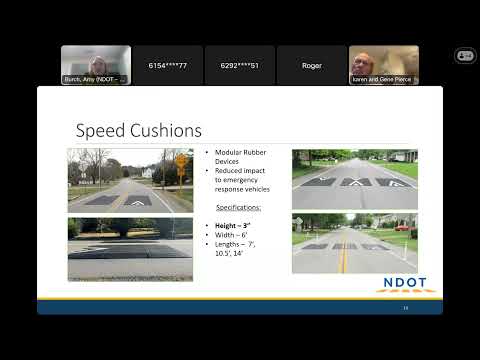
The plan shown to the neighborhood places seven sets of modular speed cushions spaced about 450 feet apart along the corridor. Burch said NDOT prefers speed cushions because they are modular, can be configured to allow emergency vehicles to straddle gaps, and have produced local reductions in measured speeds: "Average speed before" tests were about 31 mph and fell to 22 mph after cushions; the 80th-percentile speed fell in the study from 37 mph to 25 mph.
Residents at the meeting said they support traffic calming but raised concerns about related traffic congestion at the Murfreesboro Pike intersection. "Will this cause a bottleneck of traffic also?" asked Myron Williams, who said he supports street calming but worries about backups at peak times. Burch replied she did not expect the cushions to increase queueing at the Murfreesboro Pike intersection and noted that cushions will not change existing turning delays onto Murfreesboro Pike.
Other residents described frequent speeding and daily safety concerns. Gregory Jordan, who said he has lived in the neighborhood for 20 years, called the corridor "like a racetrack" and supported installation of cushions. Another attendee said grandchildren no longer play in front yards because of high speeds.
Burch explained the next steps: NDOT will complete a detailed design that refines cushion locations relative to driveways and other features, post the design on the traffic-calming website, then mail a ballot postcard with a unique code to each eligible property owner. "If 66% of those that participate in the vote vote yes, then the project moves forward," she said. Ballots remain open for six weeks; NDOT provides a phone option for owners who cannot vote online. Burch said construction typically follows ballot approval and runs about eight to 10 months, because materials are ordered after a project is confirmed.
Eligibility and mailing rules were clarified: only property owners of residential parcels that abut the affected right-of-way are eligible to vote (one vote per property); vacant and commercial parcels that do not abut the right-of-way are not eligible. NDOT will mail ballots to the property-owner mailing address recorded in Metro parcel data; if an owner lives out of state, the postcard goes to the owner's recorded mailing address. Burch acknowledged the policy has been debated and that NDOT staff hear concerns from renters and nearby residents who also use the street.
Several attendees said they had placed separate service requests for a traffic signal at Murfreesboro Pike and Hickory Woods Drive using Metro's hub (hub.nashville.gov) and encouraged neighbors to file similar requests. Burch provided contact information and the project's web resources: trafficcalming.nashville.gov and NDOT's traffic-calming email.
Action taken in the meeting was informal agreement among attendees to proceed without a second neighborhood meeting: multiple residents voiced support for moving the concept to detailed design and the ballot step. Burch said NDOT will post the design and notify the neighborhood when ballots are mailed.
The meeting did not include any formal NDOT public vote or Metro action; the formal decision point will occur when property-owner ballots are tallied and, if two-thirds of respondents approve, NDOT schedules construction.
NDOT and residents identified follow-up items: residents were advised to submit hub requests for a traffic signal if they wish NDOT to evaluate that separately; NDOT will post the detailed design and later the summarized ballot results (percent yes/no) on the project website.