Get Full Government Meeting Transcripts, Videos, & Alerts Forever!
Get email alerts on the Distributed Energy Resources topic
No spam. Unsubscribe anytime.
San Diego Community Power to relaunch solar-battery savings program with new eligibility, stepped incentives
Summary
San Diego Community Power presented a relaunch of its Solar Battery Savings program, describing pilot results, goals for expanded virtual power plant capacity, revised incentives favoring new systems and low-income customers, and an expected public launch on Sept. 30.
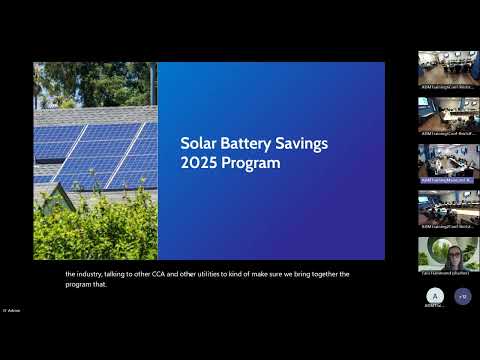
San Diego Community Power staff outlined a relaunch of the agency’s Solar Battery Savings program on Sept. 11, presenting pilot results and a multi-year rollout intended to help build a 150-megawatt virtual power plant and expand rooftop solar-plus-storage in the agency’s service area.
The update, delivered by Collin Santuby of the customer programs team, said the pilot launched in June 2024 and “the funds were expended by November.” He told the Community Advisory Committee (CAC) the pilot enrolled about 1,600 customers and roughly 2,200 batteries, with an average incentive of about $6,900 per installation and more than 50 approved contractors participating.
San Diego Community Power’s board previously directed program expansion and appropriated $18.8 million for the current fiscal year; the agency’s five-year capital investment plan carries a $55 million line item for the solar battery program. Santuby said the relaunch will prioritize new solar-plus-storage systems with relatively higher incentives and keep a 50% program target for customers in communities of concern and CARE/FER (CareFare) customers.
Program design details include a step-down incentive structure intended to phase public support as market adoption grows; Santuby said the agency will build milestones to reevaluate incentive levels and could change them as needed. The relaunch keeps a performance payment for participants that provide daily discharge — the program requires a 50% daily discharge during a defined peak window and currently compensates dispatched energy at $0.10 per kWh (stated as 10¢ per kVAH in the presentation). Santuby said the agency extended the dispatch window to four hours within the peak period (roughly 1 p.m. to 5 p.m.) and simplified enrollment options compared with the pilot.
Equipment and operation changes were also noted. All batteries eligible for the relaunch must be interoperable with the agency’s distributed energy resources management system (DERMS) provider, Virtual Peaker, Santuby said; that technical requirement likely will shrink the number of eligible battery models compared with the pilot but should simplify operations and enrollment. Contractors must attend mandatory program trainings before submitting applications, Santuby said; about 60 contractors had participated in trainings by the Sept. 11 meeting.
Santuby said the pilot drew recognition from the U.S. Department of Energy and other industry groups. He said the agency expects the first tranche of program funding (about 30 MWh) to last roughly 13 weeks at current demand; the $18.8 million appropriation is intended to cover most of a 12-month period, with the board to review budget direction in June 2026.
Committee members pressed staff on market risks and contractor oversight. Committee member Luis asked whether the current launch is “tier 1” of a step-down plan; Santuby confirmed the program is in the initial tier. Committee member Gary asked whether other community choice aggregators (CCAs) were adopting similar programs; Santuby said other CCAs have expressed interest and that the agency will appear on a panel with other CCAs. In response to concerns about contractor concentration, Santuby said no single contractor may receive more than 25% of the megawatt-hour capacity in each step, with an exception that allows contractors to continue submitting applications for CARE/FER customers after hitting the cap.
Santuby said the program will launch publicly on Sept. 30 with an outreach push led by public affairs and will include community workshops targeted at neighborhoods with lower pilot participation. He also said the agency expects to publish a written evaluation of pilot performance after staff collect a full year of seasonal data; some performance data are already available through the DERMS provider and manufacturer relationships, he said.
The presentation was informational; no CAC action was required.
The CAC discussion recorded technical and programmatic clarifications, expressed interest in seeing the contractor and equipment lists after launch, and requested a future update on marketing and outreach strategy. Santuby said he expects to return to the committee with a program update in Q1 following the public launch.