Get Full Government Meeting Transcripts, Videos, & Alerts Forever!
Get email alerts on the Water Policy topic
No spam. Unsubscribe anytime.
Senate Natural Resources hears hours of testimony on SB 358 to regulate exempt wells
Summary
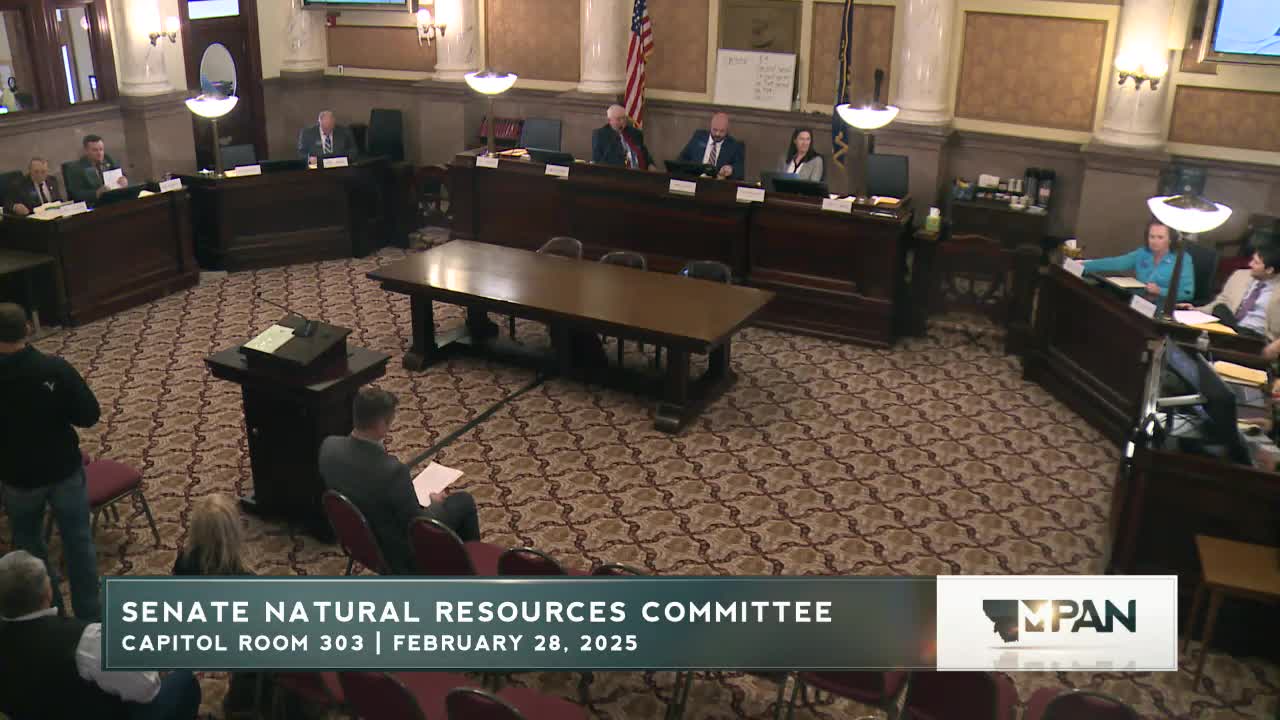
Senate Natural Resources Committee members heard more than three hours of testimony on Senate Bill 358, a stakeholder-crafted proposal to change how Montana treats so-called exempt wells, during a committee hearing where the sponsor, Senator Wiley Galt, opened the bill and dozens of stakeholders offered testimony for and against it.
Senate Natural Resources Committee members heard more than three hours of testimony on Senate Bill 358, a stakeholder-crafted proposal to change how Montana treats so-called exempt wells, during a committee hearing where the sponsor, Senator Wiley Galt, opened the bill and dozens of stakeholders offered testimony for and against it.
The bill would classify geography into green, yellow and red areas and set different rules for each, Codified proponents and DNRC staff testified that the approach is designed to allow exempt wells where they do not cause harm while providing tools to limit them in vulnerable basins. "Status quo is not working anymore," sponsor Senator Wiley Galt said, adding that without legislative action "the courts are gonna start deciding what this is gonna get across the finish line." Anna Pakenham Stevenson, water resources division administrator at the Montana Department of Natural Resources and Conservation, told the committee the DNRC "stands in strong support of this stakeholder working group compromise bill" and summarized the bill's main pathways and caps.
Why it matters: proponents said SB 358 creates a predictable framework for development and a scientific basis for when exempt wells should be curtailed; opponents said the bill could allow expanded consumptive use that harms senior water-right holders and agricultural operations in some valleys. Supporters included counties' conservation districts, livestock and development interests, and municipal organizations; opponents included farm and ranch groups, conservation organizations, and individual senior water-right holders.
Key provisions and debate
Anna Pakenham Stevenson (DNRC) described the geographic framework and two main implementation pathways: one for parcels that are not being divided and another for land divisions subject to local planning rules. She said the bill codifies criteria DNRC uses to evaluate combined appropriations and described a cap tied to preexisting decisions and lot counts. "You can create 24 lots using the exception," Stevenson said, and she described how the bill counts additional exempt wells created after a referenced court decision toward a lot cap. She said the framework is intended to limit loopholes that have allowed sequential development to result in large cumulative uses.
Proponents argued the bill is the product of roughly 18 months of stakeholder work and thousands of volunteer hours. Rayleigh Honeycutt of the Montana Stock Growers Association said the bill "gives a roadmap to the future of how exempt wells could be administered" and urged collaborative action to protect senior water rights while providing certainty for development. Kelly Lynch, executive director of the Montana League of Cities and Towns, said exempt-well development and associated septic systems have contributed nonpoint-source nutrient pressures on waterways and that the bill "provides a science based framework, to continue to allow exempt wells where they are not a problem, and to stop them in those areas where they are." Several agricultural and conservation groups — including the Montana Association of Conservation Districts and the Montana Conservation Society — also testified in support.
Opponents raised legal and practical concerns. John Tubbs of Upper Missouri Waterkeepers said the bill "fails to protect existing uses its senior water right holders" and argued SB 358 risks expanding the exception to the Water Use Act rather than returning projects to the permitting and change processes that establish and protect priority dates. Other opponents from farm bureaus, building and development associations, and individual ranchers and irrigators said the bill's proposed red-area boundaries and selected data cutoffs (several speakers referenced calendar years used to calculate lot counts and baselines) were unfair or inaccurate for specific basins such as the Bitterroot, Helena Valley and portions of the Gallatin Valley.
Procedural status and next steps
Senator Galt opened the hearing and accepted written amendments and exhibits; committee members heard both in-person and remote testimony. Several speakers asked the committee to adopt amendments addressing area boundaries, baseline dates used for calculations, monitoring rules in yellow zones, and the use of available groundwater data to define closures. The committee did not take a final vote on SB 358 during the hearing; the record shows the bill was presented and testimony taken, with proponents and opponents asked to submit written comments and proposed amendments for the committee's consideration.
Ending
Committee members heard repeated requests from both sides for technical fixes and clarifications: proponents asked the committee to keep the stakeholder compromise intact while opponents urged more safeguards for senior water-right holders or changes to the procedure for establishing red areas. The hearing record shows a high level of engagement and that the committee will receive written amendments and further technical input before any final action.