Get Full Government Meeting Transcripts, Videos, & Alerts Forever!
Get email alerts on the Healthcare Prior Authorization Reform topic
No spam. Unsubscribe anytime.
Montana lawmakers weigh bills to restrict prior authorization, extend approvals and protect discharge medications
Summary
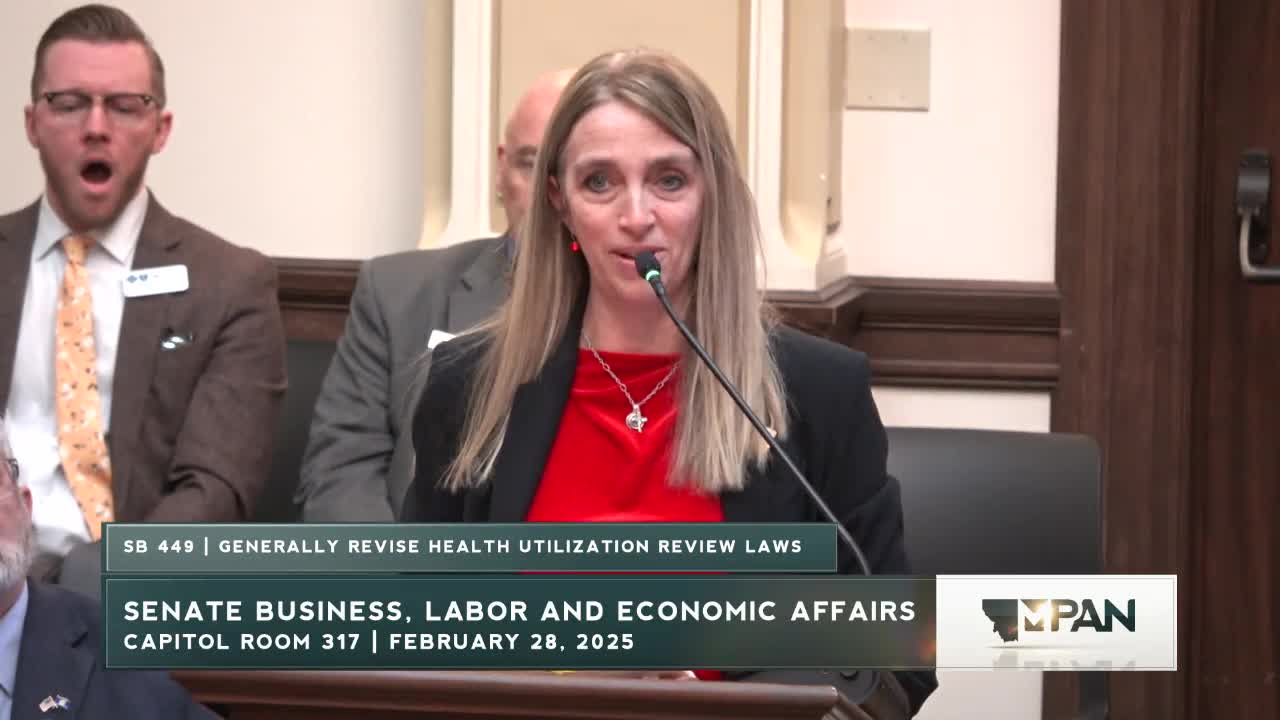
Helena — A trio of bills (SB 447, SB 449 and SB 446) would narrow prior‑authorization requirements, extend approval durations and protect hospital discharge medications; providers hailed the measures, insurers urged compromise language.
Helena — A trio of bills (Senate Bills 447, 449 and 446) proposing limits on health‑plan prior authorization won wide backing from physicians, hospitals and patient advocates at a Senate Business and Labor Committee hearing, while insurers urged the committee to advance negotiated compromise language instead of adopting the sponsors’ broader measures.
Sen. Ricky (sponsor of SB 447 and related bills) told the committee the bills aim to curb delays in care caused by expanded prior authorization practices. Key provisions across the package include extending many prior‑authorization approvals to 12 months, exempting a set of low‑cost generic drugs and time‑sensitive medicines (insulin, inhalers) from prior authorization, and requiring continuity of care when a member changes plans so previously‑authorized treatment continues for a transitional period.
Physicians and clinicians gave concrete examples of care delayed or disrupted by prior authorization. Dr. Saul Rivard, president of the Montana Academy of Family Physicians, described chronic patients who must repeatedly re‑apply for drugs that had previously worked, and said the administrative burden contributes to physician burnout. Pediatricians and subspecialists described cases in which medication or specialty test approvals were delayed for weeks; one pediatrician said a patient missed a “loading” dose of a migraine medication because of a delay and suffered more attacks.
Providers also asked for exceptions for chronic conditions, citing medication stability and long‑term management needs, and for discharge protections so patients leaving hospitals can secure needed prescriptions without waiting for new prior‑auth approvals.
Behavioral‑health advocates and substance‑use treatment providers supported removing prior authorization for medications for opioid use disorder and for other time‑sensitive behavioral‑health medicines, saying rapid access saves lives.
Pharmacists and hospital groups supported electronic prior‑authorization standards and longer approval windows; several testifiers urged stronger regulation to stop frequent insurer formulary changes that force patients to switch therapies.
Insurers and pharmacy benefit managers raised concerns. Representatives of the three Montana regulated insurers and national PBM groups said prior authorization is an important clinical‑safety and cost‑control tool; they asked the committee to consider bills negotiated in the House that they say already address many provider concerns. Insurers also noted the state’s regulatory reach covers only a subset of plans (the three regulated carriers), and cautioned that blanket carve‑outs for categories of drugs could raise costs and reduce insurer ability to steer patients to clinically equivalent, lower‑cost alternatives.
Several witnesses asked the committee to approve specific technical fixes: clarify which drugs or classes are exempt, ensure chronic‑condition continuations require clinical documentation, and preserve pathways for expedited reviews. Sponsors indicated many of the items had been or were being negotiated and that committee action should move the conversation forward.
Committee members asked about possible drafting errors and cross‑bill coordination; the sponsor acknowledged a drafting issue in section 3 and said an amendment would be forthcoming. No final committee vote was recorded in the hearing record posted with the transcript.