Get Full Government Meeting Transcripts, Videos, & Alerts Forever!
Get email alerts on the Courts Government Claims Court topic
No spam. Unsubscribe anytime.
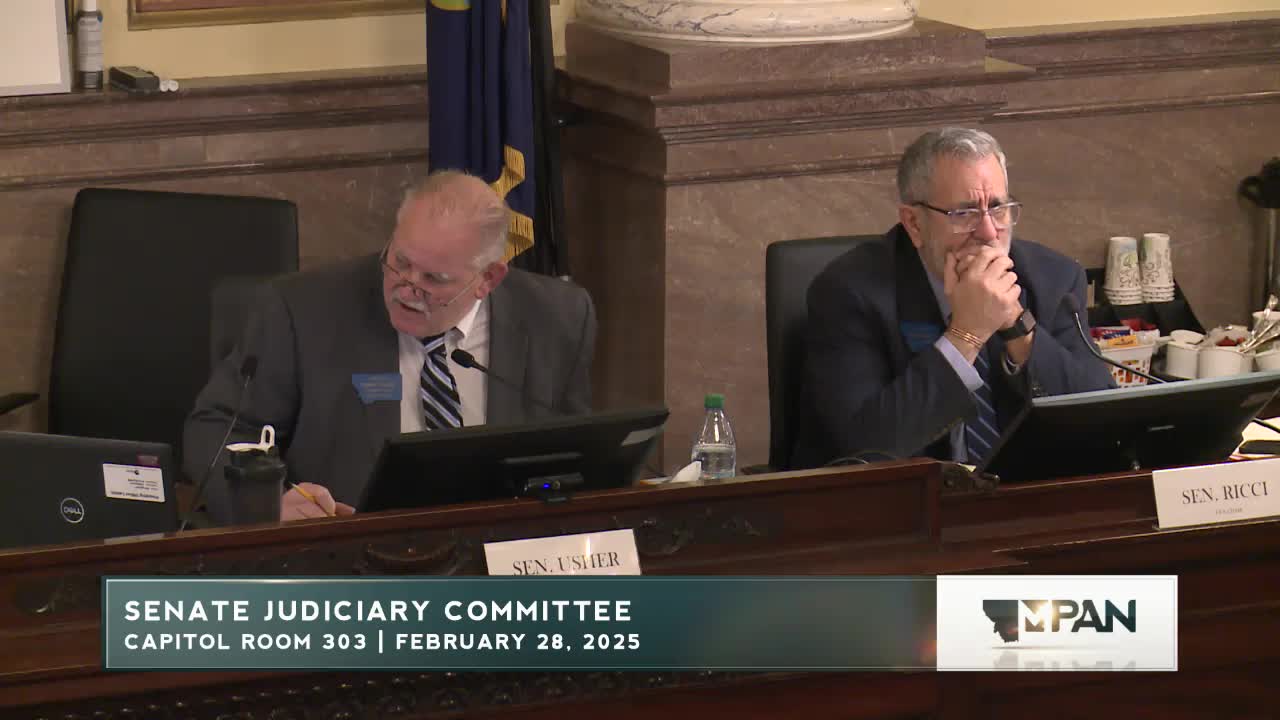
Senate panel backs creation of Montana Government Claims Court amid sharp debate
Summary
The Senate Judiciary Committee voted to advance Senate Bill 385 to the full Senate after a long hearing with supporters who said a specialty court would relieve overloaded district dockets and opponents who warned of cost, appointment power and constitutional risk.
The Senate Judiciary Committee voted to advance Senate Bill 385, authorizing a new Montana Government Claims Court intended to hear constitutional challenges to state action, administrative appeals and asbestos claims.
Sponsor Sen. Tom McGillivray introduced the bill, citing constitutional authority in Article VII and arguing the specialty court would remove complex civil cases from crowded district courts. "Senate Bill 385, which is an act creating the Montana government claims court," McGillivray told the committee in opening remarks, and he said the new court would use three appointed judges whose salaries would be set higher than current Supreme Court pay to attract experienced jurists.
Supporters said the new court would speed resolution of time-consuming constitutional and administrative cases. Derek A. Streicher, chief legal counsel for the Montana Family Foundation, said delays harm parties: "It is often been said that justice delayed is justice denied," and asked the committee for a "due pass." Henry Krieg of Americans for Prosperity Montana and other proponents argued the court would free district courts to focus on criminal, family and dependency matters.
Opponents pressed constitutional and cost concerns. Anne Sherwood of Friends of the Third Branch criticized the appointment process and the lack of a detailed caseload study or full fiscal note, arguing judges chosen by the governor could be unaccountable to voters. Attorneys representing Libby asbestos claimants, including Roger Sullivan and co-counsel Ben Snipes, warned the bill made the currently volunteer-based Asbestos Claims Court mandatory and could add expense and inefficiency for cases that, they said, were being handled without extra appropriation.
McGillivray said the bill’s jurisdiction is narrower than prior drafts and that he reduced scope to try to avoid overloading the proposed court. The bill sets three judges appointed by the governor; appeals from a single judge would go to a three-judge panel and from there to the Montana Supreme Court. The sponsor also told the committee the proposed salary for the new judges would be roughly 20% higher than current Montana Supreme Court pay.
Committee members also questioned how the Asbestos Claims Court would be folded in; the sponsor said the chief justice requested inclusion and an amendment accommodates transition of existing asbestos dockets to the new court over an 180-day period, with discretion to retain matters currently set for trial.
After nearly three hours of debate and testimony from dozens of witnesses, the committee voted to advance the bill to the Senate floor.
Ending: The bill will next go to the full Senate for consideration; committee proponents and opponents said the debate is likely to continue on the floor and during conference if the bill moves forward.