Get Full Government Meeting Transcripts, Videos, & Alerts Forever!
Get email alerts on the Labor Rights Right To Work topic
No spam. Unsubscribe anytime.
Montana panel hears hours of testimony on bill to ban union security agreements
Summary
Senate Bill 376, a proposal to ban union security agreements and bar compelled financial support for unions, drew more than three hours of testimony alongside opposing legal and economic arguments.
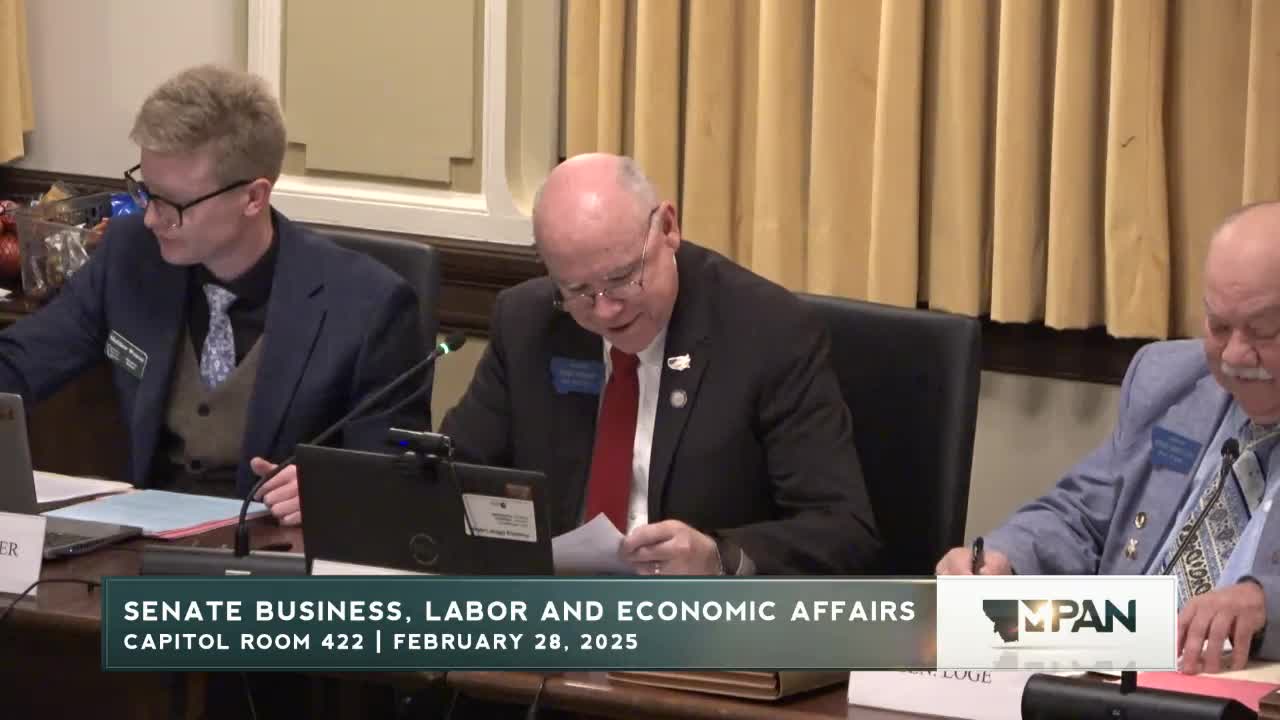
Helena — The Montana Senate Business, Labor and Economic Affairs Committee spent much of the day hearing pro and con testimony on Senate Bill 376, a Right-to-Work measure introduced by Sen. Mark Noland that would prohibit employers and unions from requiring employees to join or financially support a union as a condition of employment.
Supporters told the committee the bill would protect individual choice, encourage private-sector growth and raise household income, while opponents—including a broad coalition of construction, electrical, health-care and municipal unions—argued the measure would undercut collective bargaining, weaken apprenticeship training and lower wages.
Sen. Mark Noland (R), the bill sponsor, framed SB 376 as a freedom measure that would prevent an employer or union from penalizing a worker for refusing to pay union dues. “A right to work law simply ensures that no worker is compelled to pay,” Noland said during his opening remarks. He cited comparative statistics he and proponents attributed to outside researchers showing higher disposable income and faster private‑sector employment growth in neighboring right‑to‑work states and urged the committee to approve the bill.
Proponents including Randy Pope, executive director of Montana Citizens for Right to Work, and John Kalb of the National Right to Work Committee emphasized economic claims and the moral case against forced dues. Pope said the bill would make Montana the 28th right‑to‑work state; Kalb argued businesses and site selectors favor right‑to‑work states for recruitment.
Opponents included leaders and rank‑and‑file members from multiple unions. Amanda Bridal, representing the Montana AFL‑CIO, told the committee that Montana workers already have the choice not to join unions and that SB 376 “creates barriers to workers who wish to join together to negotiate for fair wages and safe working conditions.” Dozens of union members, apprentices and trade officials followed with testimony describing apprenticeship funding, training centers and safety programs they said would be jeopardized if the measure passed.
Labor representatives raised legal and preemption issues. Adam Haigh, representing Labor’s Local 1686, and others argued the National Labor Relations Act (NLRA) and subsequent federal case law limit states’ ability to regulate union security provisions and could subject parts of the bill to federal preemption. Haigh said union security and dues-checkoff arrangements are covered by the NLRA and the Taft‑Hartley amendments and warned the bill risks federal litigation.
Multiple witnesses described downstream effects if union funding fell. Al Ekblad of Operating Engineers Local 400 described 15 union training centers in Montana that he said are funded in part by dues and apprenticeship assessments, stating those centers train about 900–1,000 apprentices and have an annual operating budget he estimated at nearly $4 million. Several construction and trades witnesses said unionized contractors rely on apprenticeship pipelines to supply trained workers for Montana infrastructure projects.
Public‑safety and criminal‑penalty concerns also surfaced. Carter Marsh, representing Montana professional firefighters, said sections of SB 376 that create criminal and civil penalties for picketing, boycotts and other collective actions could conflict with existing statutes and constitutional protections for protest and collective action; he cited what he described as a discrepancy between the bill’s maximum misdemeanor fine and the Montana Code Annotated citation it references.
Committee members questioned witnesses about the underlying data on wages and employment cited by proponents and opponents. Proponents cited multi‑state comparisons showing higher real disposable household income and faster private‑sector job growth in some right‑to‑work states; opponents pointed to studies and local comparisons that, they said, show lower wages and fewer protections in right‑to‑work states and warned of reduced bargaining leverage.
At the close of testimony Sen. Noland moved for a “yes” vote on SB 376. The transcript records the motion but no formal roll call or final committee vote within the hearing record presented.
SB 376 drew a large set of speakers and extended public comment; the hearing record includes dozens of individual testimonies for and against the bill. The committee did not announce an immediate vote at the end of the hearing and indicated follow‑up work would continue in committee and during future legislative days.