Get Full Government Meeting Transcripts, Videos, & Alerts Forever!
Get email alerts on the Scholarship Eligibility Military topic
No spam. Unsubscribe anytime.
Committee advances bill to add active-duty military children to Georgia Promise Scholarship priority
Summary
The Senate Education and Youth Committee advanced a bill to add children of active-duty military personnel to the Georgia Promise Scholarship priority list and to authorize the Department of Education to adopt rules to implement federal guidance.
The Senate Education and Youth Committee advanced legislation to add children of active-duty military personnel to the eligibility priority list for the Georgia Promise Scholarship and to authorize the Department of Education to adopt rules to implement related federal guidance.
Sponsor Senator Sean told the committee the bill does not add dollars to the scholarship fund; rather, it clarifies eligibility so the state will be prepared if federal guidance or directives change how federal dollars are administered. “All it does is expand, not by dollars, to the Georgia Promise Scholarship Fund,” the sponsor said, and asked the department to set rules for implementation rather than codifying detailed procedures in the statute.
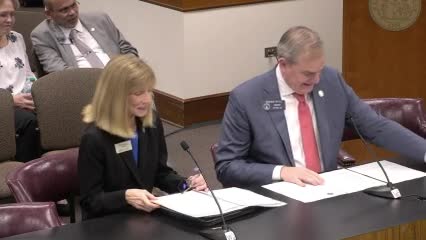
Lynn Riley, identified in the hearing as president of the Georgia Student Finance Commission and speaking for the Department of Education, explained how the Promise Scholarship’s priority list would be adjusted. She said low-income families (total family income below 400% of the federal poverty limit) retain first priority; children of active-duty military would be subsequent to those low-income families. Riley also described the program’s existing eligibility triggers, including an attendance-zone requirement tied to the governor’s student achievement list and the program’s 1% QBE cap.
Committee members asked whether federal dollars currently follow students to private schools. Sponsor Sean and Riley said the recent federal directive is open-ended and that the bill is intended to prepare the state for forthcoming guidance; the transcript records committee discussion that executive actions may require additional legal interpretation.
Members also discussed interactions with other bills, including proposals to prioritize foster-family children; Riley said those other measures carve out attendance-zone and prior-QBE requirements differently.
A motion to pass the bill carried; the chair counted opposing hands and, during the roll call, announced “1 2 4 opposed.” The chair nonetheless declared the bill passed by the committee. The transcript records that a committee amendment clarifying DOE and State Board rulemaking authority was included at the department’s request; the bill as amended was approved.
Votes at a glance: Senate Bill 124 — motion to pass as amended approved by committee; chair announced opposing hands as “1 2 4 opposed” during the roll call.
Next steps: the committee reported the measure favorably for further Senate consideration; agency staff requested DOE rulemaking authority to implement any federal guidance that may arrive before the fall school year.