Get Full Government Meeting Transcripts, Videos, & Alerts Forever!
Get email alerts on the Criminal Justice Competency topic
No spam. Unsubscribe anytime.
Senate committee advances bill to shorten competency timelines for low-level misdemeanors
Summary
The Senate Judiciary Committee voted to advance a bill that would require an initial hearing when competency is raised, shorten evaluation timelines for certain misdemeanors and create automatic dismissal rules if defendants cannot be restored within the shorter period, with a prosecutor objection process preserved.
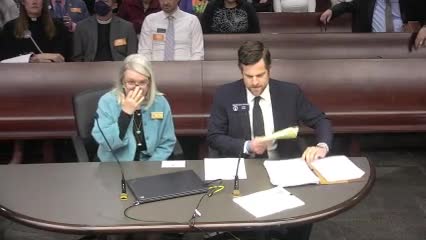
Senate Judiciary Committee members advanced Senate Bill 132 on a unanimous voice vote after a floor presentation and public testimony, moving the proposal aimed at speeding competency-to-stand-trial processes for some defendants.
The bill, carried in committee by Senator Strickland and presented with Judge Gosselin of Hall County Superior Court and input from the Behavioral Health Reform and Innovation Commission and the Department of Behavioral Health and Developmental Disabilities (DBHDD), would require an initial court hearing when competency concerns are raised. It would shorten the statutory evaluation window from 90 days to 45 days for specified non‑serious misdemeanors, reduce the restoration period from nine months to 120 days for those cases, and provide for automatic dismissal of those misdemeanor charges if restoration is not achieved — subject to a prosecutor filing an objection and asking the court to continue restoration efforts.
Proponents said the changes are intended to reduce time people are held in local jails while waiting for competency evaluations or hospital restoration, noting that some restoration processes can take many months. Senator Strickland said the bill resulted from about a year of work by a commission that included circuit, state, juvenile and probate judges, prosecutors, defense attorneys and DBHDD representatives to identify ways to streamline procedures and consider alternatives such as jail‑based medication where appropriate.
Hall County Judge Gosselin and Coweta County District Attorney Herb Cranford described the practical impacts they see in courts. Cranford noted DBHDD data indicating that a substantial share of felony competency evaluations ultimately return a finding of competency on initial evaluation and said an initial hearing could allow judges to screen for cases that do not warrant a full DBHDD evaluation. Defense attorneys from the Georgia Association of Criminal Defense Lawyers cautioned that the bill’s initial‑hearing language, as drafted, might require disclosure of privileged or ex parte materials to initiate a state evaluation; they asked for continued drafting to protect client confidentiality and avoid conflicts with existing case law such as Putnam.
Committee members asked about defendants who are released on bail; proponents confirmed the bill would apply whether a defendant is in custody or out on bail. Several witnesses, including defense counsel, said the central operational bottleneck remains hospital restoration capacity — evaluations have improved but inpatient restoration wait times can still be lengthy and are not solved simply by changing the statutory timeline.
After brief discussion the committee took a motion to pass LC 49 2 2 4 0 S (the Senate Bill 132 substitute). The motion to do pass was made by Senator Watson and seconded by Senator Steele; the committee voted to advance the bill.
The committee record indicates the bill will continue to be refined on the initial‑hearing language to address privilege concerns raised by defense counsel and to preserve prosecutors’ ability to object when appropriate.