Get Full Government Meeting Transcripts, Videos, & Alerts Forever!
Spokane County planners say UGAs lack capacity for projected growth; steercmte, outreach and infrastructure needs next steps
Summary
County planning staff told the Spokane County Planning Commission that urban growth areas (UGAs) currently lack roughly 6,000-person capacity against the Office of Financial Management projection, highlighted sewer and transportation constraints, and outlined a public outreach schedule and steering‑committee review in March.
Spokane County planning staff told the Spokane County Planning Commission on Feb. 7 that the county’s existing urban growth areas do not yet have enough developable capacity to meet a state population allocation and outlined next steps for public outreach and technical review.
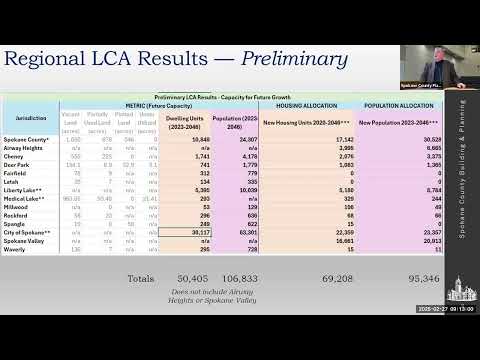
The presentation, led by Scott Chesney of county planning staff, summarized a 15-year permit scatter diagram showing growth concentrated at the edges of cities and in urban growth areas rather than in city cores and presented the county’s first-round land-capacity calculations in response to a State Office of Financial Management population forecast. Chesney said the county’s UGA lands, as currently measured, yield dwelling-unit capacity “a little less than 11,000” with a population capacity “of roughly 24,000,” while the allocation to the county is about 30,500 — leaving a shortfall of roughly 6,000 people under current assumptions.
Why this matters: the shortfall requires staff and jurisdictions to reconcile how housing capacity is being counted, whether recent zoning changes and new housing tools were included, and whether infrastructure exists to support denser infill or new fringe development.
Chesney described the county’s approach: exclude parcels unlikely or unable to develop, apply a market factor (a 30% adjustment in this analysis), use recent average densities as defensible assumptions (for example, approximately 4.46 dwelling…
Already have an account? Log in
Subscribe to keep reading
Unlock the rest of this article — and every article on Citizen Portal.
- Unlimited articles
- AI-powered breakdowns of topics, speakers, decisions, and budgets
- Instant alerts when your location has a new meeting
- Follow topics and more locations
- 1,000 AI Insights / month, plus AI Chat