Get Full Government Meeting Transcripts, Videos, & Alerts Forever!
Get email alerts on the Comprehensive Plan topic
No spam. Unsubscribe anytime.
Spokane County planners say UGAs lack capacity for projected growth; steercmte, outreach and infrastructure needs next steps
Summary
County planning staff told the Spokane County Planning Commission that urban growth areas (UGAs) currently lack roughly 6,000-person capacity against the Office of Financial Management projection, highlighted sewer and transportation constraints, and outlined a public outreach schedule and steering‑committee review in March.
Spokane County planning staff told the Spokane County Planning Commission on Feb. 7 that the county’s existing urban growth areas do not yet have enough developable capacity to meet a state population allocation and outlined next steps for public outreach and technical review.
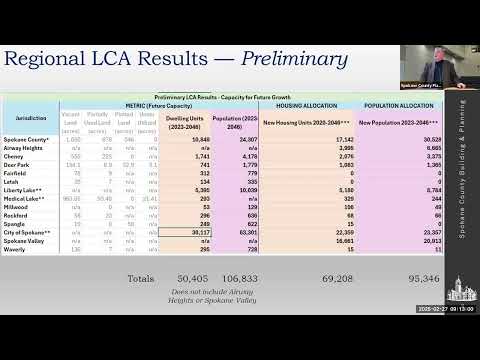
The presentation, led by Scott Chesney of county planning staff, summarized a 15-year permit scatter diagram showing growth concentrated at the edges of cities and in urban growth areas rather than in city cores and presented the county’s first-round land-capacity calculations in response to a State Office of Financial Management population forecast. Chesney said the county’s UGA lands, as currently measured, yield dwelling-unit capacity “a little less than 11,000” with a population capacity “of roughly 24,000,” while the allocation to the county is about 30,500 — leaving a shortfall of roughly 6,000 people under current assumptions.
Why this matters: the shortfall requires staff and jurisdictions to reconcile how housing capacity is being counted, whether recent zoning changes and new housing tools were included, and whether infrastructure exists to support denser infill or new fringe development.
Chesney described the county’s approach: exclude parcels unlikely or unable to develop, apply a market factor (a 30% adjustment in this analysis), use recent average densities as defensible assumptions (for example, approximately 4.46 dwelling units per acre for low-density development and about 20 units per acre for high density), and check capital facilities such as sewer and roads to see whether planned densities are supportable. He said some cities’ calculations remain under review; in particular, he flagged the City of Spokane’s preliminary submittal, which shows far greater capacity than its 2015 report and will require follow-up to explain methodological differences.
Chesney said the county is still awaiting detailed land-capacity reports from Airway Heights and Spokane Valley and plans to share all land-capacity reports with the steering committee on March 19, with staff asking jurisdictions to provide final materials by March 12 so they can be posted a week in advance.
Commissioners and participants pressed on several points. Commissioner Logan Camporelli asked whether the City of Spokane had included recently adopted zoning changes (referred to in the meeting as “Boca”) in its calculations; Chesney said the city discounted those changes from its trend analysis because they are only one to two years old and the city felt it lacked defensible trend data. Chesney added that including newer zoning would likely increase the city’s capacity estimate but that the county needs defensible trend data to support allocations.
On infrastructure, Chesney said the Riverside Treatment Plant and county facilities have expansion capacity and that, from a wastewater perspective, the county could absorb the projected growth or expand modularly. By contrast, he said some fringe projects will require entirely new sewer interceptors — for example, a former golf-course conversion would need an 8-mile interceptor to reach the treatment plant, substantially increasing development costs.
Transportation limits also factored in: Chesney and commissioners discussed constrained east–west connections, chokepoints on I‑90 and local arterials (Indian Trail and others), and the role of transit. Chesney said Spokane Transit Authority is an active partner and that transit could remove some vehicle trips but would not entirely eliminate car dependency on fringe routes.
Staff described public engagement to date: three charrettes and an online visual-preference survey that asked participants to rate images of neighborhood typologies. Common “must-haves” reported included parks, trails, green space and walkability; “things to avoid” included traffic, sprawl and high-density development in some sessions. Chesney said the county will translate the feedback into two prototype place‑types and return to each study area in late April or early May; the county also plans monthly virtual work sessions on individual Growth Management Act (GMA) elements (climate, economic development, transportation, rural lands) through late 2025 or early 2026.
The commission also discussed policy constraints and appeal risk: Chesney reminded the commission that GMA requirements and likely appeals require that the county prepare analyses it can defend; he said the county will produce a land-capacity analysis and accompanying capital-facilities review that meet GMA standards.
Votes at a glance: The commission adopted the minutes of its Jan. 30, 2025 meeting on a motion by Commissioner Wayne Burlcott, seconded by Commissioner Pete Rayner; the chair called for the vote and the minutes were adopted (recorded as an affirmative voice vote).
The meeting ended with an administrative introduction: Colin DeBruel, the county’s newly appointed deputy prosecuting attorney in the civil division, introduced himself to the commission and said he will work with planning on land‑use issues.
What the commission directed or scheduled: staff will post land-capacity reports by March 12, present them to the steering committee on March 19, hold follow-up place‑type workshops in late April/early May, and run monthly virtual public sessions on individual GMA elements. Staff said it will continue to reconcile city and county capacity calculations and prepare defensible responses in anticipation of appeals.
Limitations: the report presented was a first-round analysis; Chesney and staff noted several outstanding items (detailed LCA reports from some cities, clarification of city methodologies, and income‑band allocations) that will be refined in subsequent rounds.