Get Full Government Meeting Transcripts, Videos, & Alerts Forever!
Get email alerts on the Film Rebate Fund topic
No spam. Unsubscribe anytime.
OCTFME cites film rebate impacts, explores studio space to keep productions in D.C.
Summary
Agency officials told the Committee on Human Services that the DC Film Rebate Fund generated an estimated $18.1 million in economic activity in FY24 and that the agency is pursuing studio and infrastructure projects to attract additional productions and jobs.
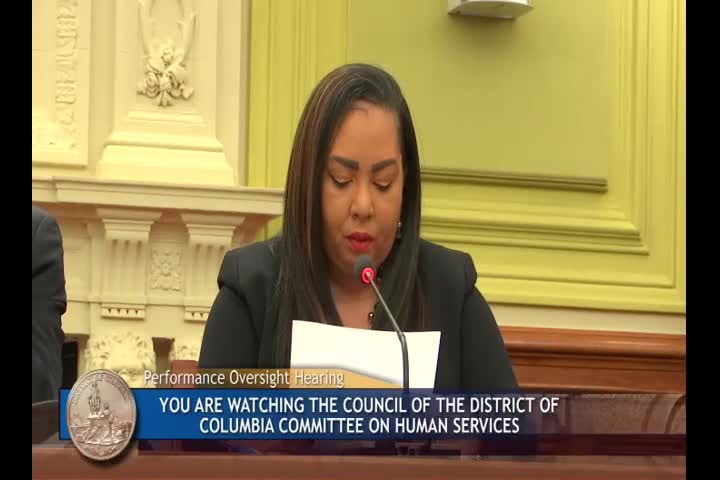
The Office of Cable Television, Film, Music and Entertainment told the Committee on Human Services Feb. 20 that the DC Film Rebate Fund helped attract major and independent productions and that agency staff are pursuing studio space and infrastructure projects to strengthen the District’s competitiveness.
Director Latoya Foster said OCTFME tracked seven rebate‑qualifying media productions and one infrastructure project in fiscal 2024. Foster reported an estimated direct, indirect and induced economic impact of $18,100,000 for those projects, 152 DC resident jobs and $460,000 in wages to DC residents; the agency issued $1,400,000 in rebates that year.
Since the program began in fiscal 2016, OCTFME reported rebates issued to 80 qualifying projects with a cumulative estimated economic impact of $203,600,000, roughly 2,062 jobs and $7,700,000 in wages to DC residents. The agency said its rebate design favors cash rebates rather than tax credits so applicants can retain more value, and it cited industry comparisons to argue the District’s percentages are competitive.
Herbert Niles, OCTFME’s associate director, said the application asks productions whether they would have filmed in the District without a rebate; the agency uses that information and a category‑based rubric to gauge whether a rebate meaningfully affects location decisions. He also said OCTFME reserves a portion of the fund for local production companies, including those led by people of color.
Councilmembers asked how OCTFME knows a production would not have filmed in D.C. absent an incentive; Niles said the application question and industry outreach inform awards. Members also asked whether infrastructure support had helped recruit the Atlantic 10 Conference headquarters; Foster said the rebate‑eligible infrastructure investment helped attract that headquarters to DuPont Circle.
Officials discussed studio availability. Foster and Lawrence Cooper, OCTFME general counsel (participating remotely), said the agency has pursued space options including vacant downtown buildings and the former Black Entertainment Television campus; Cooper said the former BET studio is a roughly 18,000‑square‑foot shell and dialogue is ongoing with owners and potential operators.
Foster framed the rebate fund as part of a broader strategy to diversify the workforce, create jobs, increase tourism and permanently showcase D.C. across film and streaming releases. The committee requested further breakdowns and the application rubric; OCTFME offered to provide the Cast & Crew comparison resource and to supply additional data to council staff for oversight.